Will a 1099 affect my disability benefits? — Yes, significantly. Earning 1099 self-employment income directly impacts both Social Security Disability Insurance (SSDI) and Supplemental Security Income (SSI) benefit eligibility under Social Security Administration (SSA) rules. For SSDI recipients, 1099 income that exceeds the 2026 Substantial Gainful Activity (SGA) threshold of $1,550 per month ($2,590 for blind individuals) can trigger benefit suspension or termination. For SSI recipients, every dollar of net 1099 self-employment income reduces monthly SSI payments through the SSA’s income counting formula — making precise 1099 income management one of the most critical financial compliance obligations for any disabled individual performing contractor work in 2026.
Understanding Will a 1099 Affect My Disability Benefits in 2026
Will a 1099 affect my disability is one of the most financially urgent questions facing disabled individuals who perform freelance work, independent contracting, or self-employed services while receiving federal disability benefits.
The interaction between 1099 self-employment income and federal disability programs is governed by a complex set of SSA rules, income counting formulas, and work incentive provisions that most disability recipients — and many benefits counselors — do not fully understand.
Getting the answer to will a 1099 affect my disability wrong carries consequences that range from unexpected benefit reductions to complete benefit termination — outcomes that can be financially catastrophic for individuals who depend on disability payments as their primary income source.
Statutory Compliance Requirements for Businesses
The governing statutory authority for will a 1099 affect my disability determinations spans two distinct federal disability programs — each with its own income counting rules, thresholds, and work incentive provisions that interact very differently with 1099 self-employment income.
SSDI — Social Security Disability Insurance is governed by Title II of the Social Security Act — 42 USC § 423. SSDI benefits are based on the recipient’s prior work history and Social Security contributions. The critical income threshold for SSDI is the Substantial Gainful Activity (SGA) level — a monthly earnings benchmark above which the SSA considers a disabled individual capable of performing gainful work.
SSI — Supplemental Security Income is governed by Title XVI of the Social Security Act — 42 USC § 1382. SSI is a needs-based program with no prior work history requirement. Every dollar of countable income — including net 1099 self-employment income — directly reduces SSI monthly payments through a specific income counting formula that applies dollar-for-dollar reductions above a modest exclusion threshold.
The SSA treats self-employment income differently from W-2 wages in several critical ways — making the will a 1099 affect my disability analysis substantially more complex than simply comparing gross 1099 receipts against benefit thresholds.
For the complete official SSA guidance on how self-employment income affects disability benefits, refer to the Social Security Administration Red Book on Work Incentives.
Understanding will a 1099 affect my disability benefits also connects to your broader tax filing obligations. Knowing whether a 1099 will affect your overall taxes ensures your self-employment income reporting strategy is fully coordinated across both your SSA benefit maintenance obligations and your federal income tax filing requirements simultaneously.
It is equally important to understand how much to set aside for taxes as a 1099 contractor when receiving disability benefits alongside self-employment income — since the combined tax treatment of SSDI payments and 1099 income creates a unique federal tax calculation that differs substantially from standard contractor-only tax scenarios in 2026.
Quick Reference Compliance Matrix
| Disability Program | Will a 1099 Affect My Disability | 2026 Critical Threshold | SSA Authority |
|---|---|---|---|
| SSDI — SGA Threshold (Non-Blind) | Yes — above $1,550/month triggers review | $1,550 per month net | 42 USC § 423(d)(4) |
| SSDI — SGA Threshold (Blind) | Yes — above $2,590/month triggers review | $2,590 per month net | 42 USC § 423(d)(4) |
| SSDI — Trial Work Period | Protected — 9 months of full earnings | $1,110/month triggers TWP month | 42 USC § 422(c) |
| SSDI — Extended Period of Eligibility | Conditional — SGA test applies | 36 months post-TWP | 42 USC § 423(a) |
| SSI — General Income Exclusion | Partial reduction — first $20 excluded | $20 monthly exclusion | 42 USC § 1382a |
| SSI — Earned Income Exclusion | Partial reduction — first $65 excluded | $65 monthly exclusion | 42 USC § 1382a |
| SSI — Countable Income Formula | Yes — $1 reduction per $2 net earnings | After exclusions applied | 42 USC § 1382a(b) |
| SSI — PASS Plan Protection | Protected — approved work expenses excluded | SSA-approved PASS only | 42 USC § 1382b |
How Will a 1099 Affect My Disability SSDI Benefits Specifically
The most critical threshold in the will a 1099 affect my disability analysis for SSDI recipients is the Substantial Gainful Activity (SGA) level — the monthly net earnings benchmark that the SSA uses to determine whether a disabled individual is capable of performing substantial work activity.
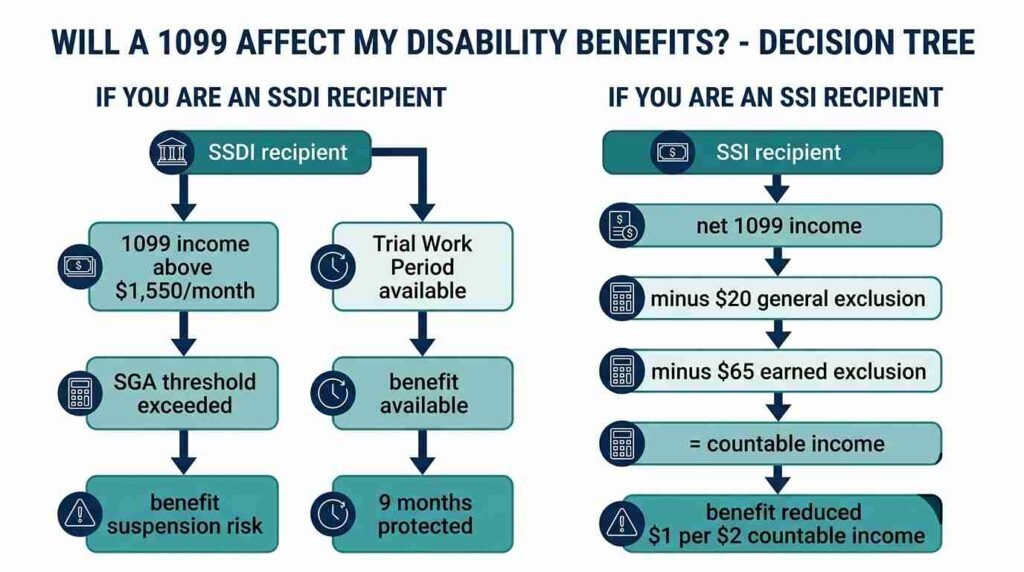
In 2026, the SGA threshold is $1,550 per month for non-blind disability recipients and $2,590 per month for blind recipients. When 1099 self-employment income — measured as net earnings after legitimate business expense deductions — consistently exceeds these monthly thresholds, the SSA considers the recipient capable of substantial gainful activity and initiates a benefit review that can result in suspension or termination.
The critical distinction for will a 1099 affect my disability SSDI analysis is that the SSA measures net self-employment income — not gross 1099 receipts. Every legitimate business expense deducted on Schedule C reduces the countable income figure the SSA evaluates against the SGA threshold. This makes aggressive and accurate business expense documentation a financially critical disability benefit protection strategy for self-employed SSDI recipients.
The Trial Work Period: The Most Valuable SSDI Protection for 1099 Contractors
The Trial Work Period (TWP) is the single most important work incentive provision in the will a 1099 affect my disability SSDI analysis — and one of the most underutilized protections available to disabled contractors considering self-employment.
The TWP allows SSDI recipients to test their ability to work for up to 9 months within a rolling 60-month window while continuing to receive full SSDI benefits — regardless of how much they earn during those trial months. In 2026, any month in which net self-employment income exceeds $1,110 counts as a TWP month.
The TWP provides complete benefit protection during those 9 months — meaning a disabled contractor can earn $5,000, $10,000, or even $20,000 per month during TWP months without any reduction in their monthly SSDI payment. This protection window gives newly self-employed disabled individuals a critical financial runway to test the viability of their contracting business before SSA benefit consequences activate.
After the 9 TWP months are exhausted, the Extended Period of Eligibility (EPE) begins — a 36-month window during which SSDI benefits are paid in any month where net 1099 income falls below the SGA threshold and suspended in months where it exceeds the threshold. Benefits are not permanently terminated during the EPE — they simply fluctuate with monthly income performance.
How Will a 1099 Affect My Disability SSI Benefits Specifically
The will a 1099 affect my disability analysis for SSI recipients operates through a completely different income counting mechanism than SSDI — one that produces a gradual benefit reduction rather than the all-or-nothing suspension dynamic of the SSDI SGA threshold.
The SSA calculates countable 1099 self-employment income for SSI purposes using a four-step sequential formula:
Step 1 — Start with gross self-employment income reported on 1099 forms received during the month.
Step 2 — Subtract all legitimate business expenses documented on Schedule C — reducing gross income to net self-employment earnings.
Step 3 — Subtract the $20 General Income Exclusion — applied once monthly across all income sources combined.
Step 4 — Subtract the $65 Earned Income Exclusion — applied specifically to earned income including self-employment earnings.
Step 5 — Divide the remaining amount by 2 — the SSA reduces SSI benefits by $1 for every $2 of countable earned income above the combined exclusion threshold.
For an SSI recipient with $500 net monthly self-employment income: $500 − $20 − $65 = $415 ÷ 2 = $207.50 SSI benefit reduction. The recipient retains their SSI payment minus $207.50 — keeping a combined income that exceeds their SSI-only baseline.
Impairment-Related Work Expenses: The Critical SSDI and SSI Deduction
Impairment-Related Work Expenses (IRWEs) represent one of the most powerful yet least understood provisions in the will a 1099 affect my disability analysis — applicable to both SSDI and SSI recipients simultaneously.
IRWEs allow disabled self-employed individuals to deduct disability-related work expenses from their countable income before the SSA applies the SGA threshold or the SSI benefit reduction formula. Qualifying IRWEs include specialized equipment, accessibility modifications, prescription medications needed for work, attendant care services, and transportation costs directly attributable to the disability and necessary for performing contractor work.
For SSDI recipients, IRWEs are deducted from gross self-employment income before the SGA threshold comparison — potentially keeping net countable income below $1,550 per month even when gross 1099 receipts significantly exceed that level.
For SSI recipients, IRWEs are deducted after business expenses but before the standard income exclusions are applied — reducing countable income at an even earlier stage of the SSA formula and producing larger benefit preservation outcomes than standard business deductions alone.
The Plan to Achieve Self-Support: The Most Powerful SSI Protection Strategy
The Plan to Achieve Self-Support (PASS) is the most powerful income and asset protection strategy available in the will a 1099 affect my disability SSI analysis — allowing disabled contractors to shelter significant amounts of 1099 income from SSI countable income calculations.
Under a SSA-approved PASS plan, an SSI recipient can set aside income and resources for a specified period to pursue a work goal — including self-employment contracting — without those funds counting as income or resources for SSI eligibility purposes.
A disabled contractor could use a PASS plan to shelter business equipment purchases, training costs, software subscriptions, marketing expenses, and professional certifications from SSI countable income — dramatically reducing the monthly SSI benefit reduction triggered by their 1099 self-employment earnings.
PASS plans must be individually approved by the SSA and submitted through a designated Work Incentive Planning and Assistance (WIPA) counselor. The approval process typically takes 4 to 6 weeks and requires a detailed work goal narrative, income and expense projection, and timeline for achieving financial self-sufficiency through the contracting business.
Reporting 1099 Income to the SSA: The Non-Negotiable Compliance Obligation
Regardless of how will a 1099 affect my disability calculations ultimately impact your specific benefit amount, the reporting obligation is absolute and non-negotiable for every disability recipient earning 1099 self-employment income.
Both SSDI and SSI recipients are required to report all self-employment activity and income to the SSA promptly — within 10 days of the end of the month in which the income was received. Failure to report 1099 income to the SSA while continuing to receive full disability benefits constitutes federal benefit fraud under 18 USC § 1343 — carrying penalties including full repayment of all overpaid benefits, civil monetary penalties up to $8,708 per violation in 2026, and potential criminal prosecution for willful concealment.
The SSA’s income cross-referencing system automatically matches IRS 1099 income data against disability benefit payment records — meaning unreported contractor income is routinely detected through routine data matching cycles without requiring any proactive investigation by SSA field offices.
Frequently Asked Questions
Will a 1099 affect my disability SSDI benefits if my net self-employment income stays below the SGA threshold every month?
No — as long as your net self-employment income consistently remains below $1,550 per month in 2026, the SSA will not consider your contractor activity as Substantial Gainful Activity and your SSDI benefits will not be affected. The key measurement is net income after all legitimate Schedule C business deductions — not gross 1099 receipts. A contractor billing $3,000 per month but incurring $1,600 in legitimate business expenses produces net self-employment income of $1,400 — below the SGA threshold and fully protected. However, you must still report all self-employment activity to the SSA monthly regardless of whether net income falls below the threshold — since the reporting obligation exists independently of whether the income triggers any benefit consequence under current SSA enforcement protocols.
Will a 1099 affect my disability SSI benefits even if I only earned a small amount from one client?
Yes — but the impact may be smaller than most SSI recipients fear. The SSA’s income counting formula applies the $20 general exclusion and $65 earned income exclusion before reducing benefits — meaning the first $85 of combined monthly self-employment income produces zero SSI benefit reduction. Income above $85 per month triggers a $1 benefit reduction for every $2 of countable income above that combined threshold.
For a recipient earning $200 net per month from a small 1099 contract: $200 − $85 = $115 ÷ 2 = $57.50 monthly SSI reduction. This means the contractor retains their SSI payment minus $57.50 while simultaneously gaining $200 in contractor income — producing a net financial gain of $142.50 per month compared to receiving SSI alone without any self-employment income.
Will a 1099 affect my disability benefits if I receive both SSDI and SSI simultaneously?
Yes — and the concurrent SSDI and SSI scenario requires the most careful 1099 income management of any disability benefit configuration. Recipients of both programs — called concurrent beneficiaries — have their 1099 income evaluated under both program rules simultaneously. The SSDI benefit is evaluated against the SGA threshold — with benefits suspended if net monthly income exceeds $1,550.
The SSI benefit is then calculated on the remaining income after the SSDI payment is counted as unearned income in the SSI formula — since SSDI payments themselves count as unearned income against SSI eligibility. The combined interaction means that exceeding the SSDI SGA threshold can simultaneously eliminate SSDI benefits while also increasing SSI payments — creating a complex monthly income recalculation that requires precise coordination with both a WIPA benefits counselor and a licensed CPA experienced in disability program income optimization.