
Will 1099 affect my taxes? — Yes, dramatically. Receiving a 1099-NEC or 1099-MISC means you are responsible for paying both federal income tax and the 15.3% self-employment tax under IRC § 1401 — a combined obligation that W-2 employees never face in full. Unlike employer-withheld payroll taxes, 1099 income arrives with zero tax withheld, making quarterly estimated payments under IRC § 6654 mandatory and turning every contractor payment into a self-managed tax liability that demands precise planning throughout the 2026 tax year.
Understanding Will 1099 Affect My Taxes in 2026
Will 1099 affect my taxes is the first real financial shock most new contractors experience — and it hits hardest in April when they realize how differently the IRS treats self-employment income compared to a standard W-2 paycheck.
Here is the blunt truth: receiving a 1099 changes your entire tax situation.
You are no longer a passive taxpayer. You become your own payroll department, tax estimator, and quarterly filer — all at once. The IRS expects you to track income, calculate obligations, and pay taxes four times per year without a single reminder.
Understanding exactly how will 1099 affect my taxes in 2026 is not optional — it is the financial foundation every contractor must build before cashing their first client payment.
Statutory Compliance Requirements for Businesses
The statutory framework governing will 1099 affect my taxes spans three distinct federal tax obligations that activate simultaneously the moment you receive 1099 income.
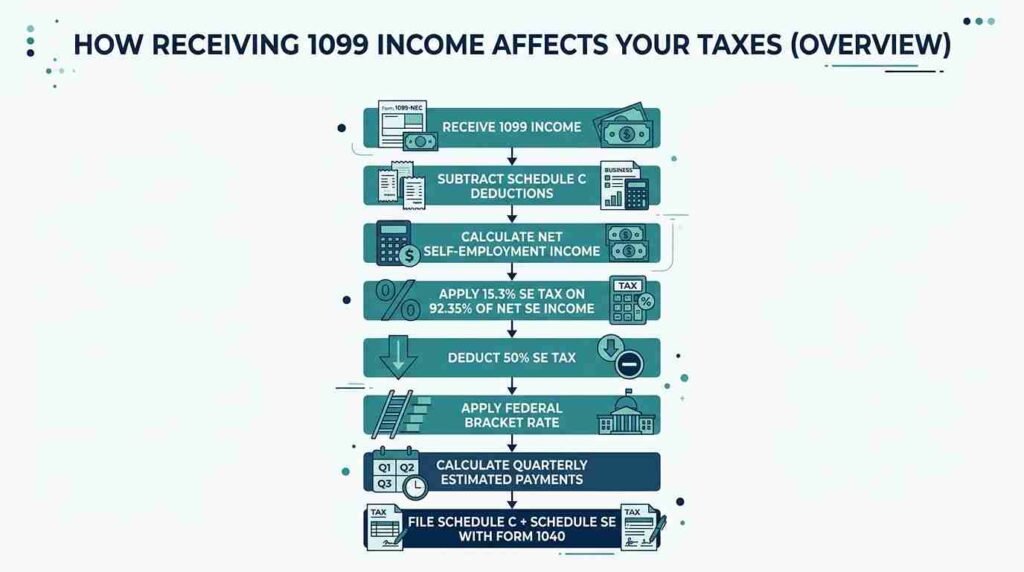
IRC § 1401 imposes the 15.3% self-employment tax on 92.35% of net self-employment income. This covers Social Security at 12.4% and Medicare at 2.9% — the same taxes W-2 employees pay, except contractors pay both the employee and employer share with no matching contribution from a hiring business.
IRC § 1 imposes federal income tax on net self-employment income after legitimate Schedule C deductions and the 50% SE tax deduction under IRC § 164(f). This layer sits on top of the SE tax and is calculated at your applicable marginal bracket rate.
IRC § 6654 mandates quarterly estimated tax payments when your annual tax liability is expected to exceed $1,000. Missing these payments triggers automatic underpayment penalties that compound across every missed quarter of the tax year.
For complete official IRS guidance on how 1099 income affects your federal tax obligations, refer to the IRS Self-Employed Individuals Tax Center.
Understanding will 1099 affect my taxes also means understanding how deductions directly reduce your exposure. Reviewing what you can write off as a 1099 contractor reveals the full spectrum of Schedule C deductions that lower your net self-employment income — directly reducing both your SE tax and federal income tax obligations simultaneously.
It is equally important to understand how much to set aside for taxes as a 1099 contractor — since the answer to will 1099 affect my taxes is only useful if you have actually reserved enough cash to cover the liability when each quarterly deadline arrives.
Quick Reference Compliance Matrix
| Tax Obligation | Will 1099 Affect My Taxes Here | 2026 Rate / Threshold | IRS Authority |
|---|---|---|---|
| Self-Employment Tax — Social Security | Yes — 12.4% on 92.35% net income | Up to $176,100 wage base | IRC § 1401(a) |
| Self-Employment Tax — Medicare | Yes — 2.9% on 92.35% net income | No upper income limit | IRC § 1401(b) |
| Additional Medicare Tax | Yes — 0.9% above $200,000 | Single filer threshold | IRC § 1401(b)(2) |
| Federal Income Tax | Yes — marginal bracket rate | 10% to 37% in 2026 | IRC § 1 |
| Quarterly Estimated Payments | Yes — mandatory above $1,000 liability | 4 deadlines annually | IRC § 6654 |
| State Income Tax | Yes — varies by state | 0% to 13.3% | State authority |
| SE Tax Deduction | Reduces — 50% of SE tax deductible | Above-the-line deduction | IRC § 164(f) |
| Schedule C Deductions | Reduces — all ordinary business expenses | Dollar-for-dollar reduction | IRC § 162 |
The Self-Employment Tax: The Biggest Surprise for New 1099 Workers
Most new contractors ask will 1099 affect my taxes expecting the answer to involve income tax brackets. The real shock is the self-employment tax — and it hits before income tax even enters the picture.
W-2 employees pay 7.65% in FICA taxes — split equally between Social Security and Medicare. Their employer quietly matches that 7.65% on top. As a 1099 contractor, you pay both sides yourself — the full 15.3% with no employer contribution offsetting half.
On $60,000 net self-employment income, that is approximately $8,478 in SE tax before you calculate a single dollar of federal income tax.
The partial mitigation is real but modest. IRC § 164(f) lets you deduct 50% of your SE tax before calculating federal income tax — reducing your taxable income base by the employer-equivalent half. On $8,478 in SE tax, that deduction is worth roughly $4,239 — saving approximately $932 in income tax at the 22% bracket.
It helps. But it does not come close to eliminating the self-employment tax burden that defines the will 1099 affect my taxes reality for every contractor.
Federal Income Tax Brackets: Where Will 1099 Affect My Taxes at the Margin
Federal income tax is the second layer in the will 1099 affect my taxes calculation — and unlike the flat SE tax rate, it scales with your net income through a progressive bracket structure.
Your 1099 income does not enter the bracket calculation at the gross level. The correct sequence is:
Start with gross 1099 income. Subtract Schedule C business deductions. Subtract 50% of self-employment tax. Subtract the standard deduction ($14,600 single / $29,200 married filing jointly in 2026). The resulting figure is your federal taxable income — and that is what your bracket rate actually applies to.
2026 Federal Tax Brackets for Single Filers:
10% on the first $11,925. 12% from $11,926 to $48,475. 22% from $48,476 to $103,350. 24% from $103,351 to $197,300. 32% from $197,301 to $250,525. 35% from $250,526 to $626,350. 37% above $626,350.
A contractor with $70,000 gross 1099 income, $10,000 in Schedule C deductions, and $4,239 SE tax deduction starts federal income tax calculations on approximately $55,761 of taxable income — landing squarely in the 22% bracket for the majority of their income.
How Will 1099 Affect My Taxes Compared to a W-2 Salary
This is the comparison that matters most for contractors evaluating whether the 1099 model makes financial sense — and the numbers are more nuanced than most people expect.
A W-2 employee earning $70,000 pays 7.65% in employee FICA taxes ($5,355) plus income tax on roughly $55,400 after the standard deduction. Their employer silently pays another $5,355 in matching FICA — a cost the employee never sees but that represents real compensation expense.
A 1099 contractor earning $70,000 gross pays the full $8,478 SE tax plus income tax on approximately $55,761. On the surface, the contractor pays roughly $3,123 more in combined taxes.
But here is what changes the equation: the contractor can also deduct home office expenses, vehicle mileage, equipment, health insurance premiums, and retirement contributions that W-2 employees cannot touch. A contractor who legitimately claims $15,000 in Schedule C deductions brings their taxable income down to approximately $40,761 — dropping their effective tax rate meaningfully below the W-2 comparison.
Will 1099 affect my taxes more than W-2 employment? Technically yes — but with the right deduction strategy, the gap narrows considerably.
Quarterly Estimated Payments: The Most Dangerous Compliance Gap
The answer to will 1099 affect my taxes is not just about how much — it is also about when the IRS expects to be paid.
W-2 employees pay taxes continuously through payroll withholding. 1099 contractors pay taxes four times per year through estimated payments — and missing even one deadline triggers penalties under IRC § 6654 that compound automatically.
The 2026 quarterly estimated tax deadlines are:
Q1 — April 15, 2026 covering January through March.
Q2 — June 16, 2026 covering April through May.
Q3 — September 15, 2026 covering June through August.
Q4 — January 15, 2027 covering September through December.
The safest strategy for most contractors is the prior year safe harbor — paying 100% of last year’s total tax liability in four equal installments. This completely eliminates underpayment penalties regardless of how much your current year income grows.
Pay using IRS Direct Pay at irs.gov or through EFTPS — the Electronic Federal Tax Payment System. Both are free, immediate, and produce instant payment confirmation.
How 1099 Income Interacts With W-2 Income on the Same Tax Return
Many contractors ask will 1099 affect my taxes while also holding a W-2 job — and this combination creates specific complications that a simple single-source income tax return does not.
Your W-2 employer withholds taxes based solely on your salary. They have no visibility into your 1099 side income. The result is that your W-2 withholding is almost always insufficient to cover your combined tax liability when self-employment income is added.
The practical solution is to increase your W-2 withholding using Form W-4 by claiming fewer allowances or specifying an additional dollar amount to withhold per pay period. This uses your existing payroll system to automatically collect taxes on your 1099 side income — eliminating the need for separate quarterly estimated payments on that portion.
Alternatively, file quarterly estimates covering the 1099 income portion specifically while leaving W-2 withholding unchanged. Either approach works — the IRS simply requires that enough tax reaches them throughout the year to avoid the underpayment penalty threshold.
State Tax: The Third Layer of How Will 1099 Affect My Taxes
Will 1099 affect my taxes at the state level depends entirely on where you live and work — and the variation is enormous.
Nine states — Alaska, Florida, Nevada, New Hampshire, South Dakota, Tennessee, Texas, Washington, and Wyoming — impose zero state income tax on self-employment income. Contractors in these states face only the federal layers described above.
California contractors face the harshest combined burden. The state imposes 1.5% Additional SE Tax plus income tax rates reaching 13.3% at the highest bracket — pushing total combined federal and state effective rates above 45% for high-earning California contractors.
New York, Oregon, and New Jersey round out the highest-burden states — all requiring contractors to file separate state estimated tax payments on the same quarterly schedule as federal obligations.
Frequently Asked Questions
Will 1099 affect my taxes if I also received W-2 income in the same year?
Yes — and the combination creates a specific problem most people miss entirely.
Your W-2 employer withholds taxes based only on your salary. They have no idea you earned 1099 income on the side.
That means your total withholding is almost certainly not enough to cover your combined liability.
The IRS does not care whose fault the shortfall is. If you underpay throughout the year, you owe penalties under IRC § 6654 regardless of whether the gap came from W-2 underwithholding or missed quarterly estimates.
The fix is straightforward — increase your W-4 withholding at your W-2 job or make quarterly estimated payments specifically covering your 1099 income. Either approach closes the gap before penalties accumulate.
Will 1099 affect my taxes more if I receive multiple 1099 forms from different clients?
Not in the way most contractors fear.
The IRS does not tax each 1099 separately. All 1099 income from every client is combined on a single Schedule C — reduced by your total business deductions — and the resulting net profit figure is what determines your tax liability.
Receiving five 1099s totaling $80,000 produces the exact same tax calculation as receiving one 1099 for $80,000.
The only additional complication is tracking income and expenses across multiple client relationships — which makes dedicated bookkeeping software like QuickBooks Self-Employed or Wave a genuine necessity rather than a luxury for contractors managing multiple income streams.
Will 1099 affect my taxes if the amount reported on the form is incorrect?
Yes — and you need to act quickly when this happens.
The IRS receives a copy of every 1099 issued to you. If the amount on the form does not match what you report on Schedule C, the IRS’s automated matching system flags the discrepancy and can trigger a CP2000 notice — an automated assessment of additional tax owed based on the higher reported figure.
If a client issued a 1099 with an incorrect amount, contact them immediately and request a corrected 1099 before the filing deadline.
If correction is not possible before you file, report your actual income received on Schedule C and attach a brief explanation. Do not simply report the incorrect 1099 amount if it overstates what you actually received — that is overpaying taxes you do not legally owe.