Are 1099 Employees Self Employed: The Definitive 2026 Guide Every Contractor Cannot Afford to Ignore
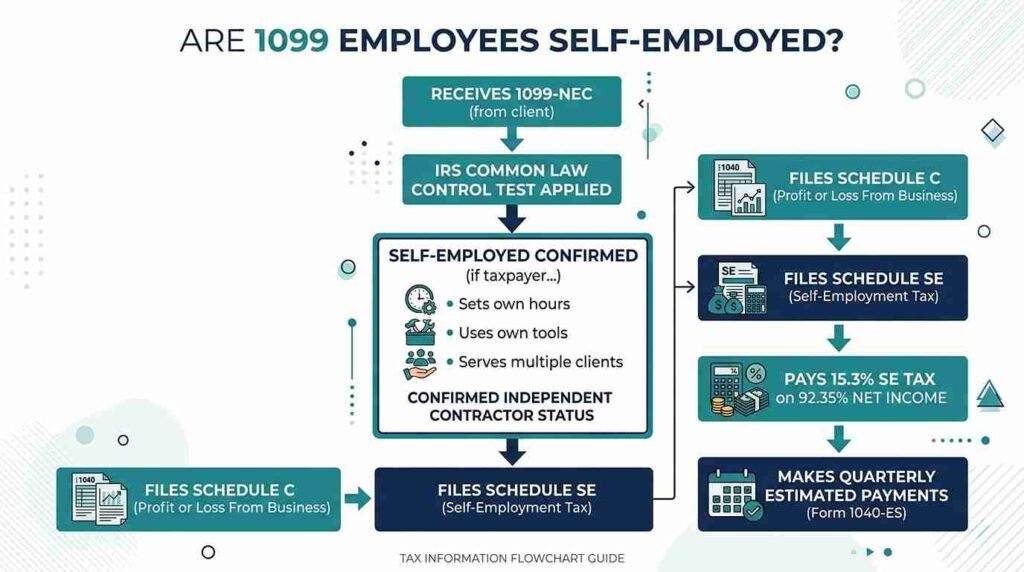
Are 1099 employees self employed? — Yes, in virtually every case. The IRS classifies 1099 independent contractors as self-employed individuals under IRC § 1401 — making them responsible for paying the full 15.3% self-employment tax on 92.35% of net self-employment income. Unlike W-2 employees whose employers handle payroll tax withholding, 1099 self-employed workers file Schedule C and Schedule SE with their annual Form 1040 — managing their own quarterly estimated payments, business deductions, and retirement contributions entirely independently under 2026 IRS rules.
Understanding Are 1099 Employees Self Employed Under 2026 IRS Rules
Are 1099 employees self employed is a question that sounds simple on the surface — but unpacking it reveals one of the most important legal and financial distinctions in the entire US tax system.
First — the terminology itself is worth addressing directly.
The phrase “1099 employee” is technically a contradiction. Under IRS rules, a worker is either a W-2 employee or a 1099 independent contractor. There is no legal middle ground that combines both classifications simultaneously.
When people ask are 1099 employees self employed, what they are really asking is this: does receiving a 1099-NEC mean you are operating as a self-employed individual under IRS rules?
The answer is yes — and that single classification decision triggers a cascade of tax obligations, benefit responsibilities, and filing requirements that every contractor must understand before they cash their first client payment.
Statutory Compliance Requirements for Businesses
The governing statutory authority confirming that are 1099 employees self employed is answered affirmatively is IRC § 1401 — which imposes self-employment tax on the net earnings of every self-employed individual operating outside of a formal employer-employee relationship.
IRC § 1402 defines “net earnings from self-employment” as the gross income derived from any trade or business carried on by the individual — minus allowable deductions — with the 92.35% adjustment applied before the SE tax rate is calculated.
IRC § 7701(a)(20) defines “employee” in the traditional sense — a definition that explicitly excludes independent contractors operating under genuine self-employment arrangements. This statutory exclusion is the legal foundation confirming that are 1099 employees self employed rather than employees under federal tax law.
The IRS Common Law Control Test operationalizes this distinction through three analytical factors — behavioral control, financial control, and type of relationship — that collectively determine whether a working arrangement constitutes genuine self-employment or a disguised employment relationship subject to W-2 treatment.
For complete official IRS guidance on self-employment classification and tax obligations, refer to the IRS Self-Employed Individuals Tax Center.
Understanding are 1099 employees self employed connects directly to the financial reality of contractor work. Knowing how much to set aside for taxes as a 1099 contractor is the most immediate practical application of self-employed status — since self-employment tax obligations activate the moment net self-employment income exceeds $400 in any calendar year.
It is equally important to understand whether 1099 jobs are financially worth it after accounting for the full self-employment tax burden, benefit replacement costs, and available deduction offsets — since the true financial picture of self-employed contractor work only becomes clear when all these variables are calculated together.
Quick Reference Compliance Matrix
| Classification Factor | Are 1099 Employees Self Employed | IRS Test Applied | 2026 Tax Consequence |
|---|---|---|---|
| Worker sets own hours freely | Yes — supports self-employed status | Behavioral Control Test | SE tax applies |
| Worker uses own tools and equipment | Yes — supports self-employed status | Financial Control Test | Schedule C deductions available |
| Worker serves multiple clients | Yes — strong self-employment indicator | Economic Realities Test | Independent business confirmed |
| Worker has profit/loss exposure | Yes — confirms self-employed status | Financial Control Test | SE tax on net profit only |
| Business dictates work methods | No — suggests employee status | Behavioral Control Test | W-2 reclassification risk |
| Indefinite exclusive arrangement | No — suggests employee status | Type of Relationship Test | DOL misclassification risk |
| Written contractor agreement present | Supports self-employed status | Type of Relationship Test | Classification defense document |
| Worker receives employee benefits | No — suggests employee status | Type of Relationship Test | IRS audit trigger |
The IRS Three-Factor Test: How Self-Employed Status Is Confirmed
The most direct answer to are 1099 employees self employed comes not from the 1099 form itself — but from the IRS Common Law Control Test that examines the actual substance of the working relationship.
The IRS evaluates three distinct factors. No single factor is automatically decisive. The full picture matters.
Behavioral Control asks the most fundamental question: does the hiring business control how the work is performed?
A self-employed contractor decides their own work methods, sequences, and processes. The client specifies the outcome — not the process for achieving it. A web developer who chooses their own coding approach, working environment, and timeline is demonstrating behavioral independence. A developer told exactly which software to use, which hours to work, and which process to follow is demonstrating something that looks far more like employment.
Financial Control asks whether the worker has genuine economic independence.
Self-employed individuals invest in their own tools and equipment. They set their own rates. They actively market their services. They risk financial loss if a project goes over budget or a client refuses payment. These are the financial behaviors of a genuine business owner — not an employee who receives a guaranteed paycheck regardless of business outcomes.
Type of Relationship asks what the overall arrangement actually looks like in practice.
Indefinite engagements with a single client, employee-type benefits, integration into the company’s core operations, and language in contracts that mirrors employment agreements all push the classification toward employee status — regardless of what the 1099 form says.
What Self-Employed Status Actually Costs: The Real SE Tax Calculation
Once you confirm that are 1099 employees self employed applies to your situation, the most immediate financial consequence is the self-employment tax — and most new contractors dramatically underestimate it.
Here is the exact calculation on $75,000 net self-employment income:
Step 1 — Apply the 92.35% adjustment: $75,000 × 0.9235 = $69,262 SE tax base.
Step 2 — Apply the 15.3% SE tax rate: $69,262 × 0.153 = $10,597 self-employment tax.
Step 3 — Deduct 50% of SE tax before income tax calculation: $10,597 × 0.50 = $5,298 above-the-line deduction.
Step 4 — Calculate federal income tax on reduced base: ($75,000 − $5,298 − $14,600 standard deduction) = $55,102 taxable income.
Step 5 — Apply 2026 bracket rates to $55,102: approximately $7,622 federal income tax at blended effective rate.
Total combined federal tax obligation: approximately $18,219 — or roughly 24.3% of gross self-employment income before any Schedule C deductions are applied.
Every legitimate business expense you claim on Schedule C reduces this calculation at both the SE tax and federal income tax level simultaneously — making aggressive and accurate deduction documentation genuinely worth thousands of dollars annually.
The Four Filing Obligations That Activate When You Are Self Employed
Confirming that are 1099 employees self employed applies to your work situation means four distinct IRS filing obligations activate simultaneously — each with its own deadlines and penalty consequences.
Schedule C — Profit or Loss From Business is where you report all 1099 income and subtract all legitimate business expenses. The resulting net profit figure feeds directly into both your SE tax and federal income tax calculations. Filing Schedule C is mandatory for every self-employed individual with net earnings above $400 in any calendar year.
Schedule SE — Self-Employment Tax is where you calculate your specific SE tax obligation based on your Schedule C net profit. This form performs the 92.35% adjustment calculation and applies the 15.3% rate — producing the SE tax figure that transfers to your Form 1040.
Form 1040-ES — Estimated Tax Payments must be filed and paid four times annually — April 15, June 16, September 15, and January 15 — to avoid underpayment penalties under IRC § 6654. Missing quarterly deadlines costs money even if you pay the full annual amount by April 15 of the following year.
Form 1040 with Schedules C and SE is the annual tax return that consolidates all self-employment income, deductions, and tax calculations into a single filing. Self-employed individuals must file by April 15, 2026 — or by October 15, 2026 with an extension, though the extension does not extend the deadline for paying taxes owed.
Self-Employed Status and Social Security: The Long-Term Consequence
One aspect of are 1099 employees self employed that most contractors do not think about until retirement is the Social Security benefit impact of self-employment tax payments.
Every dollar of SE tax paid is credited toward your Social Security earnings record — the same record that determines your eventual retirement benefit amount. Self-employed individuals who consistently pay SE tax on substantial net earnings build Social Security benefit entitlements identical to those of W-2 employees who paid the same total FICA taxes over the same period.
The difference is that self-employed individuals pay both sides of FICA simultaneously — making their total Social Security contribution per dollar of income identical to the combined employer-employee FICA contribution in a W-2 relationship.
This means a contractor who earns $80,000 per year in self-employment income and consistently pays SE tax builds the same Social Security retirement benefit as a W-2 employee earning $80,000 with matching employer FICA contributions — because the underlying tax contribution to the Social Security trust fund is mathematically identical under both payment structures.
State-Level Self-Employment Tax: What Changes Beyond Federal Rules
Are 1099 employees self employed at the state level? — Yes, but the tax consequences vary dramatically by state.
Most states that impose income tax follow federal self-employment income definitions — taxing net Schedule C profit at state marginal rates without imposing a separate state-level SE tax equivalent. The federal SE tax itself is a federal-only obligation.
However, several states impose additional self-employment specific taxes that contractors must account for beyond standard state income tax.
California imposes a 1.5% LLC fee on gross revenues above $250,000 for LLC-structured contractors — a state-specific business tax that has no federal equivalent and catches many California-based contractors completely off guard.
New York City imposes a City Unincorporated Business Tax on self-employment income earned within city limits — an additional local tax layer that applies specifically to self-employed individuals operating businesses physically located in New York City.
Washington State imposes a Business and Occupation (B&O) Tax on gross business receipts — including 1099 contractor income — without any deduction for business expenses, making it one of the most burdensome state-level self-employment taxes in the country.
Frequently Asked Questions (Gutenberg Block Ready)
Are 1099 employees self employed even if they work full-time hours for just one client?
Yes — but this specific scenario carries serious misclassification risk that every contractor must manage carefully.
Working full-time hours exclusively for a single client does not automatically eliminate self-employed status.
But it does raise a red flag.
The IRS looks at this arrangement under the Economic Realities Test — specifically whether the worker is economically dependent on a single hiring entity. A contractor who derives 100% of their income from one client, works their client’s preferred hours, and has no other active business relationships presents a classification profile that IRS examiners scrutinize heavily.
The strongest protection in this scenario is a well-drafted independent contractor agreement that explicitly preserves the worker’s right to set their own hours, use their own methods, and serve other clients simultaneously — even if they choose not to in practice.
Are 1099 employees self employed if they operate under an LLC business name?
Yes — with an important qualification.
Operating under an LLC does not change the fundamental self-employment analysis. A single-member LLC that has not elected corporate tax treatment is classified as a disregarded entity — meaning the IRS taxes the owner as a sole proprietor regardless of the LLC structure.
The SE tax applies. Schedule C applies. Quarterly estimated payments apply. All of it.
The LLC provides liability protection — separating personal assets from business debts. But it does not create a corporate tax shield that eliminates self-employment obligations unless the owner separately files Form 2553 to elect S-Corp treatment or Form 8832 to elect C-Corp treatment.
Are 1099 employees self employed for state unemployment purposes even if the IRS confirms self-employed status?
Not necessarily — and this is where the classification question gets genuinely complicated.
Several states apply significantly stricter worker classification standards than the federal IRS Control Test for unemployment insurance purposes.
California’s ABC Test presumes every worker is an employee unless the hiring business can satisfy all three prongs of a strict independence test. A contractor who passes the federal IRS Control Test may still be classified as a covered employee for California unemployment purposes under this stricter standard.
New York and New Jersey apply similar expanded classification frameworks that extend unemployment coverage to workers who would be classified as self-employed under federal IRS rules.
Confirming self-employed status for federal income tax purposes does not automatically resolve your classification status for state unemployment insurance — particularly in high-enforcement states that independently apply their own worker classification standards.