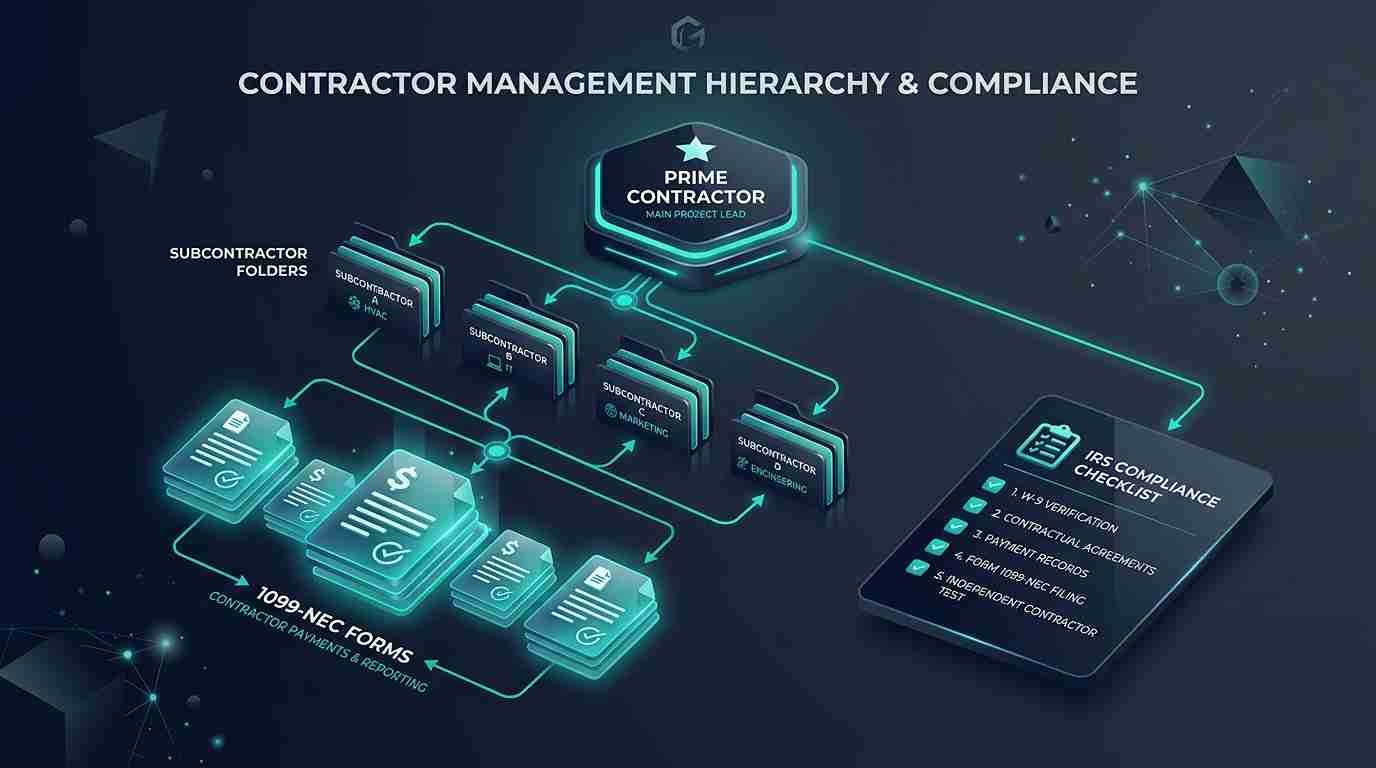
Are 1099 employees considered subcontractors? — Yes, frequently. In business practice, 1099 independent contractors and subcontractors are often the same worker described through two different lenses — 1099 describes their IRS tax reporting status while subcontractor describes their operational position in a project hierarchy. However, not every 1099 contractor is a subcontractor and not every subcontractor receives a 1099 — the distinction matters enormously for federal contract compliance, IRS reporting obligations, and worker misclassification risk under 2026 DOL and IRS enforcement guidelines.
Understanding Are 1099 Employees Considered Subcontractors in 2026
Are 1099 employees considered subcontractors is a question that comes up constantly in construction, IT services, creative agencies, consulting firms, and virtually every other industry that layers worker relationships across multiple contract tiers.
Most people use the terms interchangeably.
That habit creates real problems.
“1099 contractor” is a tax classification term — it describes how the IRS expects the hiring business to report payments to that worker. “Subcontractor” is a business relationship term — it describes where the worker sits in a project or contract hierarchy relative to the prime contractor and the end client.
The two concepts overlap heavily in practice. But treating them as identical without understanding where they diverge creates IRS compliance gaps, federal contract violations, and misclassification exposure that costs businesses serious money in audit seasons.
Getting the answer to are 1099 employees considered subcontractors right — with precision — is a foundational compliance skill for any business operating a multi-tier contractor workforce in 2026.
Statutory Compliance Requirements for Businesses
The statutory framework governing are 1099 employees considered subcontractors operates across two distinct legal domains simultaneously — federal tax law and federal contract law — and the rules in each domain serve completely different purposes.
IRC § 6041 governs the tax reporting side. It requires businesses to issue Form 1099-NEC to any unincorporated individual or entity receiving $600 or more for services — regardless of whether that worker is called a contractor, subcontractor, freelancer, or vendor in the underlying business agreement.
The Federal Acquisition Regulation (FAR) — specifically FAR Part 44 governs the subcontractor relationship side for businesses operating under federal government prime contracts. FAR defines subcontractors as any supplier, distributor, vendor, or firm that furnishes supplies or services to a prime contractor — a definition that is entirely independent of the worker’s IRS tax classification status.
Department of Labor regulations under 29 CFR Part 5 impose additional subcontractor compliance obligations for businesses operating under Davis-Bacon Act and Service Contract Act covered contracts — including prevailing wage requirements, certified payroll submissions, and worker classification standards that apply regardless of whether the subcontractor is paid as a 1099 or W-2 worker.
For the complete official IRS guidance on 1099 reporting obligations for subcontractor payments, refer to the IRS Instructions for Form 1099-NEC and Independent Contractor Reporting.
Understanding are 1099 employees considered subcontractors also requires clarity on self-employment classification. Reviewing whether 1099 employees are self employed under IRS definitions establishes the foundational tax treatment framework that applies to every subcontractor paid on a 1099 basis — since self-employment tax obligations, Schedule C filing requirements, and quarterly estimated payment rules all activate the moment a subcontractor receives 1099 income above $400 in a calendar year.
It is equally important to understand what paperwork you need for a 1099 employee before engaging any subcontractor — since the W-9 collection, independent contractor agreement, and statement of work requirements apply with equal force to subcontractor relationships as they do to direct contractor engagements at the prime contractor level.
Quick Reference Compliance Matrix
| Worker Scenario | Are 1099 Employees Considered Subcontractors | Tax Treatment | IRS / Legal Authority |
|---|---|---|---|
| Freelancer hired directly by end client | 1099 contractor — not a subcontractor | 1099-NEC at $600+ | IRC § 6041 |
| Specialist hired by prime contractor | Yes — 1099 subcontractor | 1099-NEC at $600+ | IRC § 6041 / FAR Part 44 |
| LLC hired by general contractor | Yes — subcontractor | 1099-NEC if unincorporated | IRC § 6041 |
| W-2 employee of subcontracting firm | Subcontractor’s employee — not 1099 | W-2 from subcontracting firm | IRC § 3401 |
| Federal contract subcontractor | Yes — FAR-governed subcontractor | 1099-NEC + FAR compliance | FAR Part 44 |
| Davis-Bacon covered subcontractor | Yes — prevailing wage required | Certified payroll mandatory | 29 CFR Part 5 |
| Construction trade worker | High misclassification risk | W-2 often required | DOL enforcement priority |
| IT consultant — multi-client | 1099 subcontractor likely | 1099-NEC at $600+ | IRC § 6041 |
The Core Distinction: 1099 Status vs Subcontractor Status
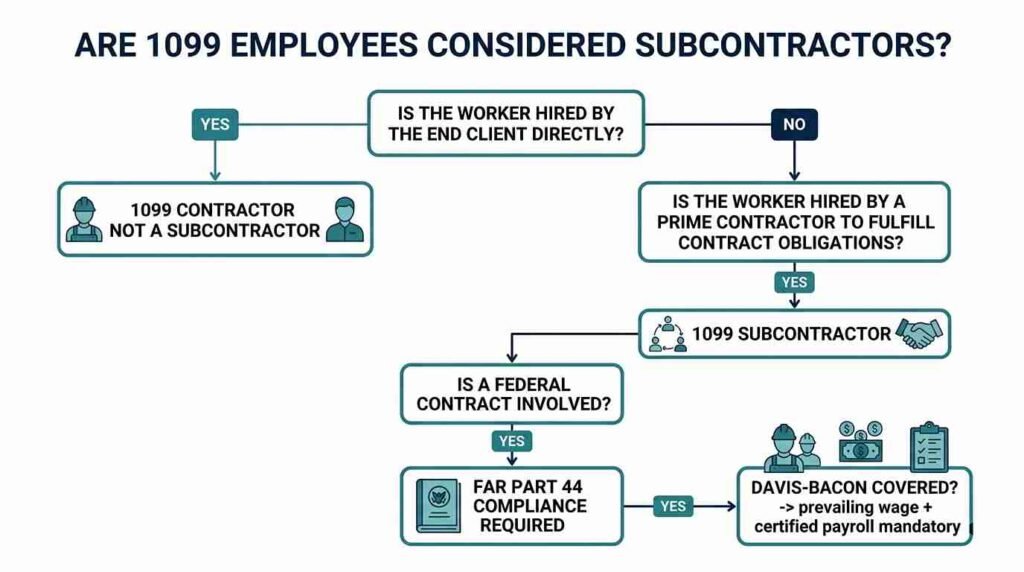
Here is the clearest way to think about are 1099 employees considered subcontractors — and why the distinction matters in practice.
1099 status answers one question: how does the IRS expect payment reporting to work between the paying business and the worker?
Subcontractor status answers a completely different question: where does this worker sit in the contractual chain between the prime contractor and the ultimate end client?
A graphic designer hired directly by a retail company to redesign their website is a 1099 contractor — but not a subcontractor. There is no prime contractor between them and the end client.
That same graphic designer hired by a marketing agency that holds the prime contract with the retail company is both a 1099 contractor and a subcontractor — paid by the agency, performing work that flows up to the agency’s client.
The tax reporting obligation is identical in both scenarios. The compliance obligations beyond tax reporting are dramatically different.
When 1099 Subcontractors Trigger Additional Federal Compliance Layers
The answer to are 1099 employees considered subcontractors becomes significantly more complex the moment a federal government contract enters the picture.
Businesses holding federal prime contracts must comply with FAR Part 44 subcontractor oversight requirements — which impose consent, notification, and flow-down clause obligations that have nothing to do with IRS 1099 reporting rules.
FAR 52.244-2 requires prime contractors to obtain contracting officer consent before awarding subcontracts above certain dollar thresholds on cost-reimbursement contracts. Paying a 1099 subcontractor without required consent can constitute a contract violation that jeopardizes the entire prime contract — a consequence far more serious than a missed 1099 filing penalty.
Davis-Bacon Act covered contracts impose prevailing wage requirements on all laborers and mechanics — including subcontractors — performing work on federally funded construction projects. Classifying a construction worker as a 1099 subcontractor to avoid prevailing wage obligations is one of the most aggressively enforced misclassification violations in the federal contracting space.
Service Contract Act covered contracts impose similar prevailing wage and fringe benefit requirements on service workers — including those structured as 1099 subcontractors — when the underlying prime contract meets the SCA coverage thresholds.
The Construction Industry: Where Are 1099 Employees Considered Subcontractors Gets Most Dangerous
No industry generates more are 1099 employees considered subcontractors misclassification enforcement actions than construction — and the financial consequences in this sector are uniquely severe.
General contractors routinely pay trade workers — electricians, plumbers, carpenters, HVAC technicians — as 1099 subcontractors rather than W-2 employees. In some cases, this classification is legitimate. In many others, it is not.
The IRS and DOL apply the same Control Test and Economic Realities Test to construction subcontractors as to any other worker relationship. A trade worker who shows up at the general contractor’s job site every day, uses the GC’s tools and equipment, follows the GC’s daily direction, and works exclusively for that GC presents a classification profile that fails virtually every independent contractor test.
State-level enforcement is even more aggressive. California, New York, and Illinois maintain dedicated construction industry misclassification task forces that conduct random job site audits — examining worker classification decisions on the spot and issuing retroactive assessments without waiting for annual tax filing cycles to identify discrepancies.
The financial exposure in construction misclassification cases routinely reaches six and seven figures when retroactive payroll taxes, workers compensation premiums, prevailing wage back-pay, and civil penalties are calculated across multiple workers and multiple years simultaneously.
Flow-Down Clauses: The Subcontractor Compliance Obligation Prime Contractors Miss
One of the most overlooked compliance dimensions of are 1099 employees considered subcontractors involves flow-down clauses — contractual provisions in prime contracts that automatically extend specific obligations to every subcontractor tier below.
When a prime contractor signs a federal contract containing equal opportunity employment clauses, cybersecurity requirements, Buy American provisions, or small business subcontracting plans — those obligations flow down to every subcontractor engaged to perform work under that prime contract.
A 1099 subcontractor who is classified correctly for IRS tax purposes but has not received or acknowledged the required flow-down clauses from the prime contractor creates a contract compliance violation that can trigger cure notices, contract termination, and suspension from future federal contracting opportunities.
Prime contractors must maintain written subcontractor agreements that explicitly incorporate all required flow-down provisions — not just a W-9 and a 1099-NEC at year-end. The IRS documentation and the federal contract documentation are two entirely separate compliance frameworks that must both be satisfied simultaneously.
How Prime Contractors Report 1099 Subcontractor Payments
The 1099 reporting mechanics for subcontractor payments follow the same rules as any other contractor payment — with one important practical distinction that affects how prime contractors structure their accounting systems.
When a prime contractor pays a 1099 subcontractor $600 or more during the calendar year, the prime contractor issues a 1099-NEC to the subcontractor by January 31 of the following year — regardless of whether the prime contractor has yet been paid by the end client for the work performed.
The cash basis reporting rule means the 1099 reflects when payment was made — not when the work was completed or when the end client paid the prime contractor. A subcontractor paid in December for work billed to the end client in January receives their 1099 in the December payment year — even if the prime contractor is still waiting for reimbursement.
Prime contractors who pass through subcontractor costs to end clients on cost-reimbursement contracts must track subcontractor 1099 issuance separately from their own contractor income reporting — since the subcontractor’s 1099 represents a business expense for the prime contractor, not a revenue item.
Frequently Asked Questions
Are 1099 employees considered subcontractors automatically when they work on client projects alongside W-2 employees?
Not automatically — and this scenario requires careful structural analysis.
Working alongside W-2 employees on the same project is actually one of the factors the IRS and DOL examine when evaluating whether a 1099 classification is legitimate.
If the 1099 worker performs the same tasks as W-2 employees, works the same hours, receives the same supervision, and is integrated into the same workflow — that parallel structure significantly weakens the independent contractor classification.
The key is genuine functional distinction.
A 1099 subcontractor who brings specialized skills not available in the W-2 workforce, operates under a defined scope of work, and delivers discrete project outputs is functionally distinguishable from W-2 staff — supporting legitimate subcontractor classification.
A 1099 worker doing the same job as the person sitting next to them who has a W-2 is a misclassification problem waiting to be discovered.
Are 1099 employees considered subcontractors for workers compensation insurance purposes?
This depends entirely on which state you operate in — and the variation is significant.
Most states allow businesses to exclude genuine independent contractor subcontractors from their workers compensation coverage obligations.
But the operative word is genuine.
States including California, New York, and Pennsylvania apply their own worker classification tests for workers compensation purposes — tests that frequently reach different conclusions than the IRS Control Test.
A subcontractor classified as a legitimate 1099 contractor for federal tax purposes may still be considered a covered worker under state workers compensation rules — making the hiring business liable for any work-related injury that subcontractor sustains on the job.
Get a certificate of insurance from every subcontractor before work begins. It documents their independent contractor status and protects your business from workers compensation liability if the classification is ever challenged.
Are 1099 employees considered subcontractors when they hire their own workers to complete the assigned project?
Yes — and this is actually one of the strongest indicators of legitimate subcontractor status.
A subcontractor who hires their own workers, manages their own team, and delivers the project output independently demonstrates precisely the kind of business autonomy that distinguishes genuine subcontracting from disguised employment.
The IRS right to substitute principle — the contractor’s ability to send qualified substitutes rather than personally performing every hour of work — is one of the clearest behavioral independence signals in the entire classification framework.
Document this arrangement explicitly in the independent contractor agreement.
Include a clause stating the subcontractor has the right to engage their own employees or sub-subcontractors to complete the work. Pair it with a requirement that the subcontractor remains responsible for the quality and timely delivery of the output.
That combination creates a well-documented, legally defensible subcontractor classification that withstands IRS examination far more reliably than a bare W-9 and an annual 1099-NEC alone.