1099 who is the payer — the payer is the business, individual, or entity that makes qualifying payments of $600 or more to an independent contractor, vendor, or service provider during the tax year and is legally required to file Form 1099-NEC or 1099-MISC with the IRS under IRC § 6041. The payer bears all filing obligations — collecting the recipient’s Form W-9, issuing the 1099 to the payee by January 31, and submitting copies to the IRS by the applicable deadline. Getting 1099 who is the payer wrong exposes businesses to penalties starting at $60 per form in the 2026 tax filing year.
Understanding 1099 Who Is the Payer Under 2026 IRS Rules
1099 who is the payer is a deceptively simple question that trips up thousands of businesses every single tax season.
Most people assume the payer is obviously the person writing the check. In straightforward client-contractor relationships, that is absolutely correct. But the moment you introduce staffing agencies, platforms, payment processors, pass-through arrangements, and multi-party contracts, the question of exactly who qualifies as the 1099 payer becomes genuinely complicated.
The IRS does not accept confusion as an excuse. If your business made qualifying payments and failed to file because you assumed someone else was the payer — you own the penalty. Full stop.
Understanding exactly 1099 who is the payer in every payment scenario your business encounters is not administrative housekeeping. It is a direct financial protection obligation that every business owner must master before January 31 arrives.
Statutory Compliance Requirements for Businesses
The governing statutory authority defining 1099 who is the payer is IRC § 6041 — which places the information return filing obligation on every person engaged in a trade or business who makes payments of $600 or more in the course of that business to any non-corporate payee during the calendar year.
The word “person” in IRC § 6041 is deliberately broad. It covers sole proprietors, partnerships, LLCs, S-Corps, C-Corps, nonprofit organizations, estates, and trusts — essentially any entity conducting business activity in the United States that makes qualifying payments to contractors or vendors.
IRC § 6041A extends the payer definition specifically to service recipients — covering businesses that pay individuals for services rendered even when the payment structure does not involve a traditional employment or vendor relationship.
The payer’s obligations under these provisions are non-negotiable and non-delegable. Even if a third party handles your bookkeeping, payroll processing, or contractor payments on your behalf — the legal filing obligation remains with the business that made the underlying payment decision.
For the complete official IRS guidance on payer obligations and 1099 filing requirements, refer to the IRS General Instructions for Certain Information Returns.
Understanding 1099 who is the payer also connects directly to recipient identification. Knowing 1099 who gets one clarifies exactly which payees trigger your filing obligation — since the payer’s responsibilities only activate when the recipient falls within a qualifying non-exempt category under current IRS rules.
It is equally important to understand what qualifies someone as a 1099 vendor from the payer’s perspective — since the payer’s W-9 collection process and 1099 filing obligation depend entirely on correctly identifying which payees qualify as 1099 vendors versus exempt corporate entities under IRS Publication 1281.
Quick Reference Compliance Matrix
| Payer Scenario | 1099 Who Is the Payer | Filing Obligation | IRS Authority |
|---|---|---|---|
| Business paying freelancer directly | The business — unambiguous | 1099-NEC by Jan 31 | IRC § 6041 |
| Staffing agency placing contractors | The staffing agency — pays the worker | 1099-NEC by Jan 31 | IRC § 6041 |
| Client paying staffing agency | The client — pays the agency | 1099 to agency if unincorporated | IRC § 6041 |
| Payment via PayPal / Stripe | The payment processor — 1099-K issued | 1099-K by Jan 31 | IRC § 6050W |
| Payment via business check or ACH | The paying business — direct obligation | 1099-NEC by Jan 31 | IRC § 6041 |
| LLC paying its own subcontractors | The LLC — payer for its own payments | 1099-NEC by Jan 31 | IRC § 6041 |
| Partnership paying service providers | The partnership — full payer obligations | 1099-NEC by Jan 31 | IRC § 6041A |
| Individual hiring home contractor | The individual — if in trade or business | 1099-NEC if business purpose | IRC § 6041 |
The Four Non-Negotiable Payer Obligations Under 2026 IRS Rules
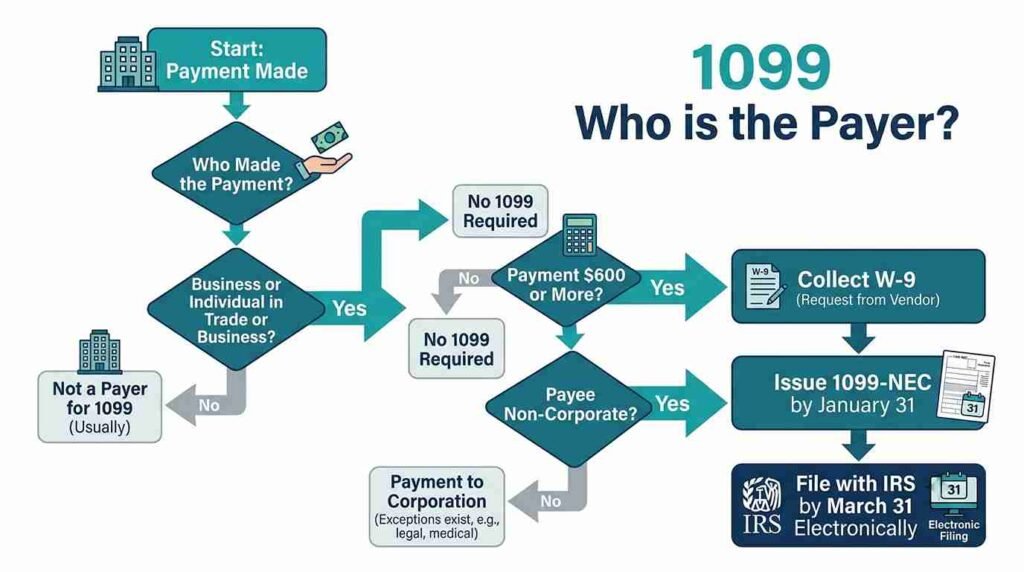
Once you establish that your business is the 1099 payer in a given payment relationship, four sequential compliance obligations activate immediately — and each one carries its own penalty exposure if missed.
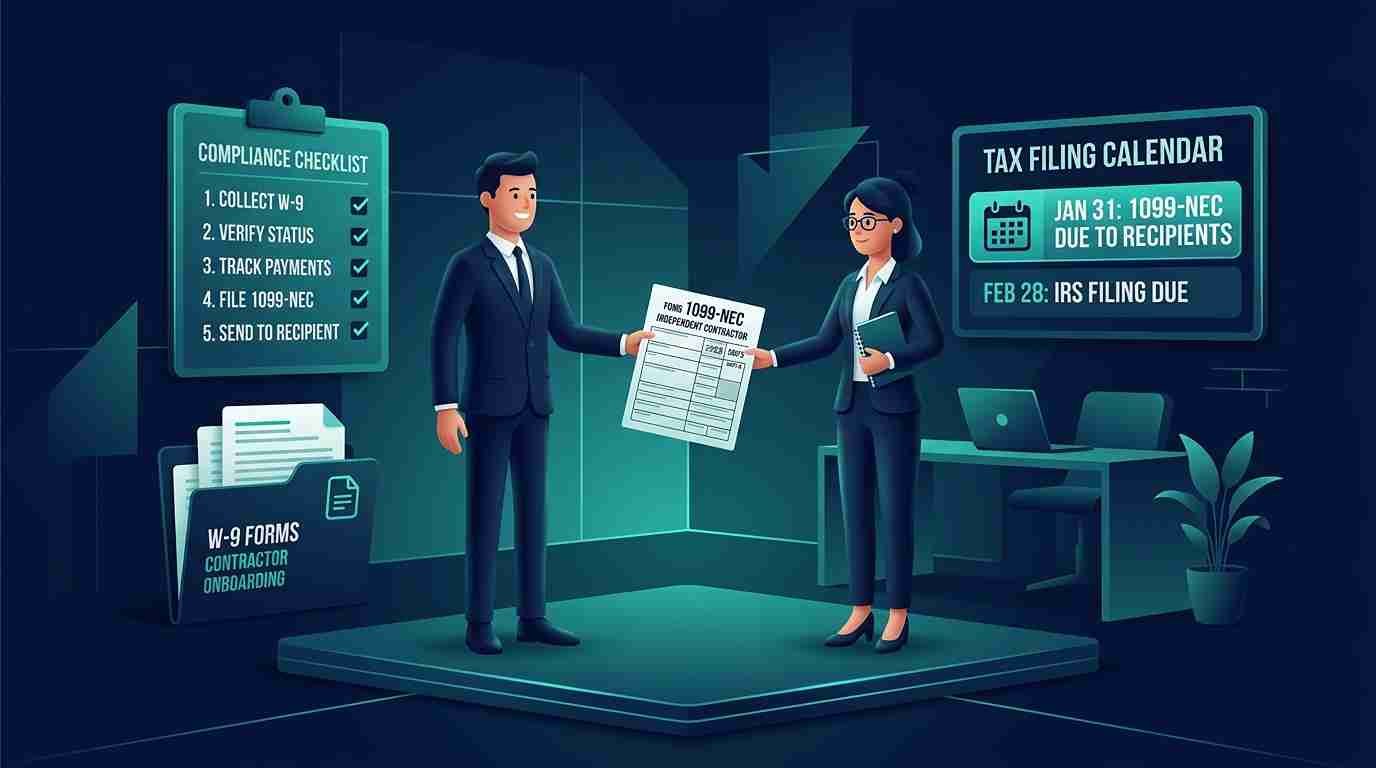
Obligation 1 — Collect Form W-9 Before the First Payment.
This is where most compliance failures begin. The W-9 gives you the payee’s legal name, TIN, and tax classification. Without it, you have no legal basis for any 1099 filing decision you make.
Collect it before money moves. Not after. Not at year-end. Before.
Obligation 2 — Track All Payments to Each Payee Throughout the Year.
The $600 threshold is cumulative — not per-invoice. Five payments of $150 across the year equal $750 total and trigger the filing obligation just as clearly as a single $750 payment does.
Your accounting system must aggregate payments by payee EIN or SSN — not by project, invoice number, or payment date.
Obligation 3 — Issue the 1099 to the Recipient by January 31.
The January 31, 2026 deadline for recipient copies is absolute. The IRS treats the recipient delivery deadline and the IRS filing deadline as separate obligations — missing the January 31 recipient deadline generates penalties even if you file with the IRS on time.
Obligation 4 — File Copies With the IRS by the Applicable Deadline.
Paper filers have until February 28, 2026. Electronic filers have until March 31, 2026. Businesses filing 10 or more information returns of any type must file electronically — no exceptions under current IRS rules.
When the 1099 Payer Identity Gets Complicated: Staffing Agencies and Platforms
The clearest real-world challenge in identifying 1099 who is the payer arises in staffing agency and platform arrangements — where money flows through multiple hands before reaching the contractor.
Here is how it actually works.
A staffing agency places contractors at client business locations. The client pays the staffing agency a total fee. The agency pays the individual contractors their share. In this structure, the staffing agency is the payer to the individual contractors — because the agency is the entity making direct payment to the workers performing the services.
The client business, meanwhile, may owe a 1099 to the staffing agency itself — if the agency is unincorporated and receives $600 or more for services. If the agency is a corporation, the client’s 1099 obligation to the agency is eliminated under the standard corporate exemption.
Freelance platforms like Upwork and Fiverr operate similarly. The platform collects client payments and distributes contractor earnings — making the platform the payer for 1099-K purposes once payments cross the applicable threshold. The client business is generally not the payer in this structure since funds flow through the platform’s settlement system rather than directly to the contractor.
The critical question in every multi-party arrangement is always the same: who physically sent the funds to the contractor? That entity is the payer.
Payment Method Determines Who Is the 1099 Payer in 2026
The payment method your business uses is not just an administrative detail — it directly determines 1099 who is the payer and whether your filing obligation exists at all.
Check, ACH, wire transfer, or cash payments — your business is unambiguously the payer. The 1099-NEC obligation is fully yours with no exceptions.
PayPal Business, Venmo for Business, Stripe, Square — the payment processor becomes the payer for 1099-K reporting purposes once the contractor receives more than $600 in payments through that platform in 2026. Your direct 1099-NEC obligation for those specific payments is eliminated.
Here is the nuance most businesses miss: if you pay the same contractor partly by check and partly through PayPal during the same year, the payment method split matters enormously.
The check payments remain your 1099-NEC obligation. The PayPal payments are the processor’s 1099-K obligation. You must track them separately — because combining them into a single 1099-NEC that duplicates the processor’s 1099-K reporting creates a double-reporting problem that generates IRS correspondence for your contractor and potential TIN-matching complications for your business.
Backup Withholding: The Payer’s Enforcement Responsibility
The 1099 payer is not just a filing entity — they are also a tax collection agent for the IRS when contractors fail to provide proper documentation.
When a payee refuses to provide a W-9, provides an incorrect TIN, or has been notified by the IRS of a TIN mismatch — the payer is legally required to withhold 24% of every payment under IRC § 3406 and remit that amount directly to the IRS.
This is called backup withholding — and it is not optional. The moment a contractor fails the W-9 documentation requirement, the payer’s withholding obligation activates automatically.
Backup withholding amounts are reported on Form 945 — Annual Return of Withheld Federal Income Tax — filed by January 31 of the following year. Failing to implement required backup withholding exposes the payer to liability for the full unwithheld amount plus penalties and interest.
The practical lesson is straightforward: never release a payment to a new contractor without a completed W-9 in hand. The W-9 is not a courtesy request — it is your legal protection against becoming involuntarily liable for your contractor’s tax obligations.
Penalties the 1099 Payer Faces for Non-Compliance in 2026
The IRS penalty structure for payer non-compliance in 2026 scales with the severity and timing of the failure — and the numbers are significant enough to make timely compliance the only rational business decision.
Filing 1 to 30 days late — $60 per form. Painful but manageable for small contractor counts.
Filing 31 days late through August 1 — $130 per form. At 20 contractors, that is $2,600 in penalties for a single filing season.
Filing after August 1 or not at all — $330 per form. Ten missed 1099s generates $3,300 in penalties before any interest accrues.
Intentional disregard of filing requirements — $660 per form with no statutory maximum cap. This category applies when the IRS determines the payer was aware of the obligation and chose not to comply — and the penalties in this category have no ceiling regardless of how many forms were missed.
The pattern is clear. Every day of delay in resolving a missed 1099 filing makes the financial outcome worse. Payers who discover a filing error should correct it immediately — the earlier the correction, the lower the penalty tier.
Frequently Asked Questions
1099 who is the payer when a business owner pays a contractor from their personal bank account?
This trips up a lot of small business owners — and the IRS position is clear.
If the payment was made in connection with a trade or business activity, the payer is the business owner — regardless of which bank account the funds came from.
The IRS does not care whether you used your business checking or personal savings to pay a contractor for business services.
What matters is the business purpose of the payment. If the work was for your business, the filing obligation exists. Personal payments — like paying a neighbor to mow your lawn — fall outside the trade or business requirement and do not trigger the 1099 payer obligation.
1099 who is the payer when two businesses jointly pay a contractor for the same project?
Joint payment arrangements require a clear written agreement between the two businesses before any payment is made.
Typically, one business designates itself the primary payer — responsible for collecting the W-9, issuing the 1099, and filing with the IRS for the contractor’s total compensation. The other business reimburses the primary payer for its share privately.
Without a clear designation, both businesses may independently conclude the other is handling the 1099 — and the contractor ends up with no 1099 filed at all.
That gap creates IRS exposure for both businesses when the contractor reports the income independently on their tax return and the IRS finds no matching information return from either payer.
1099 who is the payer if a contractor invoices through their LLC but the work was done personally?
The payer issues the 1099 to whoever provided the W-9 — which should reflect the entity that actually contracted for and performed the services.
If the contractor provided a W-9 in their LLC’s name and EIN, the 1099 goes to the LLC.
If they provided a personal W-9 with their SSN, the 1099 goes to them individually.
Here is the practical risk: if the LLC has elected S-Corp or C-Corp status and the contractor correctly showed that on their W-9, your 1099 obligation may be eliminated entirely for standard service payments.
Never guess at this. The W-9 is your legal directive. Follow it exactly — and update your records immediately whenever a contractor notifies you of a change in their business structure or tax classification.