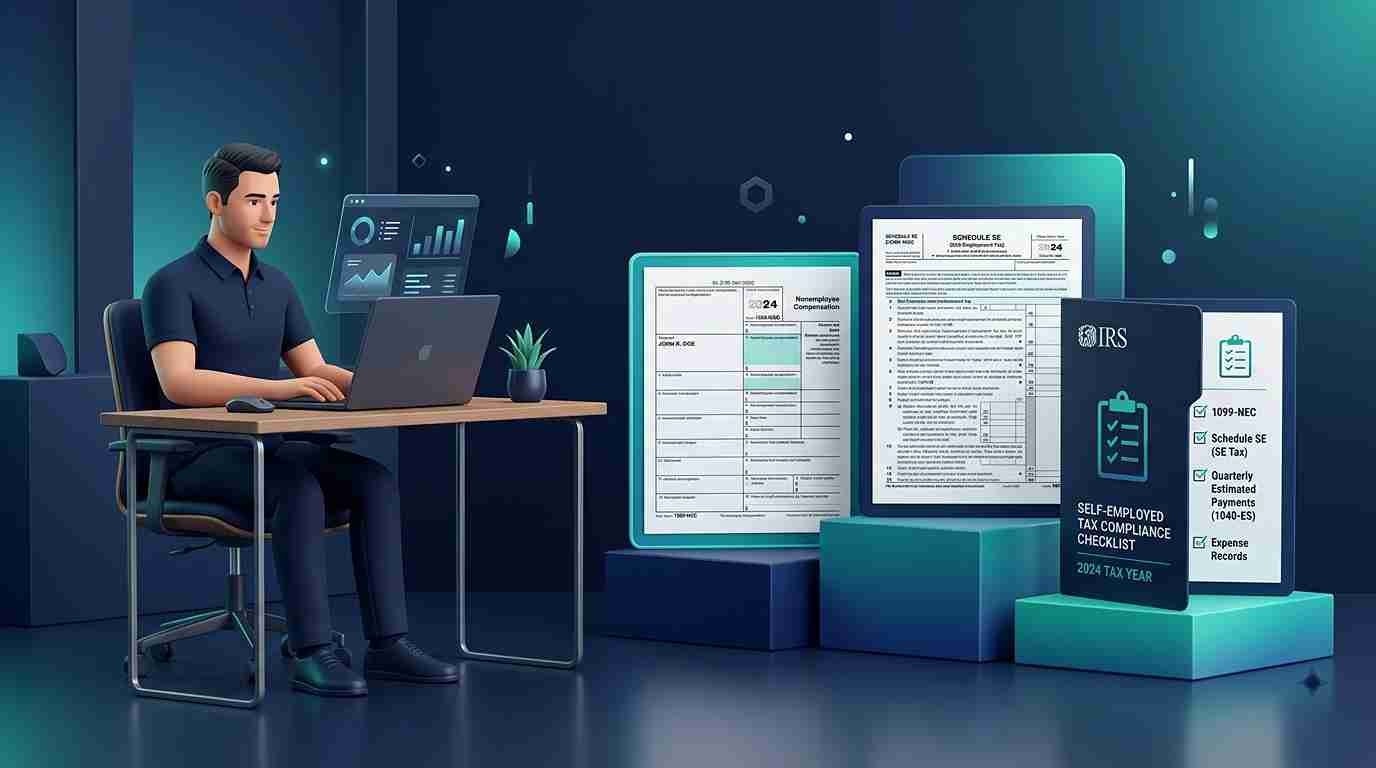
1099 who gets one — any individual, sole proprietor, partnership, or LLC taxed as a sole proprietorship or partnership that receives $600 or more in qualifying payments from a business during the tax year is entitled to receive a Form 1099-NEC or 1099-MISC under IRC § 6041. S-Corps and C-Corps are generally exempt from receiving standard 1099s under IRS Publication 1281 — but attorneys, medical providers, and fishing boat operators receive 1099s regardless of corporate status. Getting 1099 who gets one wrong in either direction creates direct IRS penalty exposure of up to $330 per form in the 2026 tax filing year.
Understanding 1099 Who Gets One Under 2026 IRS Rules
1099 who gets one is the most fundamental question every business owner, accountant, and accounts payable professional must answer correctly before January 31 arrives.
Most people assume it is simple — pay someone $600 or more, send a 1099. Done.
That assumption gets businesses into trouble every single year.
The real answer depends on who you paid, how you paid them, what you paid them for, and how their business is structured for federal tax purposes. Each of those variables can either activate or eliminate your filing obligation entirely — and confusing them costs real money in IRS penalties.
Understanding exactly 1099 who gets one in every payment scenario your business encounters is the difference between clean compliance and a January tax season scramble that ends in CP2100 notices and backup withholding demands.
Statutory Compliance Requirements for Businesses
The governing statutory authority establishing 1099 who gets one is IRC § 6041 — requiring every person engaged in a trade or business to file information returns for all payments of $600 or more made to qualifying recipients during the calendar year.
IRC § 6041A extends the same obligation to payments made for services — covering virtually every contractor, freelancer, vendor, and service provider relationship a business maintains outside of formal W-2 employment.
The recipient’s federal tax classification — confirmed through a properly completed Form W-9 — is the single variable that determines whether they fall inside or outside the 1099 recipient universe for your specific payment.
No W-9 means no classification confirmation. No classification confirmation means you have no documented basis for any filing decision you make — and the IRS will treat every undocumented decision as a potential compliance failure during examination.
For the complete official IRS guidance on recipient identification and 1099 filing obligations, refer to the IRS General Instructions for Certain Information Returns.
Understanding 1099 who gets one connects directly to payer identification. Knowing 1099 who is the payer clarifies the full scope of filing obligations from the business side — since the payer and recipient rules operate as two interlocking compliance layers that must both be correctly applied for any 1099 filing to be legally complete and defensible.
It is equally important to understand what qualifies someone as a 1099 vendor in the IRS’s operational definition — since vendor classification determines not just 1099 who gets one but also which specific form type applies, which payment threshold controls, and which exemptions are available for each payee category your business works with.
Quick Reference Compliance Matrix
| Recipient Category | 1099 Who Gets One | Applicable Form | IRS Authority |
|---|---|---|---|
| Individual / Sole Proprietor | Yes — at $600+ | 1099-NEC | IRC § 6041 |
| Single-Member LLC (Sole Prop Default) | Yes — at $600+ | 1099-NEC | IRC § 6041 |
| Multi-Member LLC (Partnership Default) | Yes — at $600+ | 1099-NEC | IRC § 6041A |
| General Partnership | Yes — at $600+ | 1099-NEC | IRC § 6041 |
| Limited Partnership (LP) | Yes — at $600+ | 1099-NEC | IRC § 6041 |
| S-Corporation | Exempt — general rule | N/A | IRS Pub. 1281 |
| C-Corporation | Exempt — general rule | N/A | IRS Pub. 1281 |
| LLC Elected S-Corp or C-Corp | Exempt — general rule | N/A | IRS Pub. 1281 |
| Attorney / Law Firm — Any Structure | Yes — no exemption at $600+ | 1099-NEC | IRC § 6045(f) |
| Medical Provider — Any Structure | Yes — no exemption at $600+ | 1099-MISC | IRC § 6041(a) |
| Landlord — Rent Payments $600+ | Yes — non-corporate landlords | 1099-MISC Box 1 | IRC § 6041 |
| Foreign Individual (Non-US) | Yes — 30% withholding applies | 1042-S | IRC § 1441 |
Individual Contractors and Sole Proprietors: The Core 1099 Recipient Category
When businesses ask 1099 who gets one, the clearest and most common answer is the individual independent contractor or sole proprietor — the single largest recipient category in the entire 1099 ecosystem.
Any individual who receives $600 or more for services performed in the course of your business gets a 1099-NEC. Full stop.
It does not matter whether they worked one day or twelve months. It does not matter whether they invoiced you weekly or sent one lump-sum bill. It does not matter whether they have a business name, a website, or a formal LLC registration.
If they are an unincorporated individual who received $600 or more from your business for services — they get a 1099-NEC by January 31.
The only documentation requirement is a completed Form W-9 confirming their legal name, SSN or EIN, and tax classification. Without a W-9, you have no verified TIN — which means your 1099 filing will likely generate a CP2100 TIN-mismatch notice even if the underlying payment amount is perfectly accurate.
LLCs and Partnerships: The Most Misidentified 1099 Recipients
Here is where most businesses make their most expensive mistakes when answering 1099 who gets one.
A vendor shows up with a professional website, a business name, and an LLC registration. The business owner assumes — incorrectly — that this level of professionalism means a corporation. No 1099 filed.
Wrong call. Potentially a $330 per-form penalty.
An LLC is not automatically a corporation. Most LLCs are taxed as sole proprietorships or partnerships by default — and they require a 1099 at the $600 threshold just like any individual contractor.
The only way to know for certain is the Form W-9. Box 3 of the W-9 is the only legally reliable source of tax classification information for any LLC vendor. If it shows sole proprietorship or partnership — the 1099 obligation is fully activated regardless of what the entity’s name, branding, or incorporation documents say.
Multi-member LLCs that have not elected corporate tax treatment are taxed as partnerships by default under IRS Treasury Regulation § 301.7701-3. They get a 1099 at the same $600 threshold as any general partnership — no exceptions.
Corporations: The Major Exemption in 1099 Who Gets One
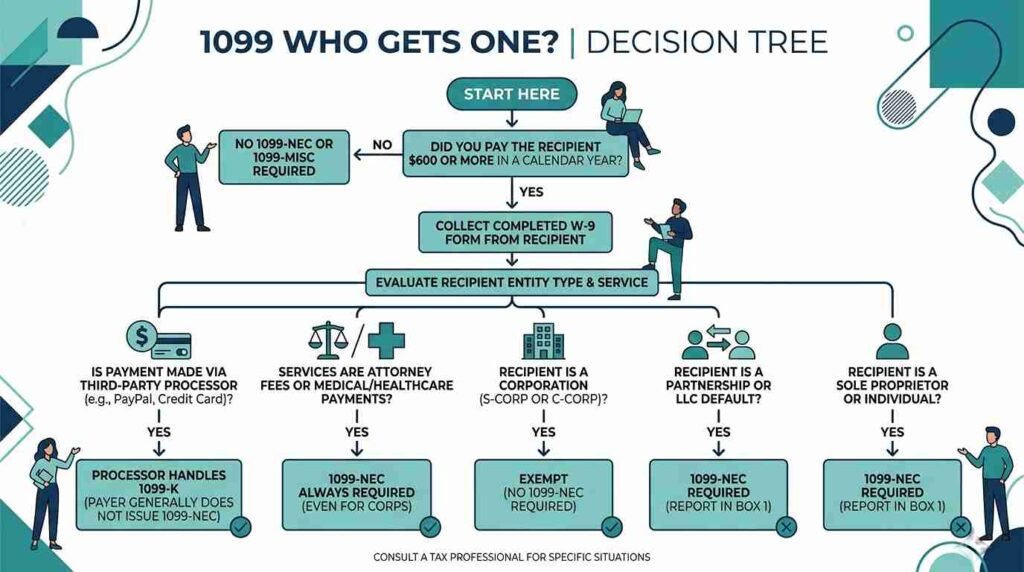
The general rule under IRS Publication 1281 is that S-Corporations and C-Corporations do not get 1099s for standard service payments.
This exemption exists because corporations file their own Form 1120 or 1120-S annual returns — giving the IRS an independent income verification trail that makes redundant 1099 cross-referencing unnecessary for routine service payments.
But here is the critical nuance that trips up experienced accountants — not just beginners.
Three payment categories permanently override the corporate exemption and require 1099 filing regardless of the recipient’s corporate status:
Attorney and legal fee payments of $600 or more — always get a 1099-NEC under IRC § 6045(f).
Medical and healthcare payments of $600 or more — always get a 1099-MISC under IRC § 6041(a).
Fishing boat proceeds — always get a 1099-MISC Box 5 under IRC § 6041.
These three exceptions apply to every corporate structure — S-Corp, C-Corp, LLC elected as either. There is no workaround and no documentation that eliminates them.
The $600 Threshold: How the Core Rule Actually Works
The $600 threshold is the most cited number in the 1099 who gets one framework — and it is also the most frequently misapplied.
Here is what most business owners get wrong.
The $600 threshold is cumulative across the entire calendar year — not per transaction, per invoice, or per project. If you paid the same contractor $200 in March, $250 in July, and $200 in November — their total for the year is $650. They get a 1099.
The threshold is also per-payee — not per payment method. If you paid a contractor $400 by check and $300 via ACH in the same year, their combined total is $700 and the threshold is crossed — regardless of how the individual transactions were processed.
The only scenario where payment method affects the threshold analysis is third-party processor payments — PayPal Business, Stripe, Square, and similar platforms. Those payments are tracked and reported separately by the processor via Form 1099-K — which has its own threshold of $600 in 2026 — and generally eliminate your direct 1099-NEC obligation for those specific transactions.
Rent Recipients: The Overlooked Category in 1099 Who Gets One
Business owners routinely overlook landlords when thinking through 1099 who gets one — and the IRS does not.
Any non-corporate landlord who receives $600 or more in rent from your business during the year gets a 1099-MISC with the amount reported in Box 1.
This applies to office space, warehouse rentals, parking lots, equipment rental, and any other property your business pays rent for. The key qualifier is non-corporate — a landlord who is an individual, sole proprietorship, partnership, or LLC taxed as either of those must receive a 1099-MISC for qualifying rent payments.
Corporate landlords — those who provide a W-9 confirming S-Corp or C-Corp status — fall under the standard corporate exemption and do not receive a 1099-MISC for rent payments.
Many small businesses rent space from individual landlords or small LLCs and never think to collect a W-9 or issue a 1099. That oversight generates the same penalty exposure as missing a contractor 1099 — because the IRS treats rent recipient reporting under identical threshold and penalty rules as service payment reporting.
When Payment Method Determines 1099 Who Gets One
The method you use to pay a vendor directly determines whether you are the 1099 filer or whether a third-party processor handles the reporting obligation.
You are the 1099 filer when payments are made via business check, personal check, ACH bank transfer, wire transfer, cash, or direct bank payment. These methods place the full 1099-NEC reporting obligation on your business with no exceptions.
The processor is the 1099-K filer when payments are made through PayPal Business, Venmo for Business, Stripe, Square, or any other third-party settlement network. In these cases, the platform tracks and reports the contractor’s total annual receipts through their platform — and your direct 1099-NEC obligation for those specific payments is eliminated.
The practical complication arises when you pay the same contractor through multiple methods in the same year.
Check payments remain your direct 1099-NEC obligation. PayPal payments are the processor’s 1099-K obligation. You must track them separately in your accounting system and issue a 1099-NEC only for the check and ACH payment total — not the combined total including processor payments — to avoid duplicate reporting that generates IRS correspondence for your contractor.
Frequently Asked Questions (Gutenberg Block Ready)
1099 who gets one if the contractor works for my business only part of the year?
Duration does not matter.
The IRS measures the total dollar amount paid — not the length of the working relationship.
A contractor who worked one week in January and received $800 gets a 1099-NEC.
A contractor who worked eleven months but received only $550 total does not get a 1099-NEC.
The calendar year total is the only measurement that controls. Track cumulative payments per payee from January 1 through December 31 — and issue a 1099-NEC to every qualifying recipient regardless of how briefly they worked.
1099 who gets one when a vendor switches from an LLC to an S-Corp mid-year?
This creates a split-year reporting scenario that requires careful handling.
Payments made before the S-Corp election effective date count toward the 1099-NEC threshold under the LLC’s prior tax classification.
Payments made after the effective date fall under the S-Corp exemption and are generally not reportable.
The practical solution is to collect an updated W-9 immediately when the vendor notifies you of the classification change.
Tally the payments made under each classification separately. If the pre-S-Corp payments total $600 or more on their own — issue a 1099-NEC for that amount only. Do not include post-election payments in the reportable total.
1099 who gets one if the contractor never invoiced my business but I paid them anyway?
The absence of a formal invoice does not change the 1099 obligation.
The IRS filing requirement is triggered by payment made — not by invoices received.
If you paid someone $600 or more for services rendered to your business — regardless of whether they invoiced you, reminded you, or even asked to be paid — they qualify for a 1099-NEC if their tax classification requires it.
The invoice is simply a payment request document. It has no bearing on the statutory filing obligation under IRC § 6041.
What you need is a completed W-9 from that payee — collected retroactively if necessary. Without it, you cannot accurately complete the 1099 form, and the IRS will flag any submission with an unverified TIN during its automated matching process.