

YasifTech is a premium financial utility platform providing smart business tax calculators, compliance roadmaps, and regulatory guides for modern entrepreneurs, LLCs, and independent contractors.
© 2026 YasifTech. All Rights Reserved
A US limited liability company is not a distinct federal tax class by default. A single-member LLC is a “disregarded entity” reported on Schedule C, while a multi-member LLC defaults to a partnership filing Form 1065 with Schedule K-1s. Either can elect corporate treatment with Form 8832 or S-corporation status with Form 2553 under the check-the-box regulations (Treas. Reg. §301.7701-3).
The limited liability company is the most flexible vehicle in the US tax code because the Internal Revenue Service does not tax it as its own category. Instead, federal taxation follows an elective “check-the-box” framework that lets the same legal entity be treated four different ways. Understanding which classification applies — and how each interacts with self-employment tax, payroll obligations, and state franchise fees — is the difference between overpaying and operating efficiently.
By default, a single-member LLC is a disregarded entity: the IRS ignores the LLC for income-tax purposes and the owner reports business profit or loss directly on Schedule C of Form 1040, exactly as a sole proprietor would. A multi-member LLC defaults to partnership taxation, filing the informational return Form 1065 and issuing a Schedule K-1 to each member that reports their distributive share of income, deductions, and credits.
In both default states the LLC is a pass-through entity, meaning profit is taxed once at the member level rather than at the entity level. There is no federal LLC income tax. This single layer of taxation is the principal reason the structure dominates among freelancers, real-estate investors, and small operating businesses that want liability protection without the double taxation of a C corporation.
The table below maps each elective classification to its federal return, self-employment treatment, and layers of taxation.
| Classification | Federal Return | Self-Employment Tax | Layers of Tax |
|---|---|---|---|
| Single-member (default) | Schedule C (Form 1040) | Yes — full 15.3% on net | Single (member level) |
| Multi-member (default) | Form 1065 + Schedule K-1 | Yes for active members | Single (member level) |
| S-corp election (Form 2553) | Form 1120-S + K-1 | Salary only; distributions exempt | Single (member level) |
| C-corp election (Form 8832) | Form 1120 | N/A (owners take wages) | Double (entity + dividends) |
Liability protection does not equal payroll-tax protection. An active member of a default-classified LLC pays self-employment tax on their share of net business income, computed on Schedule SE at the 15.3 percent combined rate (12.4 percent Social Security plus 2.9 percent Medicare), applied to 92.35 percent of net earnings. A member earning $100,000 of net profit therefore faces roughly $14,130 in self-employment tax before income tax is even considered.
The key planning lever is that this 15.3 percent burden is unavoidable under default classification — forming an LLC alone changes nothing about self-employment tax. The only structural way to carve a portion of profit out of the self-employment base is to elect S-corporation taxation, covered below, which reclassifies part of the return as distributions exempt from FICA.
An LLC can override its default classification. Filing Form 8832 (Entity Classification Election) elects to be taxed as a C corporation, while Form 2553 (Election by a Small Business Corporation) elects S-corporation status. The S election is the popular choice because it preserves pass-through treatment while allowing the owner to split earnings between a reasonable W-2 salary (subject to FICA) and distributions (exempt from self-employment tax).
Timing is strict. To take effect for the current tax year, Form 2553 must generally be filed no later than two months and fifteen days after the beginning of that tax year, although the IRS grants relief for late elections under Rev. Proc. 2013-30 when reasonable cause is shown. A C-corp election should be modeled carefully because corporate profit is then taxed at the entity level and again as dividends.
State obligations run parallel to federal taxation. Formation requires filing Articles of Organization with the secretary of state, designating a registered agent, and — though rarely filed with the state — maintaining an operating agreement that governs member rights. Many states then impose recurring duties: an annual or biennial report and, in several jurisdictions, a franchise tax or entity-level fee.
California is the headline example: every LLC doing business in the state owes an $800 minimum annual franchise tax regardless of profit, plus a gross-receipts-based fee once revenue crosses defined tiers. Delaware charges an annual LLC tax and report. Because these costs are levied independent of income, multistate operators must map each state of registration to its specific fee schedule before expanding.
Free Tool
Select your structure, enter your numbers, and get an instant estimate.
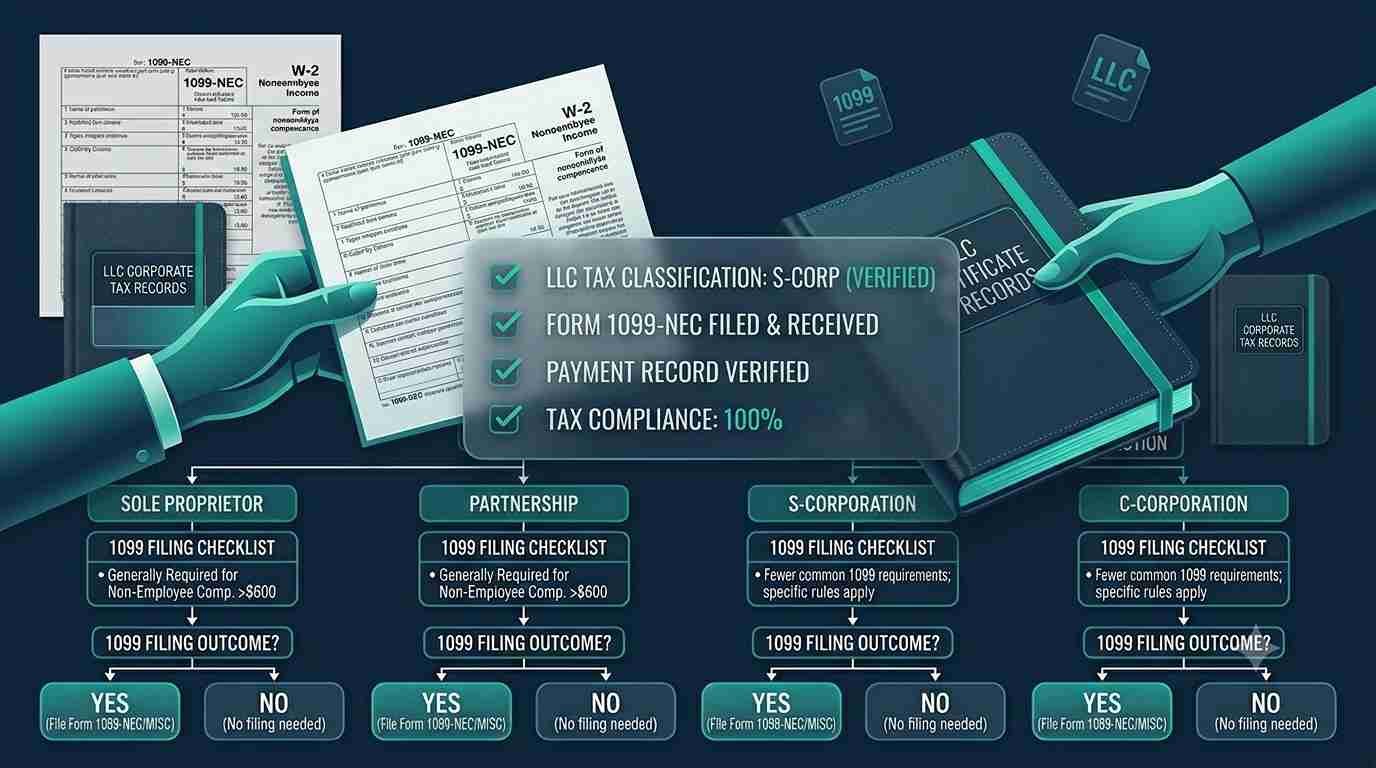
Corporations are generally exempt from standard 1099-NEC withholdings. Net corporate profits are subject to corporate filing status or salary-dividend distributions. Consult your CPA.
Yes. A single-member LLC is a disregarded entity taxed as a sole proprietorship, so the owner reports net profit on Schedule C and pays 15.3 percent self-employment tax on 92.35 percent of those net earnings via Schedule SE.
A multi-member LLC files Form 1065, the partnership informational return, and issues a Schedule K-1 to each member reporting their distributive share. The members then report that share on their personal Form 1040.
Form 2553 must generally be filed no later than two months and fifteen days after the start of the tax year for which the election is to take effect. Late elections may qualify for relief under Revenue Procedure 2013-30 with reasonable cause.
No. Forming an LLC by itself does not change self-employment tax under default classification. Only electing S-corporation taxation lets you split earnings into a reasonable salary and FICA-exempt distributions.
California imposes an $800 minimum annual franchise tax on every LLC doing business in the state, payable regardless of income, plus an additional gross-receipts fee once revenue exceeds defined thresholds.
YasifTech is a premium financial utility platform providing smart business tax calculators, compliance roadmaps, and regulatory guides for modern entrepreneurs, LLCs, and independent contractors.
© 2026 YasifTech. All Rights Reserved