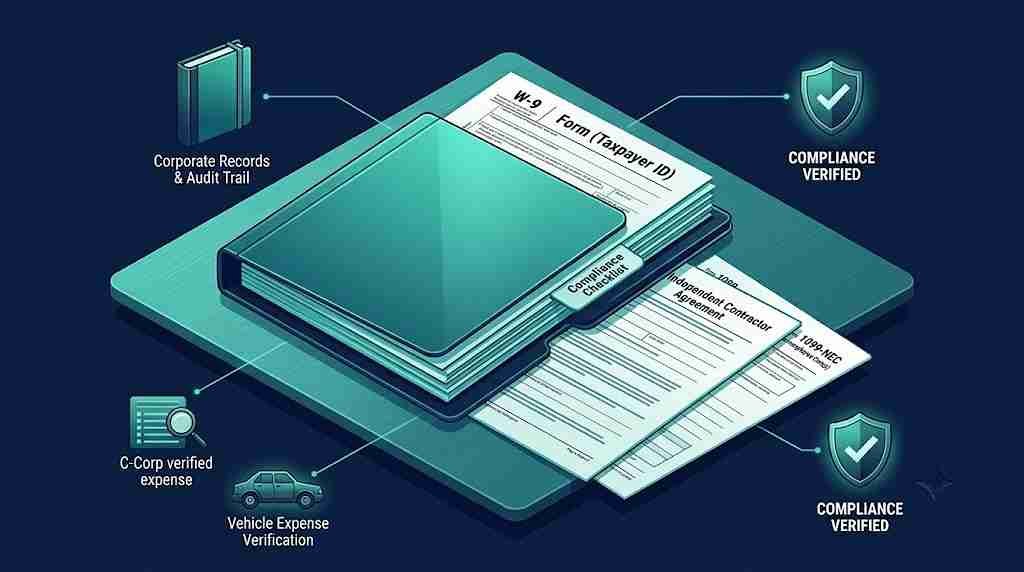
What paperwork do I need for a 1099 employee covers five essential documents every business must collect before the first contractor payment clears. The IRS requires a completed Form W-9 as the foundational document for every 1099 independent contractor relationship — establishing the contractor’s legal name, EIN or SSN, and federal tax classification. Beyond the W-9, a compliant 2026 contractor onboarding package must include a signed Independent Contractor Agreement, Form 1099-NEC at year-end, a Statement of Work, and backup withholding documentation where applicable under IRC § 3406.
Understanding What Paperwork Do I Need for a 1099 Employee in 2026
What paperwork do I need for a 1099 employee is the most operationally critical question any business must answer before engaging a single independent contractor in 2026.
The term “1099 employee” is a common shorthand — but under IRS rules, these workers are independent contractors, not employees. That classification distinction determines every document your business must collect, retain, and file.
Missing even one required document in your contractor onboarding stack creates direct IRS audit exposure, backup withholding liability, and misclassification risk that can haunt your business through multiple tax filing cycles.
Statutory Compliance Requirements for Businesses
The governing statutory framework for what paperwork do I need for a 1099 employee spans multiple IRC provisions simultaneously. IRC § 6041 mandates information return filing. IRC § 3406 governs backup withholding when documentation is incomplete. IRC § 162 governs deductibility of contractor payments as ordinary business expenses.
All three provisions activate the moment your business engages a contractor — making pre-payment document collection a non-negotiable operational standard rather than an administrative convenience.
The IRS document retention requirement for all contractor paperwork is a minimum of four years from the date of payment — covering the standard three-year audit statute of limitations plus one additional year of buffer for complex examination scenarios.
For the complete official IRS guidance on contractor documentation and information return requirements, refer to the IRS Independent Contractor Tax Center.
Understanding what paperwork do I need for a 1099 employee also connects directly to your year-end filing obligations. Knowing what you can write off as a 1099 contractor ensures your contractor payment documentation system supports both 1099 issuance compliance and maximum Schedule C deduction substantiation simultaneously.
It is equally critical to understand whether 1099 employees are considered subcontractors under your specific engagement structure — since subcontractor classification carries additional documentation requirements beyond the standard W-9 and contractor agreement package in certain industries and federal contract scenarios.
Quick Reference Compliance Matrix
| Document | IRS Requirement Level | Collection Timing | Retention Period |
|---|---|---|---|
| Form W-9 | Mandatory — IRC § 3406 | Before first payment | 4 years minimum |
| Independent Contractor Agreement | Strongly Required — audit defense | Before work begins | Duration + 4 years |
| Statement of Work (SOW) | Recommended — misclassification defense | Per project | Duration + 4 years |
| Form 1099-NEC | Mandatory — IRC § 6041 | By January 31, 2026 | 4 years minimum |
| Backup Withholding Records | Mandatory if applicable — IRC § 3406 | Upon W-9 failure | 4 years minimum |
| Form W-8BEN (Foreign Contractors) | Mandatory — IRC § 1441 | Before first payment | 4 years minimum |
| Invoice Records | Recommended — payment substantiation | Per payment | 4 years minimum |
| Proof of Business Insurance | Industry-specific | Before work begins | Duration + 4 years |
| Form 945 (Backup Withholding) | Mandatory if applicable | January 31 annually | 4 years minimum |
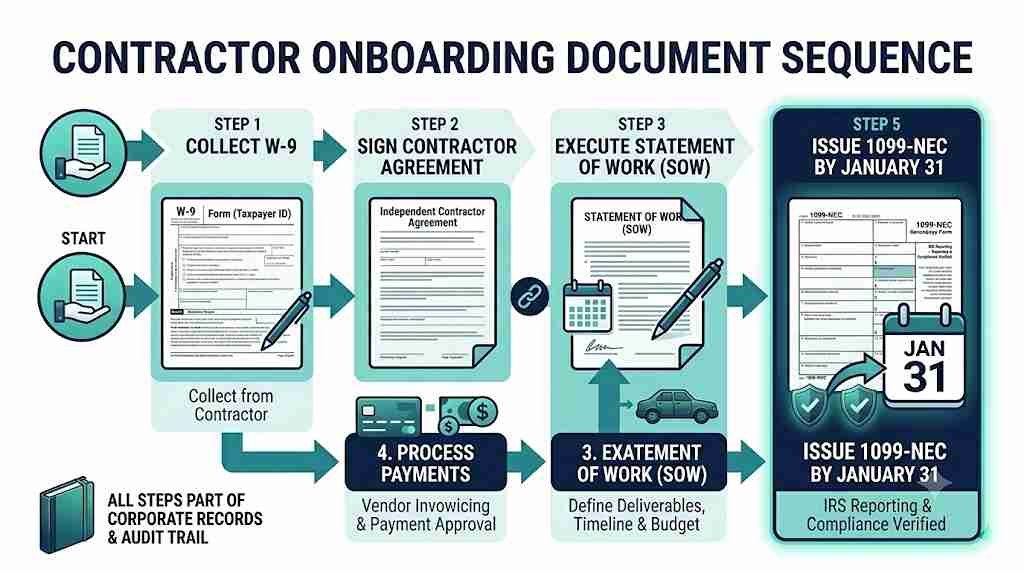
Document 1 — Form W-9: The Non-Negotiable Foundation
The Form W-9 is the absolute first document in the answer to what paperwork do I need for a 1099 employee — and it must be collected before any payment is processed, without exception.
The W-9 captures the contractor’s full legal name, business name if applicable, federal tax classification, address, and Taxpayer Identification Number (TIN) — either their Social Security Number or Employer Identification Number.
Box 3 of the W-9 is the most critical field in the entire document. It reveals the contractor’s federal tax classification — sole proprietor, partnership, S-Corp, C-Corp, or LLC with a specific election — which determines your complete 1099 filing obligation for that vendor relationship.
If a contractor refuses to provide a W-9, backup withholding at 24% activates immediately under IRC § 3406. You must withhold this amount from every subsequent payment and remit it to the IRS — making W-9 collection a direct financial protection mechanism for your business.
Document 2 — Independent Contractor Agreement: Your Misclassification Shield
The Independent Contractor Agreement is the most powerful misclassification defense document in your entire contractor paperwork stack — and one of the most frequently overlooked by small businesses.
A properly drafted contractor agreement explicitly establishes the non-employee nature of the relationship, confirms the contractor’s right to set their own hours and work methods, acknowledges their responsibility for self-employment taxes, and specifies the project-based or deliverable-based nature of the engagement.
Key clauses that strengthen misclassification protection include a right to substitute clause — allowing the contractor to send a qualified replacement — and a multiple client acknowledgment clause confirming the contractor actively services other businesses simultaneously.
The agreement should be signed before work begins — not after the first invoice arrives. A retroactively signed contractor agreement carries significantly less legal weight in both IRS examination and DOL investigation proceedings.
Document 3 — Statement of Work: The Project Scope Boundary Document
The Statement of Work (SOW) defines the specific deliverables, timelines, payment terms, and project scope for each contractor engagement — and serves as the operational backbone of your misclassification defense strategy.
A well-constructed SOW demonstrates that the contractor relationship is project-based and outcome-focused — not an indefinite, hour-based arrangement that mirrors traditional employment. This distinction is critical when IRS examiners evaluate the Type of Relationship factor in the Common Law Control Test.
Each new project or engagement extension should generate a fresh SOW — documenting the specific scope change and confirming the continued independent nature of the contractor relationship throughout the engagement lifecycle.
Document 4 — Form 1099-NEC: The Year-End Mandatory Filing
The Form 1099-NEC is the year-end reporting document that completes the answer to what paperwork do I need for a 1099 employee — and its issuance is governed by a strict January 31, 2026 deadline for recipient copies.
The 1099-NEC must be issued to every contractor who received $600 or more in payments during the 2025 calendar year — regardless of how many individual payments composed that total. The form captures the contractor’s legal name, TIN, and total compensation paid and is simultaneously filed with the IRS.
Businesses filing 10 or more information returns of any combined type must file electronically through the IRS FIRE system under regulations effective from the 2024 tax year. Paper filing remains available only for businesses below this threshold — with a February 28, 2026 paper deadline and March 31, 2026 electronic deadline for IRS copies.
Document 5 — Foreign Contractor Documentation: Form W-8BEN and W-8BEN-E
If your business engages international contractors operating outside the United States, the W-9 is replaced by an entirely different documentation framework that most domestic-focused businesses are completely unprepared to handle.
Individual foreign contractors must provide a Form W-8BEN — Certificate of Foreign Status of Beneficial Owner — before receiving any payment. This form establishes the contractor’s foreign status and claims any applicable tax treaty benefits that reduce the standard 30% withholding rate under IRC § 1441.
Foreign business entities acting as contractors must provide a Form W-8BEN-E instead — a more complex document capturing the entity’s foreign tax classification, FATCA status, and treaty claim details. Both forms expire after three calendar years and must be recollected from foreign contractors on a rolling renewal schedule.
Frequently Asked Questions (Gutenberg Block Ready)
What paperwork do I need for a 1099 employee if they operate under an LLC business name?
The documentation requirements are identical regardless of whether the contractor operates as an individual or under an LLC business name. You must collect a Form W-9 completed with the LLC’s legal registered name, its Employer Identification Number, and its confirmed federal tax classification in Box 3. The Independent Contractor Agreement and Statement of Work should reference the LLC as the contracting party — not the individual owner’s personal name — to properly reflect the business-to-business nature of the engagement. If the LLC has elected S-Corp or C-Corp status, the W-9 confirmation of that election eliminates your 1099-NEC filing obligation for standard service payments under IRS Publication 1281.
What paperwork do I need for a 1099 employee if I pay them through a payroll platform like Gusto or QuickBooks?
Using a third-party payroll or contractor management platform does not eliminate your underlying documentation obligations — it simply automates parts of the collection and filing process. You still need a completed W-9 on file for every contractor regardless of which platform processes their payments. Most platforms including Gusto, QuickBooks, and ADP have built-in W-9 collection workflows that request the form digitally during contractor onboarding. However, the Independent Contractor Agreement and Statement of Work remain your direct responsibility — payroll platforms do not generate or store these legal documents on your behalf under any standard service tier available in 2026.
What paperwork do I need for a 1099 employee if they refuse to sign an independent contractor agreement?
A contractor’s refusal to sign an Independent Contractor Agreement is a significant operational and legal red flag that demands immediate attention before any payment is processed. Without a signed agreement, your business has no documented basis for the classification decision — leaving you fully exposed in any subsequent IRS misclassification audit or DOL Wage and Hour investigation. In this scenario, you should pause the engagement, consult with a qualified employment attorney, and evaluate whether the contractor’s reluctance to sign reflects a fundamental misunderstanding of the relationship structure or a deliberate attempt to preserve future legal claims. Never process a payment to a contractor without at minimum a completed W-9 and a signed contractor agreement on file in your vendor documentation system.