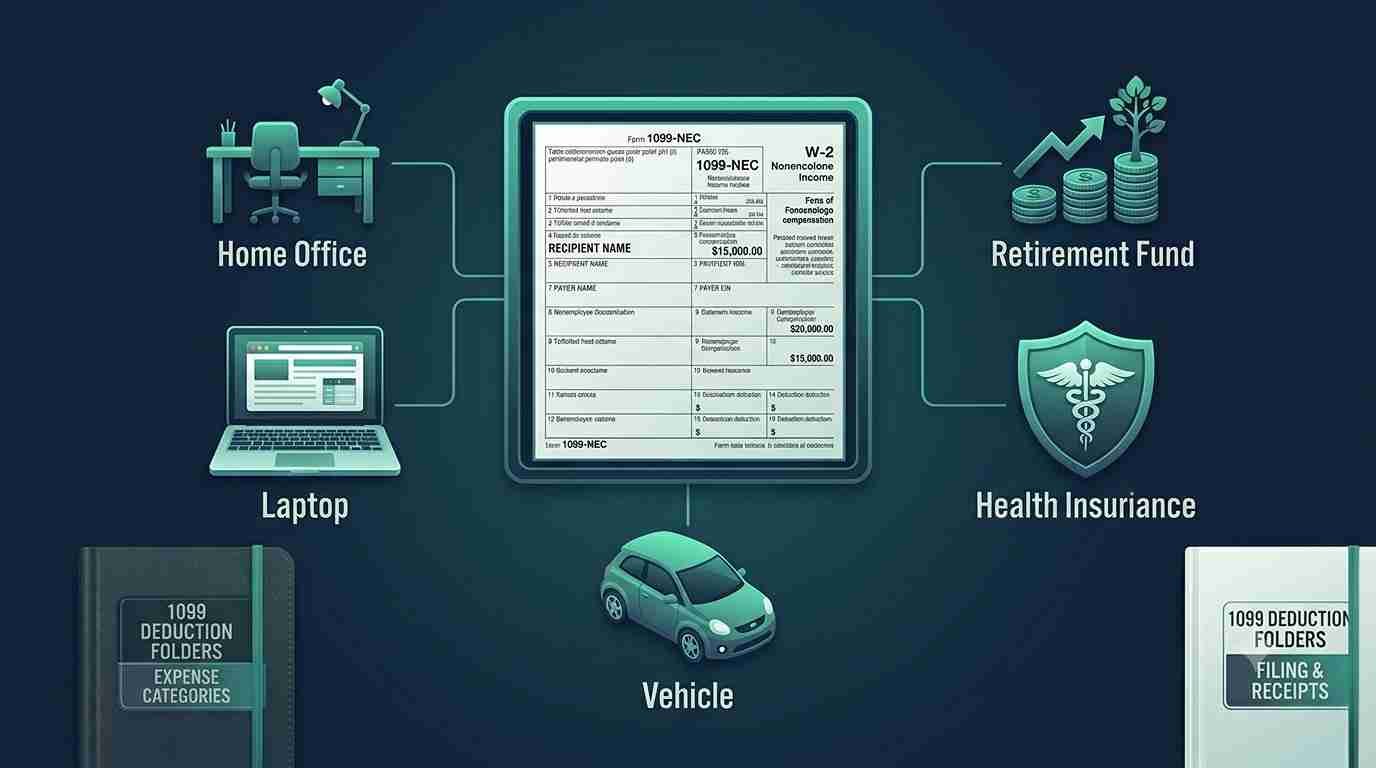
What can you write off as a 1099 contractor covers a powerful range of IRS-approved self-employment deductions that dramatically reduce your taxable income. As a 1099 independent contractor, you can deduct ordinary and necessary business expenses under IRC § 162 — including your home office, vehicle mileage, health insurance premiums, self-employment tax, retirement contributions, and business equipment. Maximizing these deductions is the single most effective legal strategy for reducing your Schedule C tax liability in the 2026 filing year.
Understanding What Can You Write Off as a 1099 Contractor in 2026
What can you write off as a 1099 worker is the most financially impactful question any independent contractor or freelancer can ask heading into tax season.
Unlike W-2 employees who lost most miscellaneous itemized deductions after the Tax Cuts and Jobs Act (TCJA), 1099 self-employed workers retain full access to an extensive menu of above-the-line business deductions directly on Schedule C of Form 1040.
Understanding exactly what can you write off as a 1099 contractor — and documenting those deductions correctly — is the difference between overpaying thousands in taxes and keeping every dollar you are legally entitled to retain.
Statutory Compliance Requirements for Businesse
The governing legal standard for all 1099 contractor deductions is IRC § 162, which permits deductions for all expenses that are both ordinary (common and accepted in your trade) and necessary (helpful and appropriate for your business). Both criteria must be satisfied simultaneously for an expense to survive IRS scrutiny.
The IRS Schedule C (Form 1040) is the primary reporting document where all deductible business expenses are itemized and subtracted from your gross 1099 income. The resulting net profit figure is then subject to both income tax and the 15.3% self-employment tax — making every legitimate deduction doubly valuable for contractors.
For the complete official IRS guidance on self-employed deductions and Schedule C filing requirements, refer to the IRS Self-Employed Individuals Tax Center.
Knowing what can you write off as a 1099 worker also connects directly to your quarterly estimated tax obligations. Understanding how much to set aside for taxes as a 1099 contractor ensures your deduction strategy is coordinated with your Q1 through Q4 estimated payment schedule for maximum cash flow efficiency.
Before building your deduction strategy, it is equally critical to understand whether 1099 jobs are financially worth it after accounting for self-employment tax, benefit costs, and deduction offsets — since the true financial picture only emerges after all write-offs are properly applied.
Quick Reference Compliance Matrix
| Deduction Category | IRS Authority | 2026 Limit / Rate | Schedule C Line |
|---|---|---|---|
| Home Office (Simplified Method) | IRC § 280A | $5 per sq ft — max 300 sq ft ($1,500) | Line 30 |
| Home Office (Actual Expense Method) | IRC § 280A | Proportional % of actual home costs | Line 30 |
| Vehicle — Standard Mileage Rate | IRS Rev. Proc. 2025-xx | 67 cents per mile (2026 rate) | Line 9 |
| Vehicle — Actual Expense Method | IRC § 179 / § 168 | Business-use % of actual costs | Line 9 |
| Health Insurance Premiums | IRC § 162(l) | 100% of premiums — above the line | Form 1040 Line 17 |
| Self-Employment Tax Deduction | IRC § 164(f) | 50% of SE tax paid | Schedule 1 Line 15 |
| Retirement Contributions (SEP-IRA) | IRC § 408(k) | Up to $69,000 or 25% of net earnings | Schedule 1 Line 16 |
| Retirement Contributions (Solo 401k) | IRC § 401(a) | Up to $69,000 combined ($76,500 if 50+) | Schedule 1 Line 16 |
| Business Equipment (Section 179) | IRC § 179 | Up to $1,220,000 in 2026 | Form 4562 |
| Bonus Depreciation | IRC § 168(k) | 40% in 2026 (phasing down) | Form 4562 |
| Professional Development & Education | IRC § 162 | 100% if maintaining current skills | Line 27a |
| Internet & Phone (Business %) | IRC § 162 | Business-use percentage only | Line 25 |
| Software & Subscriptions | IRC § 162 | 100% if business-use only | Line 22 |
| Professional Services (CPA, Legal) | IRC § 162 | 100% of fees paid | Line 17 |
| Business Insurance Premiums | IRC § 162 | 100% of premiums | Line 15 |
| Meals (Business Purpose) | IRC § 274 | 50% deductible in 2026 | Line 24b |
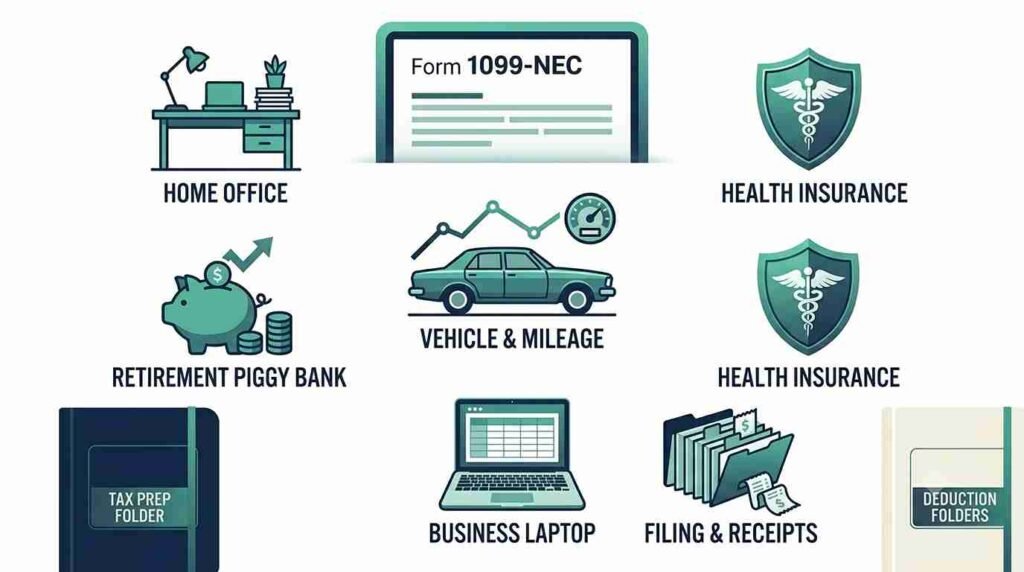
The Home Office Deduction: Most Claimed 1099 Write-Off in 2026
The home office deduction remains the single most valuable write-off available to 1099 contractors — and the most frequently audited. The IRS requires the space to be used regularly and exclusively for business purposes.
The simplified method allows a flat deduction of $5 per square foot up to a maximum of 300 square feet, capping the deduction at $1,500 annually. No depreciation recapture applies when you sell your home under this method.
The actual expense method calculates the percentage of your home used for business and applies that percentage to all actual home costs — mortgage interest, rent, utilities, repairs, and homeowner’s insurance. This method requires more documentation but consistently yields a larger deduction for contractors with dedicated office spaces.
Vehicle Deductions: The Standard Mileage vs. Actual Expense Decision
Vehicle expenses represent one of the largest and most frequently missed write-offs when contractors ask what can you write off as a 1099 worker. Every business mile driven is a deductible asset.
The standard mileage rate for 2026 allows a deduction of 67 cents per mile for all business-purpose driving. This includes client visits, supply runs, bank trips, and travel to temporary work locations. You must maintain a contemporaneous mileage log documenting date, destination, business purpose, and miles driven for each trip.
The actual expense method tracks all vehicle operating costs — fuel, insurance, maintenance, registration, and depreciation — then applies the business-use percentage to the total. If your vehicle is used more than 50% for business, you may also qualify for Section 179 expensing or bonus depreciation on the vehicle’s purchase price.
Retirement Contributions: The Most Powerful 1099 Tax Reduction Strategy
For high-earning 1099 contractors, retirement account contributions represent the single most powerful legal tax reduction strategy available — producing dollar-for-dollar reductions in both income tax and self-employment tax simultaneously.
A SEP-IRA allows contributions of up to 25% of net self-employment income or $69,000 in 2026, whichever is lower. Setup is straightforward and contributions can be made up until the tax filing deadline including extensions.
A Solo 401(k) allows even higher combined contributions — up to $69,000 in 2026, or $76,500 for contractors age 50 or older — through a combination of employee elective deferrals and employer profit-sharing contributions. The Solo 401(k) also offers a Roth contribution option not available in the SEP-IRA structure.
Health Insurance Premiums: The Above-the-Line Deduction W-2 Workers Cannot Access
One of the most significant financial advantages of 1099 status is the ability to deduct 100% of health insurance premiums paid for yourself, your spouse, and your dependents as an above-the-line deduction under IRC § 162(l).
This deduction is claimed directly on Form 1040 Schedule 1 — not on Schedule C — meaning it reduces your Adjusted Gross Income (AGI) even if you do not itemize deductions. The only restriction is that your deduction cannot exceed your net self-employment income for the year.
Dental and vision premiums paid for yourself and qualifying family members are fully included in this deduction category alongside standard medical insurance costs.
Frequently Asked Questions
What can you write off as a 1099 contractor for a home office if you rent your home?
Renters have full access to the home office deduction under the same IRC § 280A rules that apply to homeowners. Under the actual expense method, you deduct the business-use percentage of your monthly rent alongside the proportional share of utilities, renters insurance, and internet costs attributable to the office space. The simplified method — $5 per square foot up to $1,500 — is often more straightforward for renters since it eliminates the need to track proportional utility costs separately throughout the year.
Can you write off equipment purchases as a 1099 contractor in 2026?
Yes — and 2026 offers two powerful mechanisms for doing so. Section 179 expensing allows you to immediately deduct the full cost of qualifying business equipment up to $1,220,000 in the year of purchase rather than depreciating it over multiple years. Additionally, bonus depreciation under IRC § 168(k) allows an immediate 40% deduction on qualifying new and used property placed in service during 2026. Qualifying equipment includes laptops, cameras, specialized tools, office furniture, and any tangible property used predominantly for business purposes throughout the tax year.
What can you write off as a 1099 contractor if you work in multiple states?
Working across multiple states as a 1099 contractor creates both expanded deduction opportunities and additional filing obligations. Travel expenses — including flights, hotels, ground transportation, and 50% of meals — incurred while conducting business in other states are fully deductible on Schedule C under IRC § 162. However, you may also be required to file non-resident state income tax returns in each state where you earned income above that state’s filing threshold. The cost of tax preparation fees for all required state filings is itself a fully deductible professional service expense in the year paid.