
1099 how much to set aside for taxes in 2026 follows one essential rule — reserve between 25% and 30% of every payment received as a baseline tax provision. 1099 independent contractors owe both federal income tax and the 15.3% self-employment tax under IRC § 1401 — covering Social Security at 12.4% and Medicare at 2.9% on 92.35% of net self-employment income. Adding federal income tax at your marginal bracket rate produces a combined effective tax obligation that makes the 25% to 30% set-aside rule the most reliable starting benchmark for most freelancers, LLC owners, and self-employed contractors in the 2026 tax filing year.
Understanding 1099 How Much to Set Aside for Taxes in 2026
1099 how much to set aside for taxes is the single most urgent financial planning question every new and experienced independent contractor must answer correctly before spending a single dollar of their gross contractor income.
Unlike W-2 employees who have federal income tax, Social Security, and Medicare automatically withheld from every paycheck, 1099 independent contractors receive their full gross payment with zero tax withheld — placing the entire burden of tax estimation, reservation, and quarterly payment directly on the contractor.
Getting 1099 how much to set aside for taxes wrong — either through underestimation or failure to make quarterly payments — triggers IRS underpayment penalties, interest charges, and a devastating tax bill at filing time that can destabilize even a well-managed contractor business.
Statutory Compliance Requirements for Businesses
The governing statutory framework for 1099 how much to set aside for taxes spans three distinct tax obligation layers that every contractor must calculate and provision for simultaneously.
Layer 1 — Self-Employment Tax under IRC § 1401: Every 1099 contractor owes 15.3% self-employment tax on 92.35% of net self-employment income — the 92.35% adjustment accounting for the deductible employer-equivalent portion of SE tax. This layer applies regardless of income level up to the Social Security wage base of $176,100 in 2026, above which only the 2.9% Medicare portion continues with no upper limit.
Layer 2 — Federal Income Tax under IRC § 1: Federal income tax is calculated on net self-employment income after subtracting the 50% SE tax deduction under IRC § 164(f) and all legitimate Schedule C business deductions under IRC § 162. The resulting taxable income is then subject to the applicable 2026 federal marginal tax brackets — ranging from 10% to 37% depending on total taxable income and filing status.
Layer 3 — State Income Tax: Most states impose additional state income tax on self-employment income — ranging from zero in the nine states with no income tax to 13.3% in California for high-income contractors. State tax must be calculated and provisioned for separately alongside federal obligations.
For the complete official IRS guidance on self-employment tax calculation and quarterly estimated payment requirements, refer to the IRS Self-Employment Tax Center — Schedule SE Instructions.
Understanding 1099 how much to set aside for taxes connects directly to your retirement contribution strategy. Knowing whether 1099 employees can contribute to a 401k allows you to precisely calculate how Solo 401(k) and SEP-IRA contributions reduce your taxable self-employment income — directly lowering the total tax set-aside percentage required for your specific income level.
It is equally important to understand what you can write off as a 1099 contractor before finalizing your tax set-aside calculation — since every legitimate Schedule C deduction reduces your net self-employment income base and proportionally lowers the total dollar amount you need to reserve for taxes throughout the year.
Quick Reference Compliance Matrix
| Income Level | SE Tax Obligation | Federal Income Tax | Recommended Set-Aside % |
|---|---|---|---|
| $0 — $20,000 net | 15.3% on 92.35% | 10% bracket | 25% minimum |
| $20,001 — $44,725 net | 15.3% on 92.35% | 12% bracket | 25% — 27% |
| $44,726 — $95,375 net | 15.3% on 92.35% | 22% bracket | 27% — 30% |
| $95,376 — $176,100 net | 15.3% on 92.35% | 24% bracket | 30% — 33% |
| $176,101 — $200,000 net | 2.9% Medicare only | 32% bracket | 33% — 35% |
| $200,001 — $500,000 net | 2.9% + 0.9% FICA | 35% bracket | 35% — 38% |
| $500,001+ net | 2.9% + 0.9% FICA | 37% bracket | 38% — 40% |
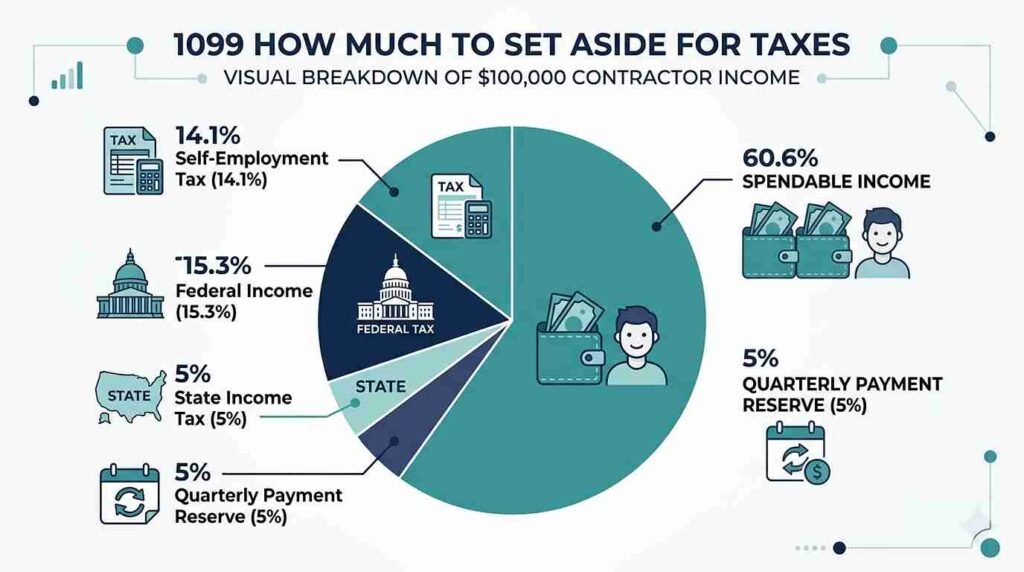
The Self-Employment Tax Calculation: The Foundation of 1099 Tax Set-Aside
Understanding 1099 how much to set aside for taxes begins with the self-employment tax — the layer of taxation that surprises most new contractors and remains the largest single tax obligation for lower and mid-income 1099 workers.
The self-employment tax rate is 15.3% — composed of 12.4% Social Security tax and 2.9% Medicare tax. However, this rate does not apply to your full gross 1099 income — it applies to 92.35% of your net self-employment income after Schedule C deductions are subtracted from gross revenue.
The 92.35% adjustment exists because the IRS allows contractors to deduct the employer-equivalent half of self-employment tax before calculating the SE tax base — mirroring the treatment of employer FICA contributions in W-2 employment relationships.
The practical calculation for a contractor earning $80,000 net:
Net self-employment income × 92.35% = SE tax base → $80,000 × 0.9235 = $73,880 SE tax base
SE tax base × 15.3% = SE tax owed → $73,880 × 0.153 = $11,304 self-employment tax
This $11,304 is the minimum floor of the tax set-aside calculation — before a single dollar of federal income tax is added to the total obligation.
The Additional Medicare Tax: The Hidden Layer Above $200,000
When calculating 1099 how much to set aside for taxes at higher income levels, the Additional Medicare Tax of 0.9% under IRC § 1401(b)(2) introduces a frequently overlooked third layer of SE tax obligation.
The Additional Medicare Tax applies to all self-employment income above $200,000 for single filers — or $250,000 for married couples filing jointly. Unlike the standard SE tax, the Additional Medicare Tax is calculated on the full amount above the threshold with no 92.35% adjustment applied.
For a single contractor earning $300,000 net, the Additional Medicare Tax calculation is: ($300,000 − $200,000) × 0.9% = $900 additional Medicare tax on top of the standard SE tax calculated on the full $300,000 income base.
High-earning contractors must specifically increase their 1099 how much to set aside for taxes percentage to account for this additional layer — which most standard percentage-based set-aside rules fail to incorporate at the income levels where it activates.
The 2026 Federal Tax Brackets Applied to 1099 Income
Federal income tax is the second major layer in the 1099 how much to set aside for taxes calculation — and its interaction with the SE tax deduction makes the effective calculation slightly more complex than simply adding the bracket rate to the SE tax rate.
Before applying federal tax brackets, two critical deductions reduce your taxable income base:
Deduction 1 — 50% SE Tax Deduction: Under IRC § 164(f), you deduct 50% of your total SE tax from gross income before calculating federal income tax. For the contractor owing $11,304 in SE tax, this deduction equals $5,652 — reducing the federal income tax calculation base by that amount.
Deduction 2 — Schedule C Business Deductions: All legitimate business expenses — home office, vehicle, equipment, health insurance, retirement contributions — reduce your net self-employment income before both SE tax and federal income tax are calculated. Every dollar of valid Schedule C deductions reduces your 1099 how much to set aside for taxes obligation proportionally.
2026 Federal Tax Brackets for Single Filers:
10% on income from $0 to $11,925. 12% on income from $11,926 to $48,475. 22% on income from $48,476 to $103,350. 24% on income from $103,351 to $197,300. 32% on income from $197,301 to $250,525. 35% on income from $250,526 to $626,350. 37% on income above $626,350.
Quarterly Estimated Tax Payments: The Non-Negotiable 1099 Obligation
Calculating 1099 how much to set aside for taxes is only half the obligation — the IRS also requires contractors to pay their estimated tax liability in four quarterly installments rather than waiting until the annual filing deadline.
The 2026 quarterly estimated tax payment deadlines are:
Q1 Payment — April 15, 2026 covering January 1 through March 31.
Q2 Payment — June 16, 2026 covering April 1 through May 31.
Q3 Payment — September 15, 2026 covering June 1 through August 31.
Q4 Payment — January 15, 2027 covering September 1 through December 31.
The IRS underpayment penalty under IRC § 6654 applies when a contractor pays less than 90% of their current year tax liability or less than 100% of their prior year tax liability (110% for contractors with AGI above $150,000) through quarterly estimated payments.
The safest quarterly payment strategy for most contractors is the prior year safe harbor method — paying exactly 100% of last year’s total tax liability in four equal installments. This approach completely eliminates underpayment penalty risk regardless of how much your current year income increases.
The Practical Set-Aside System: How to Reserve the Right Amount Every Payment
The most reliable operational system for managing 1099 how much to set aside for taxes uses a dedicated tax reserve account — a separate bank account where a fixed percentage of every contractor payment is transferred immediately upon receipt.
The Standard 30% Rule works as follows: Every time a client payment clears your business account, immediately transfer 30% of the gross amount to your dedicated tax reserve account. Never commingle tax reserves with operating funds or personal spending accounts.
For contractors in the 22% bracket: Transfer 27% to 30% — covering approximately 14.1% for SE tax plus 22% federal income tax minus the 50% SE tax deduction benefit, adjusted for standard deductions.
For contractors in the 24% bracket: Transfer 30% to 33% — the higher bracket interaction with SE tax creates a combined marginal rate approaching 38% on each additional dollar before deductions are applied.
For contractors with significant Schedule C deductions: Recalculate your effective set-aside percentage quarterly — not annually — since large deductions for retirement contributions, home office, and equipment can reduce your effective set-aside requirement substantially below the standard 30% benchmark.
State Income Tax: The Third Layer in 1099 How Much to Set Aside for Taxes
State income tax represents the third and most geographically variable layer in the complete 1099 how much to set aside for taxes calculation — and it is the layer most frequently underprovisioned by contractors operating across multiple states.
Nine states impose zero state income tax on self-employment income — Alaska, Florida, Nevada, New Hampshire, South Dakota, Tennessee, Texas, Washington, and Wyoming. Contractors operating exclusively in these states can reduce their total set-aside percentage by 4% to 8% compared to contractors in high-tax states.
California imposes the highest state income tax rate in the nation — reaching 13.3% on income above $1,000,000 and 9.3% on income above $66,295 for single filers in 2026. California contractors must add their applicable state marginal rate directly to their federal set-aside calculation — producing total combined set-aside requirements approaching 40% to 45% for mid-to-high income California-based 1099 workers.
New York, Oregon, Minnesota, and New Jersey round out the highest state tax burden states for 1099 contractors — with combined federal and state effective rates that consistently justify 35% to 42% total set-aside percentages for contractors operating in these jurisdictions at middle and upper income levels.
Frequently Asked Questions
1099 how much to set aside for taxes if this is my first year as a contractor with no prior year tax liability?
In your first year as a 1099 contractor, you have no prior year tax liability to reference for the safe harbor method — making accurate current-year estimation your only option. The IRS still requires quarterly estimated payments beginning with the April 15 deadline regardless of your experience level. For first-year contractors, the most reliable approach is to calculate your projected annual net self-employment income, apply the full SE tax calculation at 15.3% on 92.35% of that amount, add your estimated federal income tax liability based on your applicable bracket, divide the total by four, and transfer that amount to the IRS by each quarterly deadline.
Erring toward slightly overpaying in quarterly installments is always preferable to underpayment since overpayments generate a tax refund at filing while underpayments generate penalties and interest charges under IRC § 6654.
1099 how much to set aside for taxes when income fluctuates significantly between months?
Highly variable contractor income creates a challenging set-aside management problem — and the standard fixed-percentage approach works best in this scenario. Rather than calculating a fixed quarterly dollar amount, apply the 30% set-aside rule to every individual payment regardless of size — immediately transferring 30% of each client payment to your tax reserve account on the day it clears.
This variable-dollar, fixed-percentage approach automatically scales your tax reserves with your actual income — building larger reserves in high-income months and smaller reserves in low-income months without requiring you to track and adjust a fixed quarterly target. At the end of each quarter, calculate your actual tax liability for that quarter’s net income and make the IRS Form 1040-ES payment from your accumulated reserve — returning any excess reserve funds to your operating account after the quarterly payment clears.
1099 how much to set aside for taxes after maximizing a Solo 401k contribution in 2026?
A maximum Solo 401(k) contribution dramatically reduces the 1099 how much to set aside for taxes calculation — and this is one of the most powerful and underutilized tax reduction strategies available to high-earning contractors. For a contractor earning $150,000 net who makes the maximum $69,000 Solo 401(k) contribution in 2026, the taxable income base for federal income tax purposes drops to approximately $74,300 after accounting for the SE tax deduction and retirement contribution deduction simultaneously.
This reduction moves a significant portion of income out of the 24% federal bracket and into the 22% bracket — reducing the required set-aside percentage from approximately 32% to approximately 24% on gross pre-contribution income. The retirement contribution does not reduce the SE tax calculation base — Solo 401(k) contributions are deducted after SE tax is calculated — but the federal income tax savings alone generate retirement-funded tax savings of approximately $10,000 to $16,000 annually for contractors operating at this income level.