
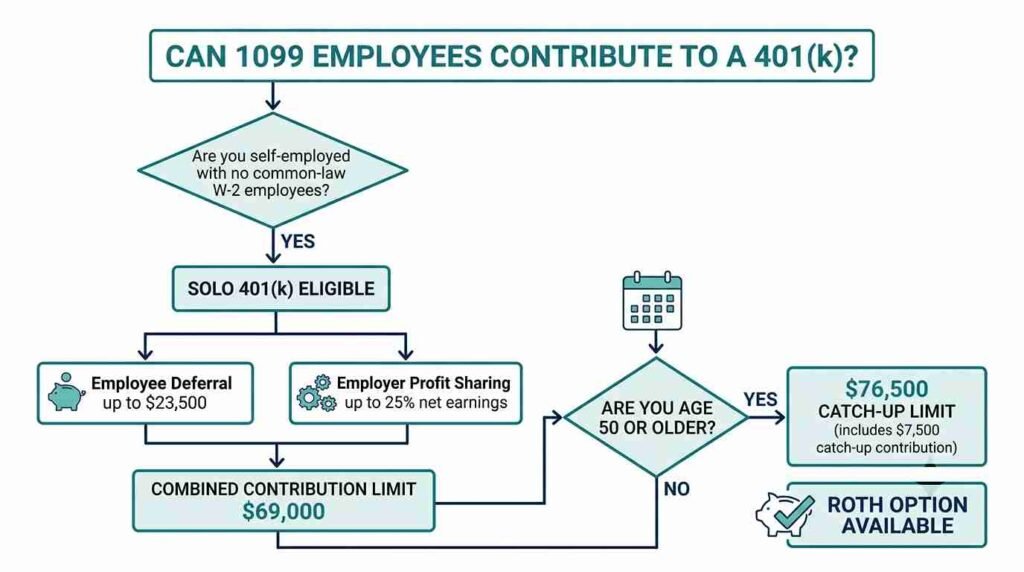
Can 1099 employees contribute to 401k plans? — Yes, absolutely. While 1099 independent contractors cannot participate in a hiring company’s employer-sponsored 401(k) plan, they can establish and maximize a Solo 401(k) — also called an Individual 401(k) or Self-Employed 401(k) — under IRC § 401(a). The 2026 Solo 401(k) contribution limit reaches $69,000 — or $76,500 for contractors age 50 or older — making it the single most powerful tax-advantaged retirement vehicle available to any self-employed individual, freelancer, LLC owner, or 1099 contractor in the current IRS regulatory framework.
Understanding Can 1099 Employees Contribute to 401k Plans in 2026
Can 1099 employees contribute to 401k plans is one of the most financially impactful questions any independent contractor or freelancer can ask — and the answer reveals a retirement savings opportunity that most 1099 workers dramatically underutilize.
The phrase “1099 employee” is a common shorthand — but under IRS rules, these workers are independent contractors operating as self-employed individuals. That classification does not restrict retirement savings access — it actually expands it through self-employed retirement vehicles unavailable to standard W-2 employees.
Understanding exactly how can 1099 employees contribute to 401k plans works under 2026 IRS rules is the single most powerful step any contractor can take toward building long-term financial security while simultaneously reducing their current-year federal tax liability.
Statutory Compliance Requirements for Businesses
The governing statutory authority establishing how can 1099 employees contribute to 401k plans operates is IRC § 401(a) — which authorizes qualified retirement plans — combined with IRC § 401(k) which specifically governs elective deferral provisions within those plans.
The Solo 401(k) is the primary vehicle answering whether can 1099 employees contribute to 401k arrangements. It is specifically designed for self-employed individuals with no full-time W-2 employees other than the business owner and their spouse — making it the perfect retirement structure for the vast majority of 1099 independent contractors operating in 2026.
The Solo 401(k) allows contributions in two distinct capacities simultaneously — as an employee making elective deferrals and as an employer making profit-sharing contributions. This dual contribution structure is precisely why the Solo 401(k) reaches contribution limits dramatically higher than standard employer-sponsored 401(k) plans available to W-2 employees.
The plan establishment deadline for a Solo 401(k) is December 31 of the tax year for which you want to make employee elective deferrals — though employer profit-sharing contributions can be made up until the tax filing deadline including extensions. Missing the December 31 establishment deadline eliminates the employee deferral contribution for that tax year entirely.
For the complete official IRS guidance on Solo 401(k) plans and self-employed retirement contribution limits, refer to the IRS One-Participant 401(k) Plans Resource Center.
Understanding whether can 1099 employees contribute to 401k plans is the right strategy for your specific income level connects directly to your overall tax planning framework. Knowing how much to set aside for taxes as a 1099 contractor ensures your Solo 401(k) contribution strategy is fully coordinated with your quarterly estimated tax payment obligations — since large retirement contributions directly reduce your self-employment income tax base and quarterly payment requirements simultaneously.
It is equally important to understand what you can write off as a 1099 contractor beyond retirement contributions — since the Solo 401(k) deduction works in concert with home office deductions, vehicle expenses, health insurance premiums, and business equipment write-offs to produce the maximum possible reduction in your total 2026 federal tax liability.
Quick Reference Compliance Matrix
| Retirement Plan Type | Can 1099 Employees Contribute to 401k / Plan | 2026 Contribution Limit | IRS Authority |
|---|---|---|---|
| Solo 401(k) — Employee Deferral | Yes — up to annual limit | $23,500 employee portion | IRC § 402(g) |
| Solo 401(k) — Employer Profit Sharing | Yes — up to 25% of net earnings | Up to $45,500 employer portion | IRC § 404(a) |
| Solo 401(k) — Combined Maximum | Yes — both layers combined | $69,000 total in 2026 | IRC § 415(c) |
| Solo 401(k) — Age 50+ Catch-Up | Yes — additional catch-up | $76,500 total in 2026 | IRC § 414(v) |
| Solo Roth 401(k) | Yes — after-tax contributions | Same limits as traditional | IRC § 402A |
| SEP-IRA | Yes — employer contributions only | 25% of net / max $69,000 | IRC § 408(k) |
| SIMPLE IRA | Yes — with conditions | $16,500 / $20,000 age 50+ | IRC § 408(p) |
| Traditional IRA | Yes — income limits apply | $7,000 / $8,000 age 50+ | IRC § 219 |
| Employer 401(k) — Client’s Plan | No — employee-only access | N/A | ERISA § 3(2) |
The Solo 401(k) Employee Deferral: The First Contribution Layer
The first and most immediately accessible answer to can 1099 employees contribute to 401k plans involves the employee elective deferral — the same mechanism W-2 employees use to contribute to their employer’s standard 401(k) plan.
As a self-employed 1099 contractor, you wear both the employee and employer hat simultaneously within your Solo 401(k) structure. In your employee capacity, you can defer up to $23,500 of net self-employment income in 2026 — the same elective deferral limit that applies to W-2 employees in standard employer plans.
This employee deferral is a pre-tax contribution for a traditional Solo 401(k) — reducing your taxable self-employment income dollar-for-dollar in the contribution year. For a contractor in the 22% federal tax bracket, a full $23,500 employee deferral generates approximately $5,170 in immediate federal income tax savings before the employer contribution layer is even considered.
Roth Solo 401(k) contributions are an alternative that many 1099 contractors overlook. Roth contributions are made with after-tax dollars — producing no immediate tax deduction — but all future qualified withdrawals including decades of investment growth are completely tax-free under IRC § 402A. Contractors who expect to be in a higher tax bracket during retirement than during their working years benefit most from the Roth contribution election.
The Employer Profit-Sharing Contribution: The Second and More Powerful Layer
The employer profit-sharing contribution layer is where the can 1099 employees contribute to 401k answer becomes dramatically more powerful than anything available through standard W-2 employment.
In your employer capacity within the Solo 401(k) structure, you can make an additional profit-sharing contribution of up to 25% of your net self-employment income — calculated after subtracting the deductible portion of self-employment tax from net business income. This employer contribution is completely independent of and additive to the $23,500 employee deferral made in your employee capacity.
For a contractor with $150,000 in net self-employment income, the employer profit-sharing contribution capacity reaches approximately $28,227 — bringing the total Solo 401(k) contribution for that year to approximately $51,727 when combined with the full employee deferral amount.
The employer profit-sharing contribution is deducted on Schedule 1 of Form 1040 — not on Schedule C — meaning it reduces Adjusted Gross Income directly and interacts favorably with AGI-sensitive deductions and credits throughout the entire tax return calculation.
Solo 401(k) vs SEP-IRA: Which Retirement Plan Wins for 1099 Contractors
The SEP-IRA is the most commonly recommended retirement alternative when contractors ask can 1099 employees contribute to 401k plans — but a direct comparison reveals that the Solo 401(k) wins at most income levels.
The SEP-IRA allows contributions of up to 25% of net self-employment income with a maximum of $69,000 in 2026 — but only the employer contribution layer is available. There is no separate employee elective deferral component in a SEP-IRA structure.
At lower income levels — typically below $80,000 in net self-employment income — the SEP-IRA actually outperforms the Solo 401(k) in raw contribution capacity. This is because the employee deferral layer of the Solo 401(k) is limited to actual net self-employment income at very low income levels, while the SEP-IRA’s 25% calculation can still generate a meaningful contribution.
At income levels above $100,000, the Solo 401(k) consistently wins — because the employee deferral component allows contributions well above what the 25% employer-only SEP-IRA calculation produces. The crossover point where the Solo 401(k) surpasses the SEP-IRA in contribution capacity occurs at approximately $93,000 in net self-employment income for 2026.
The Roth Solo 401(k): The Tax-Free Retirement Strategy for High-Earning Contractors
The Roth Solo 401(k) is one of the most strategically powerful retirement options available to 1099 contractors — and one of the most underutilized answers to whether can 1099 employees contribute to 401k plans in a tax-efficient way.
Unlike the Roth IRA — which phases out at $150,000 MAGI for single filers and $236,000 for married couples filing jointly in 2026 — the Roth Solo 401(k) has no income limit. High-earning contractors who are completely phased out of direct Roth IRA contributions can still make full Roth elective deferrals up to $23,500 through their Solo 401(k) plan.
The long-term tax advantage is compelling. A contractor who contributes $23,500 annually to a Roth Solo 401(k) starting at age 35 — assuming a 7% average annual return — accumulates approximately $2.3 million in completely tax-free retirement assets by age 65. Every dollar of that growth is withdrawn in retirement without federal income tax liability under current IRC § 402A qualified distribution rules.
How to Establish a Solo 401(k) as a 1099 Contractor in 2026
Establishing a Solo 401(k) is administratively straightforward — but the timing requirements are strict and non-negotiable under current IRS rules.
Step 1 — Choose a Solo 401(k) Provider: Major financial institutions offering Solo 401(k) plans include Fidelity, Vanguard, Charles Schwab, and E*TRADE. Fidelity and Schwab offer zero-fee Solo 401(k) plans with no annual maintenance charges — making them the most cost-efficient options for most 1099 contractors in 2026.
Step 2 — Complete Plan Adoption Agreement: The plan adoption agreement is the legal document establishing your Solo 401(k). It must be signed and executed by December 31 of the tax year for which you want to make employee elective deferrals. This deadline is absolute — no extensions are available for plan establishment.
Step 3 — Obtain Plan EIN: Your Solo 401(k) plan requires its own Employer Identification Number separate from your personal SSN or business EIN. This takes approximately four business days to obtain through the IRS online EIN application system.
Step 4 — Make Contributions: Employee deferral contributions must be deposited by December 31 of the plan year. Employer profit-sharing contributions can be deposited as late as the tax filing deadline including extensions — giving you until October 15 of the following year for the employer contribution layer.
Step 5 — File Form 5500-EZ When Required: Once your Solo 401(k) plan assets exceed $250,000, you must file Form 5500-EZ annually with the IRS. Below this threshold, no annual filing is required — keeping administrative burden minimal for most contractors in the early years of plan operation.
Frequently Asked Questions
Can 1099 employees contribute to 401k plans if they also have a W-2 job simultaneously?
Yes — and this combination creates one of the most powerful retirement savings opportunities available in the entire US tax code. A contractor who simultaneously holds a W-2 position and operates a 1099 self-employment business can contribute to both their employer’s 401(k) plan and a Solo 401(k) in the same tax year. However, the $23,500 employee deferral limit applies across all plans combined — meaning total employee elective deferrals across both the W-2 employer plan and the Solo 401(k) cannot exceed $23,500 in 2026. The employer profit-sharing contribution from the Solo 401(k) is calculated and applied independently — meaning a dual W-2 and 1099 earner can potentially shelter a combined total approaching $92,500 in retirement contributions in a single tax year when both plan structures are fully maximized.
Can 1099 employees contribute to 401k plans retroactively for prior tax years they missed?
No — and this is one of the most financially costly timing mistakes 1099 contractors make. Solo 401(k) employee elective deferrals cannot be made retroactively for prior tax years — contributions must be made within the same calendar year as the tax year they apply to, with the plan established by December 31 of that year.
The only retroactive contribution option available is the employer profit-sharing contribution, which can be made up until the tax filing deadline including extensions — giving contractors until October 15 of the following year to make this layer of contribution. The SEP-IRA offers greater retroactive flexibility — the entire contribution can be made up until the filing deadline including extensions — making it the preferred option for contractors who missed the December 31 Solo 401(k) establishment deadline for the prior tax year.
Can 1099 employees contribute to 401k plans through a Solo 401(k) if they hire subcontractors for their business?
Yes — with one critical qualification that every 1099 contractor operating a growing business must understand. The Solo 401(k) is specifically designed for owner-only businesses with no full-time W-2 employees other than the owner and their spouse. Hiring subcontractors classified as 1099 contractors does not affect Solo 401(k) eligibility — since subcontractors are not employees of your business under IRS classification standards. However, hiring even one part-time W-2 employee who works 1,000 or more hours annually requires you to either include that employee in your retirement plan or convert to a different plan structure — typically a standard employer 401(k) or SIMPLE IRA — that satisfies ERISA non-discrimination testing requirements for plans covering multiple participants beyond the sole owner-operator.