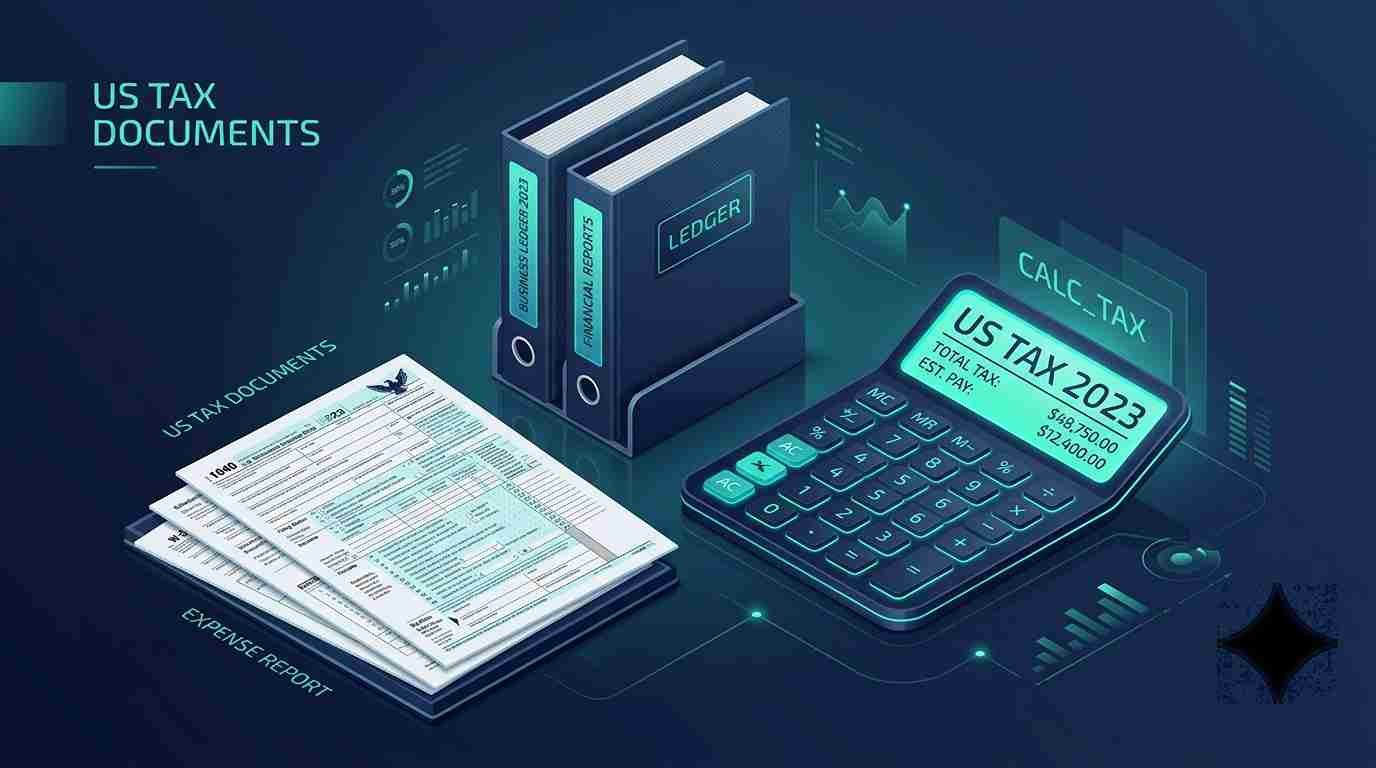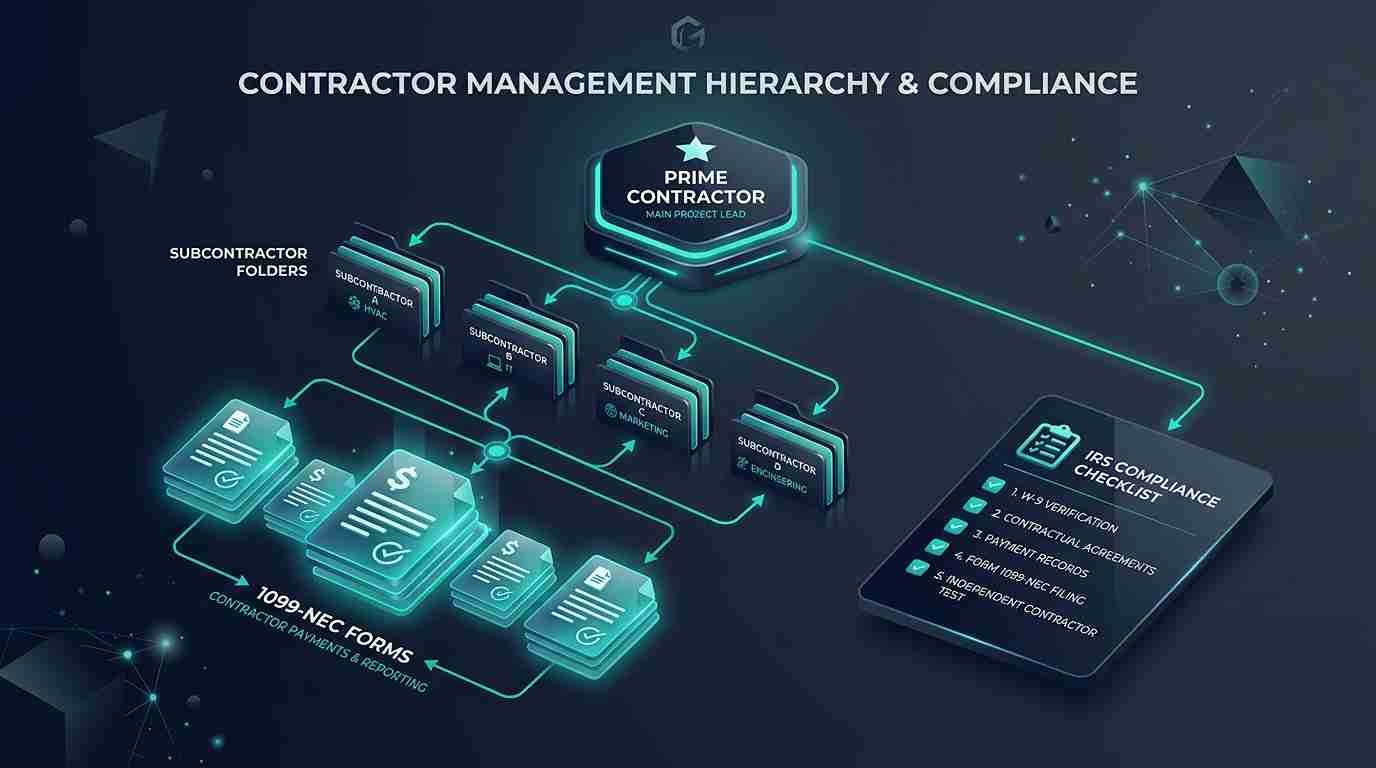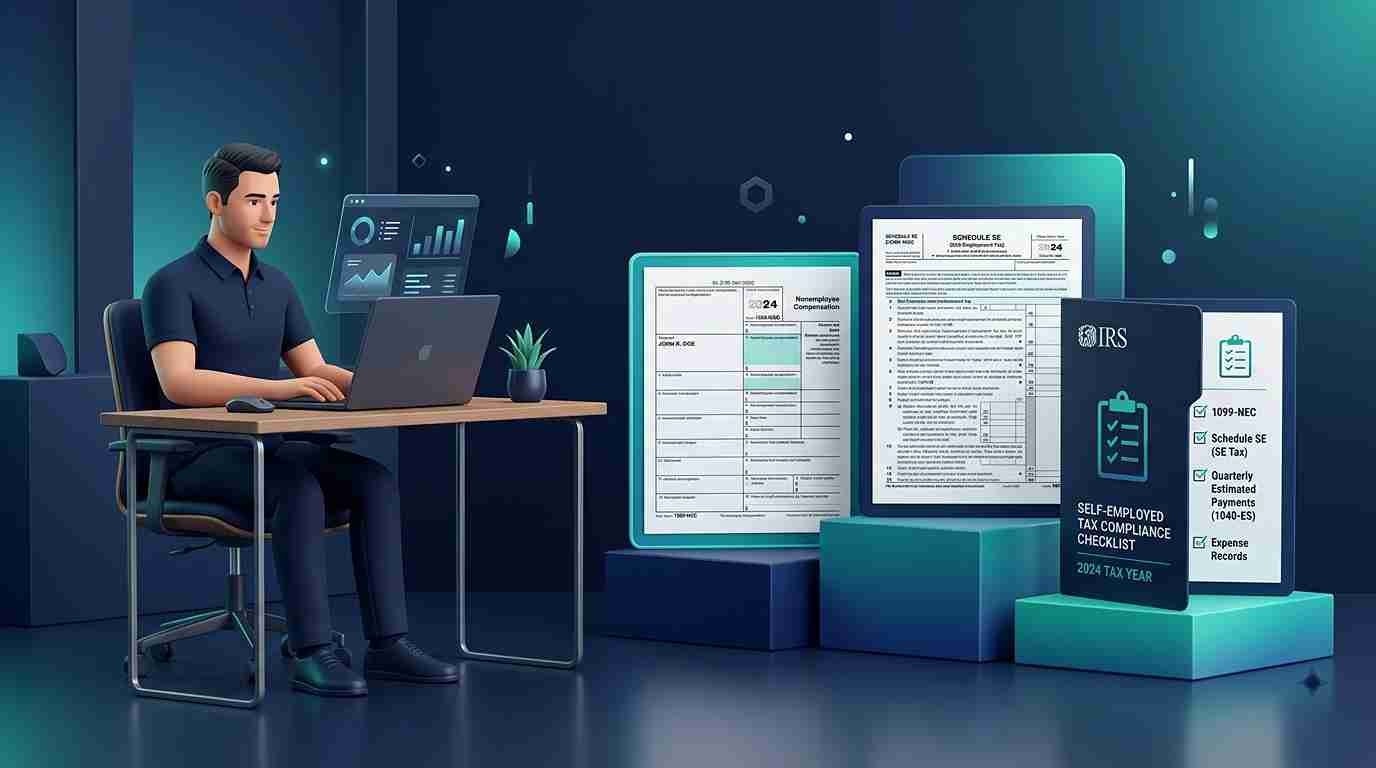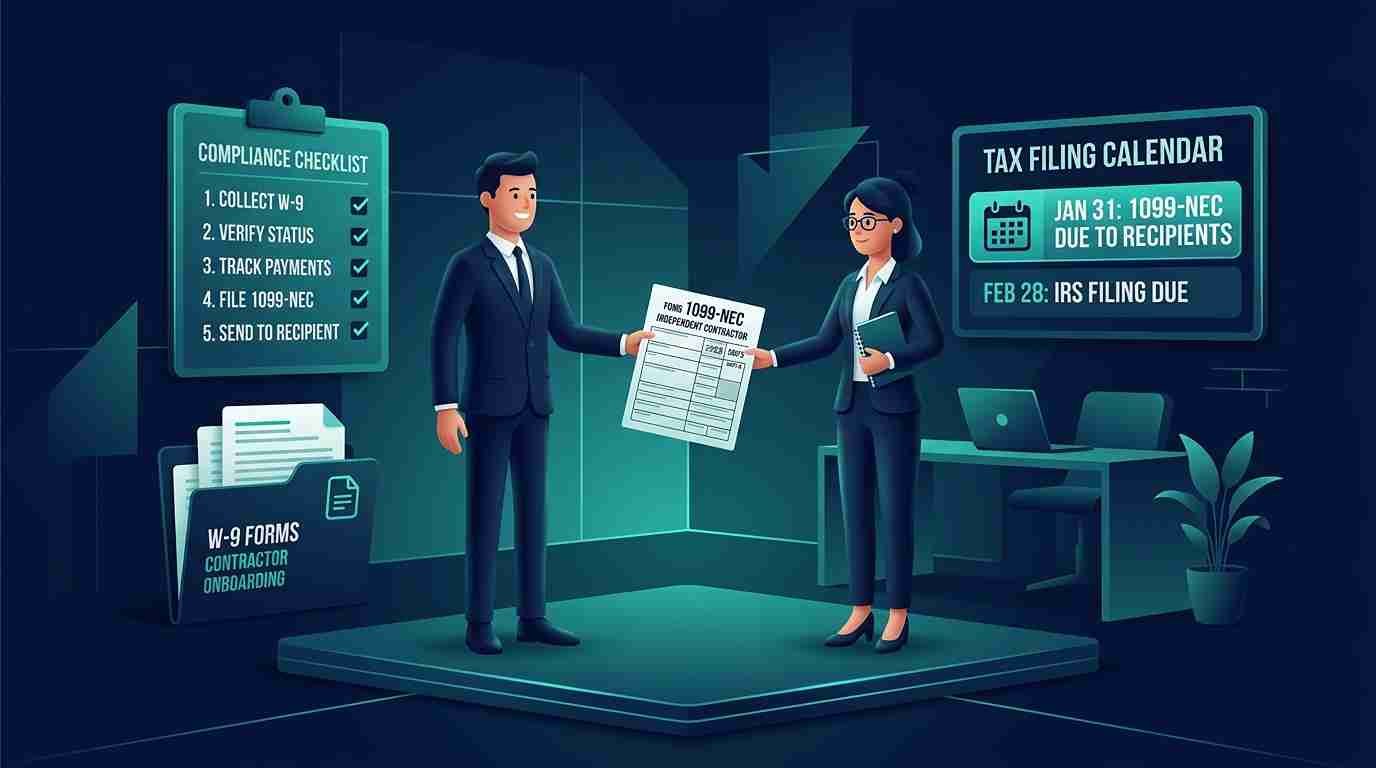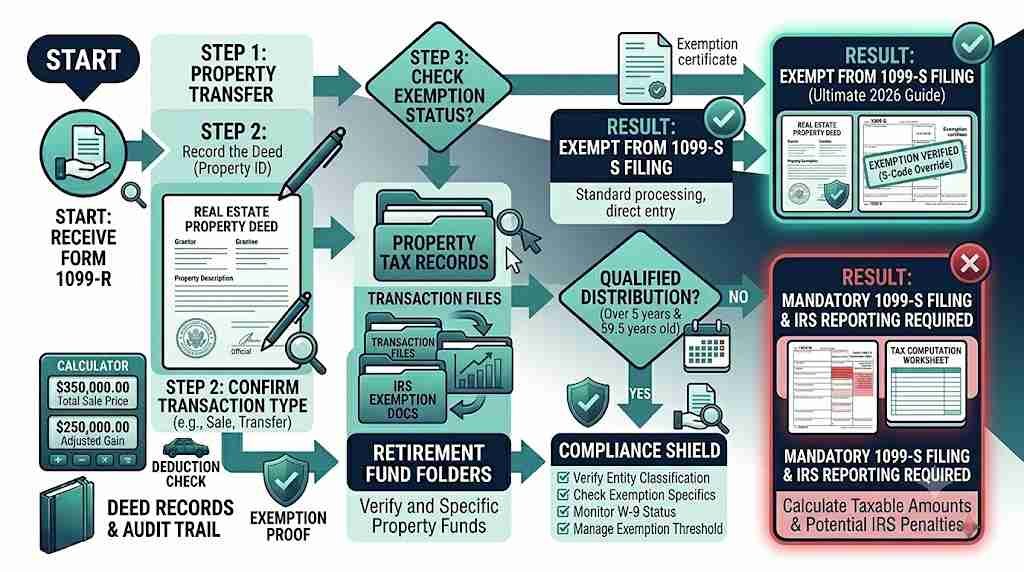
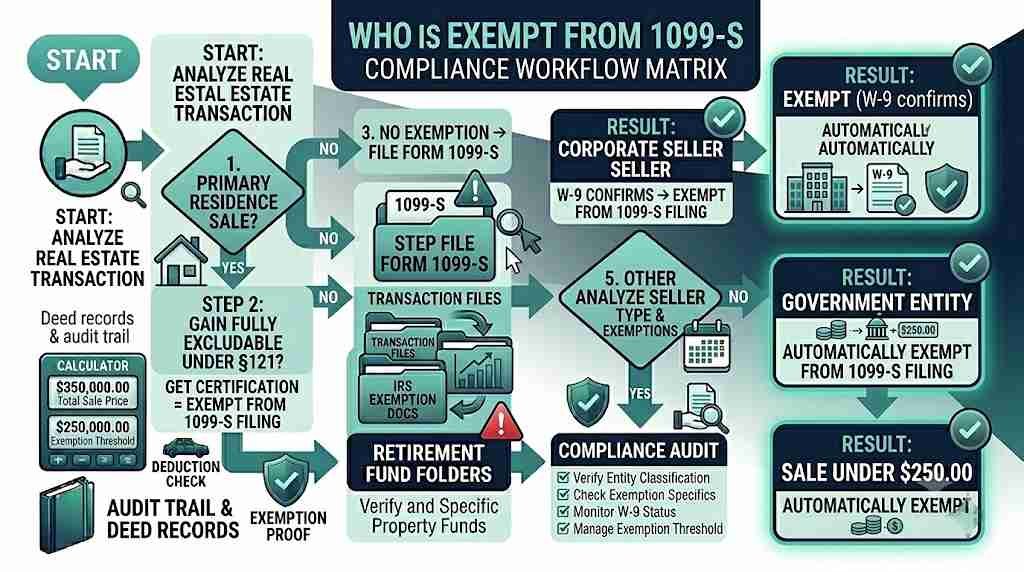
Who is exempt from 1099-S reporting? — Several categories of sellers qualify for complete exemption from Form 1099-S real estate proceeds reporting under IRC § 6045(e). The most common exemption applies when a primary residence seller certifies that their gain is fully excludable under the IRC § 121 exclusion — up to $250,000 for single filers and $500,000 for married couples filing jointly. Additional exemptions cover corporate sellers, government entity transactions, and sales below specific price thresholds — all governed by IRS Treasury Regulation § 1.6045-4 throughout the 2026 tax filing year.
Understanding Who Is Exempt From 1099-S Under 2026 IRS Rules
Who is exempt from 1099-S is the most critical question facing real estate attorneys, title companies, closing agents, and property sellers at every residential and commercial transaction closing in 2026.
Form 1099-S — Proceeds From Real Estate Transactions — is an information return that closing agents and settlement companies are required to file with the IRS whenever a reportable real estate transaction occurs. It captures the seller’s gross proceeds and personal information for IRS income matching purposes.
Understanding exactly who is exempt from 1099-S reporting eliminates unnecessary filing burdens, prevents erroneous IRS correspondence, and ensures that qualifying sellers receive the full benefit of available statutory exclusions without triggering unwarranted audit scrutiny.
Statutory Compliance Requirements for Businesses
The governing statutory authority for who is exempt from 1099-S determinations is IRC § 6045(e) — which mandates real estate proceeds reporting — combined with the detailed exemption framework established in IRS Treasury Regulation § 1.6045-4. These provisions collectively define both the reporting obligation and the specific categories of transactions that qualify for complete exemption from Form 1099-S filing requirements.
The closing agent, title company, or settlement attorney handling the transaction is the designated Responsible Reporting Person (RRP) under Treasury Regulation § 1.6045-4(e). The RRP bears the primary legal obligation to determine whether an exemption applies — and to collect the required seller certification before declining to file a 1099-S for any qualifying exempt transaction.
The exemption certification process is not optional administrative paperwork — it is the legal mechanism that activates the exemption and protects both the seller and the RRP from subsequent IRS inquiry. Without a properly executed certification on file, the closing agent has no documented basis for withholding the 1099-S filing.
For the complete official IRS guidance on 1099-S reporting requirements and exemption categories, refer to the IRS Instructions for Form 1099-S — Proceeds From Real Estate Transactions.
Understanding who is exempt from 1099-S also connects directly to broader real estate tax strategy. Knowing what you can write off as a 1099 contractor when operating a real estate investment business ensures your transaction cost documentation system supports both 1099-S exemption certification and maximum Schedule C or Schedule E deduction substantiation across your entire real estate portfolio.
It is equally important to understand whether a 1099 will affect your overall tax liability when real estate proceeds combine with other income sources — since a received 1099-S can interact with capital gains rates, depreciation recapture, and Net Investment Income Tax obligations in ways that significantly alter your total federal tax liability for the transaction year.
Quick Reference Compliance Matrix
| Exemption Category | Who Is Exempt From 1099-S | IRS Authority | Certification Required |
|---|---|---|---|
| Primary Residence — Full § 121 Exclusion | Exempt — gain fully excluded | IRC § 121 / Treas. Reg. § 1.6045-4 | Yes — written certification |
| Primary Residence — Partial § 121 Exclusion | Not Exempt — 1099-S required | IRC § 121(c) | N/A |
| Corporate Seller (C-Corp) | Exempt — corporate entity | Treas. Reg. § 1.6045-4(b)(2) | Yes — W-9 confirming corp status |
| S-Corp Seller | Exempt — corporate entity | Treas. Reg. § 1.6045-4(b)(2) | Yes — W-9 confirming corp status |
| Government Entity Seller | Exempt — sovereign immunity | Treas. Reg. § 1.6045-4(b)(3) | No certification needed |
| Sale Price Under $250 | Exempt — de minimis threshold | Treas. Reg. § 1.6045-4(b)(4) | No certification needed |
| Foreclosure / Abandonment | Not Exempt — 1099-A required instead | IRC § 6050J | N/A |
| Like-Kind Exchange (§ 1031) | Not Exempt — 1099-S required | IRC § 1031 | N/A |
| Deceased Seller Estate | Not Exempt — estate must report | IRC § 6045(e) | N/A |
The Primary Residence Exemption: The Most Widely Used 1099-S Exclusion
The primary residence exemption is by far the most commonly applied answer to who is exempt from 1099-S — and it operates through the intersection of two distinct but complementary IRC provisions.
IRC § 121 allows qualifying homeowners to exclude up to $250,000 of capital gain from the sale of their primary residence if filing as a single taxpayer — or up to $500,000 if filing as a married couple filing jointly. To qualify, the seller must have owned and used the property as their primary residence for at least 2 of the 5 years immediately preceding the sale date.
Treasury Regulation § 1.6045-4 then translates this gain exclusion into a 1099-S filing exemption — but only when the seller provides a written certification to the closing agent confirming that the full gain qualifies for the § 121 exclusion. The certification must be signed under penalties of perjury and retained by the closing agent for four years from the closing date.
The exemption is all-or-nothing at the transaction level. If the seller’s gain exceeds the applicable § 121 exclusion limit — even by one dollar — the entire transaction becomes reportable and the closing agent must file a complete Form 1099-S reflecting the full gross proceeds amount.
Who Is Exempt From 1099-S as a Corporate Entity Seller
C-Corporations and S-Corporations selling real estate qualify for 1099-S exemption under Treasury Regulation § 1.6045-4(b)(2) — the same corporate exemption framework that applies to standard 1099-NEC reporting for service payments.
The corporate exemption applies because corporations file their own comprehensive Form 1120 or 1120-S tax returns with the IRS — providing an independent and verifiable income reporting trail that makes redundant 1099-S cross-referencing unnecessary for corporate real estate transactions.
The closing agent must collect a Form W-9 from the corporate seller confirming C-Corp or S-Corp tax classification before declining to file the 1099-S. Without a properly completed W-9 on file documenting corporate status, the closing agent has no documented basis for applying the exemption — and the IRS will treat the missing 1099-S as a compliance failure regardless of the seller’s actual corporate status.
LLC sellers require careful classification scrutiny in this context. An LLC taxed as a C-Corp or S-Corp qualifies for the corporate exemption. An LLC taxed as a sole proprietorship or partnership does not — and requires full 1099-S reporting at the standard gross proceeds threshold.
The Government Entity Exemption and Sovereign Transactions
Federal, state, and local government entities selling real estate are automatically exempt from 1099-S reporting under Treasury Regulation § 1.6045-4(b)(3) — no seller certification or W-9 documentation is required to activate this exemption.
The sovereign immunity basis for this exemption reflects the IRS’s recognition that government entity transactions are subject to independent public accountability frameworks that make federal information return reporting redundant and administratively unnecessary.
This exemption covers all levels of government — federal agencies, state departments, county governments, municipal entities, and qualifying tribal governments operating under federal recognition. It does not extend to quasi-governmental entities, public-private partnerships, or government-sponsored enterprises that operate with independent corporate structures.
The De Minimis Price Threshold Exemption
Transactions with a gross sales price of $250 or less are automatically exempt from 1099-S reporting under Treasury Regulation § 1.6045-4(b)(4) — with no certification requirement and no filing obligation for the closing agent.
This de minimis threshold reflects the IRS’s administrative efficiency judgment that the compliance cost of reporting and processing information returns for nominal-value real estate transactions exceeds the tax revenue benefit of tracking them through the information return system.
While genuinely low-value real estate transactions meeting this threshold are relatively rare in the current market environment, the exemption remains technically available and automatically applicable whenever a qualifying transaction occurs within its scope.
Critical Transactions That Do NOT Qualify for 1099-S Exemption
Understanding who is exempt from 1099-S requires equal clarity about which commonly misunderstood transaction types specifically do not qualify for exemption — despite seller assumptions to the contrary.
IRC § 1031 Like-Kind Exchange transactions do not qualify for 1099-S exemption. Even though the seller is deferring capital gains recognition through the exchange mechanism, the gross proceeds are still reportable and the closing agent must file a complete 1099-S reflecting the full relinquished property proceeds.
Partial § 121 exclusion scenarios — where the seller qualifies for a reduced exclusion due to a change in employment, health circumstances, or unforeseen events — do not qualify for the 1099-S exemption. The transaction becomes fully reportable at the complete gross proceeds level even when a partial exclusion reduces the ultimately taxable gain amount.
Estate sales of previously primary residences do not qualify for the living seller’s § 121 exclusion — the deceased owner’s exclusion does not transfer to the estate or heirs. The closing agent must file a complete 1099-S for any estate real estate sale regardless of the property’s prior use as a primary residence.
The Seller Certification Process: How to Properly Claim Your Exemption
The seller certification is the operational mechanism through which qualifying sellers formally claim their who is exempt from 1099-S status and legally activate the filing exemption at the transaction closing.
The certification must be a written document signed under penalties of perjury by the seller — or by each seller in a jointly owned property transaction. It must specifically state that the property was the seller’s principal residence for the required ownership and use periods, that the gain does not exceed the applicable § 121 exclusion limit, and that no portion of the property was used for business or rental purposes that would reduce the available exclusion.
The closing agent must collect and retain the signed certification for a minimum of four years from the closing date. If the IRS subsequently determines that the certification was inaccurate or fraudulent, civil and criminal penalties apply to the seller — not to the closing agent who relied in good faith on the executed certification document.
Frequently Asked Questions (Gutenberg Block Ready)
Who is exempt from 1099-S when selling a home that was partially used as a home office or rental property?
Sellers who used any portion of their primary residence for business or rental purposes face a significantly more complex exemption analysis. The § 121 exclusion is reduced proportionally for any portion of the property allocated to business or rental use — and depreciation previously claimed on the business portion is subject to unrecaptured § 1250 gain taxation at a maximum 25% rate regardless of the § 121 exclusion availability. If the business-use portion generates gain that exceeds the reduced exclusion amount, the transaction is not fully exempt from 1099-S reporting — and the closing agent must file a complete Form 1099-S reflecting the total gross proceeds. Sellers in this situation should consult a qualified CPA before executing any exemption certification at closing.
Who is exempt from 1099-S when multiple sellers are involved in a single property transaction?
When a property has multiple sellers — such as co-owners, divorcing spouses, or inherited property with multiple heirs — each seller’s exemption eligibility is evaluated independently under the applicable § 121 ownership and use tests. Each qualifying seller must execute a separate written certification confirming their individual exemption eligibility. If even one seller among multiple co-owners does not qualify for the full § 121 exclusion applicable to their ownership share, the closing agent must file a 1099-S allocating gross proceeds proportionally among all sellers — including those who individually qualify for exemption — since the transaction cannot be partially exempt at the document level under current IRS reporting protocols.
Who is exempt from 1099-S for transactions involving a trust or living trust as the property seller?
Revocable living trusts — the most common estate planning vehicle for real estate ownership — are treated as disregarded entities for federal income tax purposes. The individual grantor who created and controls the trust is treated as the direct property owner for all tax purposes including § 121 exclusion eligibility and 1099-S exemption certification.
If the grantor satisfies the ownership and use requirements through their personal occupancy of the property — even while legal title is held in the trust name — they qualify for the § 121 exclusion and can execute the 1099-S exemption certification on behalf of the trust. Irrevocable trusts, by contrast, are separate taxable entities that cannot claim the § 121 personal residence exclusion — making 1099-S reporting mandatory for any real estate sale conducted through an irrevocable trust structure.