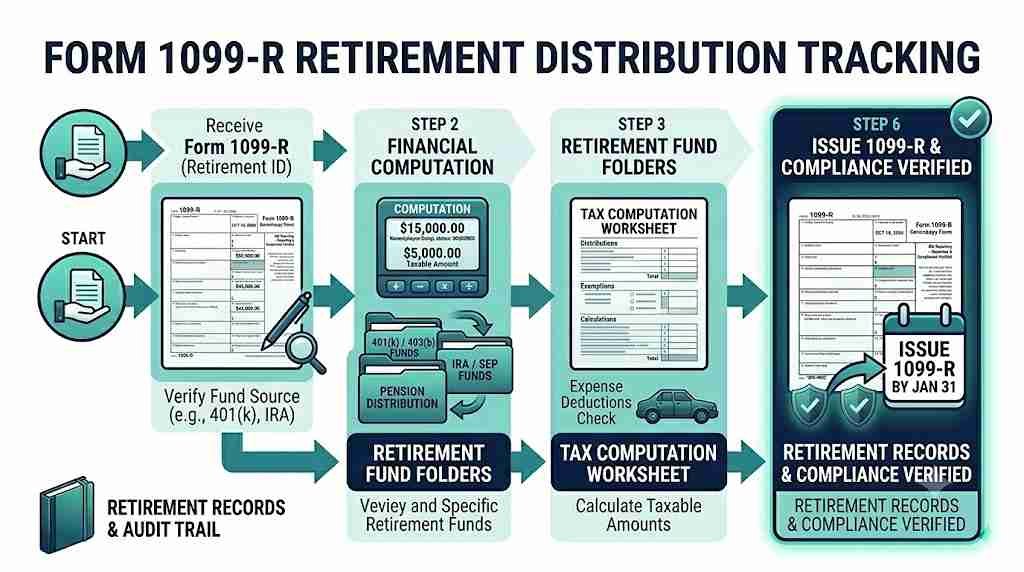
How do I calculate taxable amount on 1099-R depends on which retirement account generated the distribution. For traditional IRA, 401(k), and pension distributions, the taxable amount equals the total gross distribution in Box 1 minus any after-tax contributions (your cost basis). For Roth IRA and Roth 401(k) distributions, qualified withdrawals are 100% tax-free under IRC § 408A. When Box 2a on your Form 1099-R is blank, you must calculate your taxable amount manually using the IRS Simplified Method or the General Rule — both governed by IRS Publication 575 for the 2026 tax filing year.
Understanding How Do I Calculate Taxable Amount on 1099-R in 2026
How do I calculate taxable amount on 1099-R is the most critical question facing retirees, pension recipients, and retirement account holders when preparing their annual federal tax return.
Form 1099-R is issued by pension administrators, IRA custodians, annuity providers, and retirement plan trustees to report all distributions made from qualifying retirement accounts during the calendar year.
The taxable amount calculation is not always straightforward — it depends on your account type, contribution history, cost basis, and distribution code — making a precise understanding of the 1099-R box-by-box breakdown absolutely essential for accurate 2026 tax filing.
Statutory Compliance Requirements for Businesses
The governing statutory framework for how do i calculate taxable amount on 1099-r spans multiple IRC provisions. IRC § 72 governs the taxation of annuities and pension distributions. IRC § 408 governs traditional IRA distributions. IRC § 408A governs Roth IRA qualified distributions. IRC § 402 governs employer-sponsored retirement plan distributions including 401(k) and 403(b) accounts.
Each provision establishes a distinct taxability framework — meaning the identical gross distribution amount can produce dramatically different taxable amounts depending solely on which account type generated the distribution and whether after-tax contributions were previously made.
The IRS requires payers to complete Box 2a of Form 1099-R with the taxable amount when it can be determined. When Box 2a is left blank or shows zero with Box 2b checked as “Taxable amount not determined” — the full burden of calculating the correct taxable amount shifts entirely to the recipient taxpayer.
For the complete official IRS guidance on retirement distribution taxation and 1099-R calculation methods, refer to the IRS Publication 575 — Pension and Annuity Income.
Understanding how do i calculate taxable amount on 1099-r correctly also connects directly to your broader retirement income tax strategy. Knowing how much to set aside for taxes as a 1099 contractor ensures your quarterly estimated tax payments adequately cover retirement distribution tax liability alongside any self-employment income received during the same calendar year.
It is equally important to understand whether a 1099 will affect your overall tax liability when retirement distributions combine with other income sources — since the interaction between 1099-R income and W-2 wages, Social Security benefits, and self-employment income can significantly alter your effective tax rate and standard deduction optimization strategy.
Quick Reference Compliance Matrix
| Distribution Source | Taxable Amount Calculation Method | IRS Authority | Key Form |
|---|---|---|---|
| Traditional IRA — No Basis | 100% of Box 1 gross distribution | IRC § 408(d) | Form 8606 |
| Traditional IRA — With Basis | Box 1 minus pro-rata basis allocation | IRC § 408(d)(1) | Form 8606 |
| Roth IRA — Qualified Distribution | $0 taxable — 100% tax-free | IRC § 408A(d)(1) | Form 8606 |
| Roth IRA — Non-Qualified Distribution | Earnings portion only taxable | IRC § 408A(d)(2) | Form 8606 |
| 401(k) — Pre-Tax Contributions Only | 100% of Box 1 gross distribution | IRC § 402(a) | Form 1040 |
| 401(k) — After-Tax Contributions | Box 1 minus after-tax basis | IRC § 72(e) | Form 8606 |
| Pension / Defined Benefit Plan | Simplified Method calculation | IRC § 72(d) | IRS Pub. 575 |
| Annuity Distribution | General Rule or Simplified Method | IRC § 72 | IRS Pub. 575 |
| Early Distribution (Under 59½) | Taxable amount + 10% penalty | IRC § 72(t) | Form 5329 |
| Disability Distribution | Taxable amount — penalty waived | IRC § 72(m)(7) | Form 5329 |
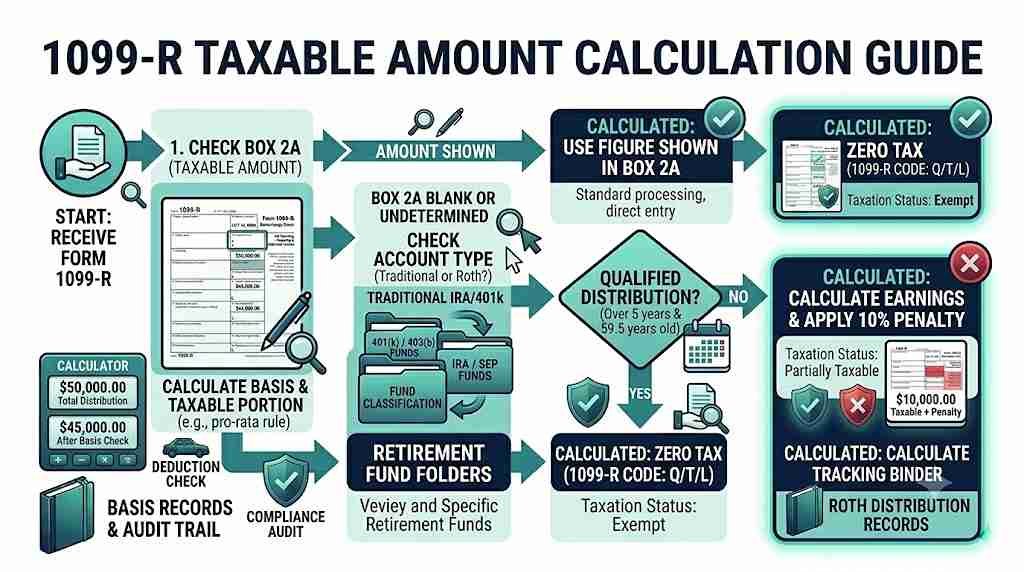
Step-by-Step: Reading Your Form 1099-R Box by Box
Before answering how do I calculate taxable amount on 1099-R for your specific situation, you must understand exactly what each critical box on the form is telling you.
Box 1 — Gross Distribution shows the total amount distributed from your retirement account during the year — before any taxes, penalties, or basis adjustments. This is your starting point for every taxable amount calculation.
Box 2a — Taxable Amount is the most important box on the entire form. When your plan administrator completes this box, it represents their calculation of the taxable portion. When it is blank or shows zero with Box 2b checked, you must calculate this amount yourself using IRS-approved methods.
Box 2b — Taxable Amount Not Determined is checked when the plan administrator lacks sufficient information about your cost basis to calculate the taxable amount — most commonly occurring with IRA distributions where after-tax contributions have been made across multiple custodians over many years.
Box 7 — Distribution Code is the single most critical classification field on the form. It tells the IRS — and you — exactly what type of distribution occurred and whether additional penalties apply. Code 1 signals an early distribution subject to the 10% penalty. Code 2 signals an early distribution exempt from penalty. Code 7 signals a normal distribution from a taxpayer over age 59½.
The Simplified Method: Calculating Taxable Pension and Annuity Income
The IRS Simplified Method is the mandatory calculation approach for most pension and annuity distributions from qualified employer plans when Box 2a is blank on your 1099-R.
The Simplified Method calculates a monthly tax-free recovery amount by dividing your total after-tax investment in the plan (your cost basis) by the number of anticipated monthly payments — determined by an IRS actuarial table based on your age at the annuity start date.
Step 1 — Identify your total cost in the plan — the total after-tax dollars you contributed that were not previously deducted. This figure is typically available from your plan administrator’s records or your prior year Form 1040 worksheets.
Step 2 — Determine your expected number of payments from the IRS Simplified Method table. For a single life annuity, ages 55-60 use 310 payments. Ages 61-65 use 260 payments. Ages 66-70 use 210 payments. Ages 71 and above use 160 payments.
Step 3 — Divide your total cost basis by the expected number of payments to calculate your monthly tax-free amount. Multiply this by 12 to determine your annual tax-free recovery. Subtract this annual tax-free amount from your Box 1 gross distribution to arrive at your final taxable amount.
Step 4 — Once your cumulative tax-free recovery equals your total cost basis, all subsequent payments become 100% taxable — even if the same monthly payment amount continues unchanged.
The General Rule: When the Simplified Method Does Not Apply
The General Rule is an actuarial calculation method used for annuity distributions from non-qualified plans — contracts that do not qualify as employer-sponsored retirement plans under IRC § 72.
Under the General Rule, the exclusion ratio is calculated by dividing your investment in the contract (cost basis) by the expected return — determined using IRS actuarial tables published in IRS Publication 939. This exclusion ratio is then applied to each payment received to determine the tax-free portion.
The General Rule is significantly more complex than the Simplified Method and typically requires assistance from a qualified tax professional or CPA to execute accurately — particularly for joint and survivor annuities, period-certain contracts, and variable annuity products with fluctuating payment amounts.
Calculating Taxable Amount for Traditional IRA Distributions With Basis
When a traditional IRA contains after-tax contributions — documented through previously filed Form 8606 returns — the taxable amount calculation requires a pro-rata allocation across all traditional IRA accounts held simultaneously.
The IRS pro-rata rule prevents taxpayers from selectively withdrawing only their after-tax basis tax-free while leaving pre-tax funds invested. Instead, every distribution is treated as a proportional blend of pre-tax and after-tax funds based on the ratio of your total basis to your total IRA value across all accounts.
The calculation formula is: Taxable Amount = Gross Distribution × (1 − [Total Basis ÷ Total IRA Value at Year-End + Gross Distribution])
This calculation is performed annually on Form 8606 — Nondeductible IRAs and must be filed with your Form 1040 for every year in which a traditional IRA distribution is received and after-tax basis exists in any traditional IRA account.
Early Distribution Penalty: The Additional 10% Tax Calculation
When Box 7 of your 1099-R shows Distribution Code 1, an additional 10% early distribution penalty applies to the taxable portion of your distribution under IRC § 72(t) — on top of your regular income tax liability.
The penalty is calculated as 10% of the taxable amount — not the gross distribution. If your taxable amount is $20,000, the additional penalty tax is $2,000, reported on Form 5329 and added directly to your total tax liability on Form 1040.
IRC § 72(t)(2) provides a specific list of penalty exceptions that eliminate the 10% surcharge even when distributions occur before age 59½. Key exceptions include total and permanent disability, substantially equal periodic payments (SEPP/72(t) plans), qualified first-time homebuyer expenses up to $10,000, qualified higher education expenses, and health insurance premiums paid during unemployment.
Frequently Asked Questions (Gutenberg Block Ready)
How do I calculate taxable amount on 1099-R when Box 2a is left completely blank by my plan administrator?
When Box 2a is blank and Box 2b is checked as “Taxable amount not determined,” the IRS requires you to calculate the taxable amount independently using the appropriate method for your account type. For pension and qualified plan annuities, use the IRS Simplified Method worksheet included in the Form 1040 Instructions. For traditional IRAs with after-tax contributions, complete Form 8606 using the pro-rata calculation formula. For non-qualified annuities, apply the General Rule using actuarial tables from IRS Publication 939. Never report the full gross distribution from Box 1 as taxable without first determining whether a cost basis exists — doing so consistently results in significant overpayment of federal income tax that requires amended return filings to recover.
How do I calculate taxable amount on 1099-R for a Roth IRA distribution that occurred before age 59½?
For a non-qualified Roth IRA distribution — one that occurs before age 59½ or before the five-year holding period is satisfied — the taxable amount calculation follows a specific ordering rule under IRC § 408A(d)(4). Roth IRA withdrawals are treated as coming first from regular contributions (always tax-free and penalty-free), then from conversion amounts (tax-free but potentially subject to the 10% penalty if within five years of conversion), and finally from earnings (both taxable and subject to the 10% early distribution penalty). Your Form 8606 tracks the cumulative contribution and conversion history needed to apply this ordering rule accurately across multiple years of Roth IRA activity.
How do I calculate taxable amount on 1099-R if I received multiple 1099-R forms from different retirement accounts in the same tax year?
Each Form 1099-R received from a different plan administrator represents a separate distribution that must be calculated and reported independently — but all taxable amounts are ultimately combined and reported on the same Form 1040 tax return. Traditional IRA distributions from multiple custodians are subject to the aggregate pro-rata rule — meaning your total basis across all traditional IRAs is divided by the combined year-end value of all traditional IRAs plus all distributions taken during the year. This aggregation prevents the selective withdrawal strategy of emptying only high-basis accounts while keeping low-basis accounts invested. Complete a single Form 8606 that captures all traditional IRA activity across every custodian simultaneously — not a separate Form 8606 for each individual 1099-R received.