How many hours can a 1099 employee work? — There is no federal hour limit for 1099 independent contractors under current IRS or Department of Labor rules. Unlike W-2 employees protected by the Fair Labor Standards Act (FLSA), contractors control their own schedules entirely. However, when a business begins dictating work hours, schedules, or minimum availability, this constitutes behavioral control — a primary trigger for IRS worker misclassification audits and DOL reclassification enforcement in 2026.
Understanding How Many Hours Can a 1099 Employee Work in 2026
How many hours can a 1099 employee work is one of the most critical yet misunderstood questions in contractor workforce management today.
The term “1099 employee” is itself a legal contradiction — under U.S. tax law, a worker is either a 1099 independent contractor or a W-2 employee, never both simultaneously.
This distinction matters enormously in 2026 because the IRS and Department of Labor are aggressively targeting businesses that treat 1099 contractors like employees — including those who control contractor hours — through coordinated misclassification enforcement campaigns.
Statutory Compliance Requirements for Businesses
The Fair Labor Standards Act (FLSA) governs hour restrictions, overtime mandates, and minimum wage protections exclusively for W-2 employees. Independent contractors operating under 1099 arrangements fall completely outside the FLSA’s jurisdiction.
This means there is no statutory maximum on how many hours a 1099 contractor can work per day, per week, or per year under federal law. The contractor sets their own hours as a core feature of their independent status.
However, the critical compliance danger emerges when businesses attempt to control contractor hours. The moment a company mandates specific start times, enforces minimum weekly hours, or requires schedule approval, it begins demonstrating behavioral control — the single most weighted factor in the IRS Common Law Control Test.
For the complete official IRS guidance on worker classification and behavioral control standards, refer to the IRS Independent Contractor vs. Employee Classification Center.
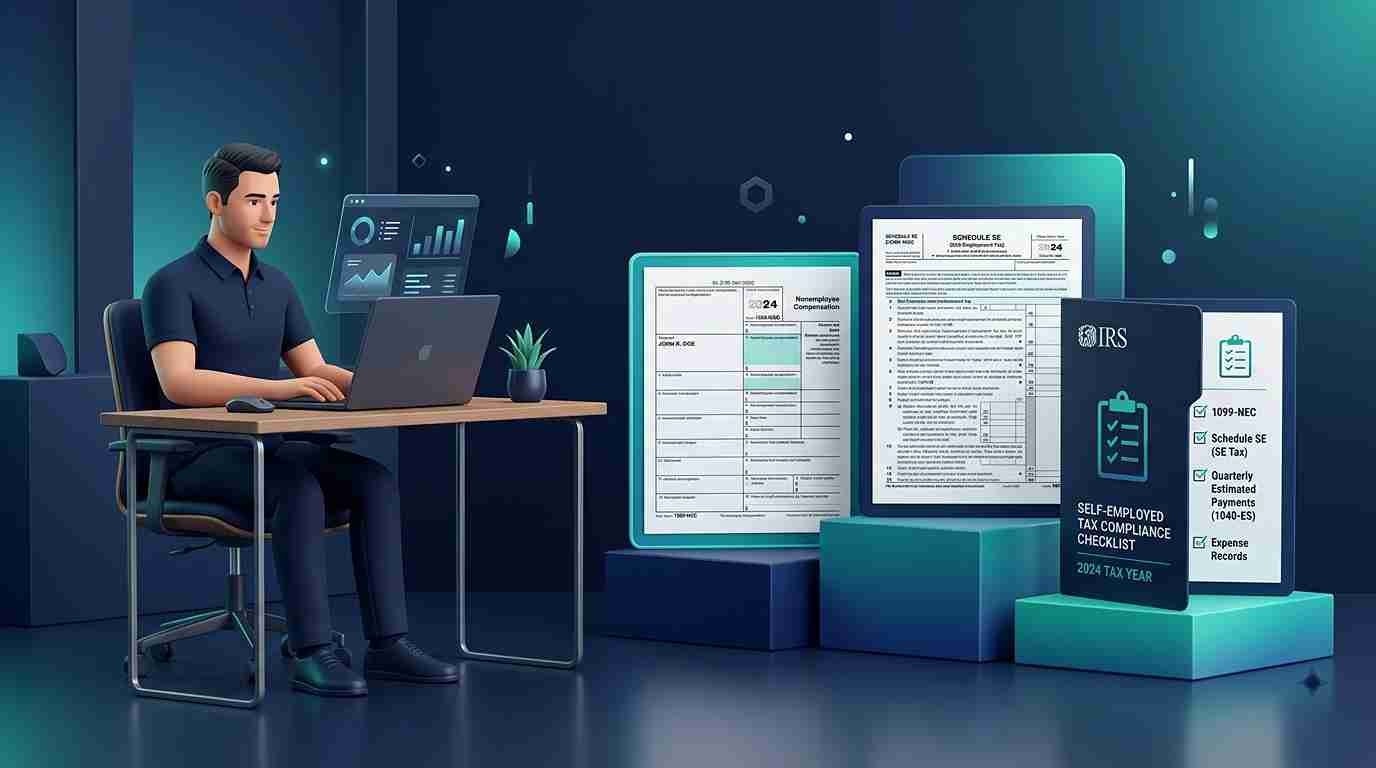
Understanding what paperwork you need for a 1099 employee is essential before engaging any contractor, since your written agreement must explicitly preserve the contractor’s autonomy over their own working hours and schedule.
It is equally important to understand whether 1099 employees are considered self-employed under IRS definitions, since self-employed status is directly tied to the worker’s freedom to control when, where, and how long they work on any given engagement.
Quick Reference Compliance Matrix
| Hour Control Scenario | Classification Risk Level | IRS Behavioral Control Signal | 2026 Enforcement Status |
|---|---|---|---|
| Contractor sets own hours freely | No Risk | Supports contractor status | Compliant |
| Business suggests preferred hours | Low Risk | Minimal control signal | Generally compliant |
| Business requires set daily start time | High Risk | Strong employee indicator | Audit trigger |
| Business mandates minimum weekly hours | Critical Risk | Dominant control signal | Reclassification likely |
| Business requires timesheet approval | Critical Risk | Direct behavioral control | DOL enforcement target |
| Contractor works 60+ hrs/week voluntarily | No Risk | No control signal present | Fully compliant |
| Business caps contractor hours per week | High Risk | Suggests employment relationship | Audit trigger |
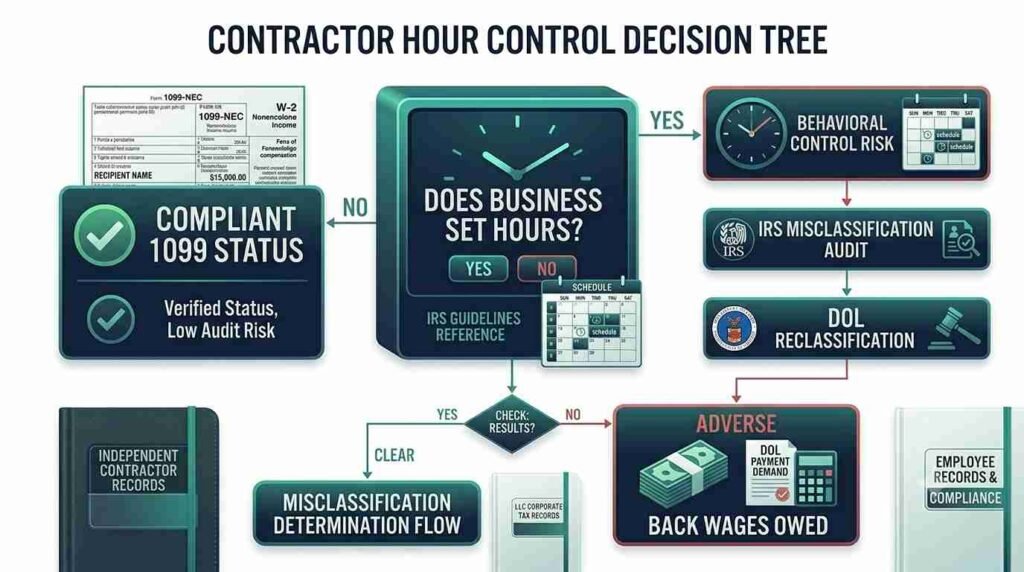
How Many Hours Can a 1099 Employee Work Compliance Workflow Matrix
The IRS Three-Factor Control Test and Hour Management
The IRS Common Law Control Test evaluates worker classification across three distinct dimensions — and working hours sit squarely inside the most heavily weighted factor.
Behavioral Control examines whether the business controls how the worker performs their tasks. Dictating hours is one of the clearest and most direct expressions of behavioral control recognized by IRS examiners in audit proceedings.
Financial Control examines whether the worker has a genuine opportunity for profit or loss, invests in their own tools, and serves multiple clients. A contractor working exclusively long hours for one client at a fixed hourly rate begins to resemble an employee financially.
Type of Relationship examines whether the engagement is indefinite, includes employee-type benefits, or contains language inconsistent with true independence. Open-ended contracts with mandatory availability windows are a significant red flag in this category.
All three factors are evaluated together — no single factor is automatically decisive. However, hour control combined with exclusivity creates a particularly strong reclassification case for DOL investigators.
What Happens When Hour Control Triggers Misclassification
When the IRS or Department of Labor determines a 1099 contractor was actually a misclassified employee, the financial consequences for the hiring business are severe and retroactive.
The business becomes liable for unpaid employer-side FICA taxes — covering Social Security at 6.2% and Medicare at 1.45% — going back up to three years for non-willful violations and six years for willful misclassification.
The DOL Wage and Hour Division can simultaneously order back payment of all overtime wages the worker would have earned as a W-2 employee — calculated at 1.5x their effective hourly rate for every hour worked beyond 40 in any given week.
Additional penalties include interest on unpaid taxes, civil monetary penalties, and in egregious cases, criminal referral to the Department of Justice for willful violations.
How Many Hours Can a 1099 Employee Work Across Multiple Clients
One of the strongest indicators of genuine contractor status is the worker’s ability to serve multiple clients simultaneously. There is absolutely no legal limit on total hours worked across multiple engagements.
A 1099 contractor can legally work 80, 90, or even 100 hours per week across different client engagements without triggering any federal hour violation — because no single entity is controlling that total output.
The compliance risk only emerges when one business accounts for the vast majority of the contractor’s total working hours over an extended period, creating a de facto employment relationship that courts and the IRS may scrutinize under the Economic Realities Test.
State-Level Hour Rules That May Affect 1099 Contractors
While federal law imposes no hour limits on contractors, several states have enacted worker protection statutes that extend beyond federal minimums.
California remains the most aggressive jurisdiction. Under AB5 and the ABC Test, many workers previously classified as 1099 contractors were reclassified as employees — instantly making California’s 8-hour daily overtime rule applicable to their work arrangements.
New York applies the economic dependence test more broadly than federal standards, meaning contractors who derive the majority of their income from a single source may qualify for state-level hour protections even without formal reclassification.
Always audit your contractor arrangements against your specific state’s labor code before establishing any hour-related expectations in contractor agreements or project scopes.
Frequently Asked Questions
How many hours can a 1099 employee work per week before triggering misclassification risk?
There is no specific hour threshold that automatically triggers misclassification under federal law. The risk is not determined by the total number of hours worked — it is determined by who controls those hours. A contractor voluntarily working 70 hours per week across their own schedule presents zero misclassification risk. A contractor required by the hiring business to work a minimum of 30 hours per week on a fixed schedule presents critical reclassification exposure regardless of the total hour count involved.
Can a business legally require a 1099 contractor to be available during specific business hours?
Requiring mandatory availability windows from a 1099 contractor is one of the most direct forms of behavioral control recognized by IRS auditors. While a business can express a preference for when deliverables are completed or when communication is expected, mandating that a contractor be available and working during specific hours — particularly combined with other control indicators — significantly strengthens an IRS or DOL misclassification case. Any availability expectations should be framed around project deadlines and deliverable outcomes, never around specific clock-in and clock-out requirements.
Does working full-time hours for one client automatically make a 1099 contractor an employee?
Not automatically — but it creates substantial risk that demands careful management. The IRS Economic Realities Test considers whether the worker is economically dependent on a single business as one of several classification factors. A contractor working full-time equivalent hours exclusively for one client over an extended period — particularly if the client also controls their methods, tools, and schedule — presents a high-risk classification profile. The strongest legal protection in this scenario is a well-drafted independent contractor agreement that explicitly preserves the worker’s autonomy, combined with documented evidence that the contractor genuinely operates as an independent business entity.