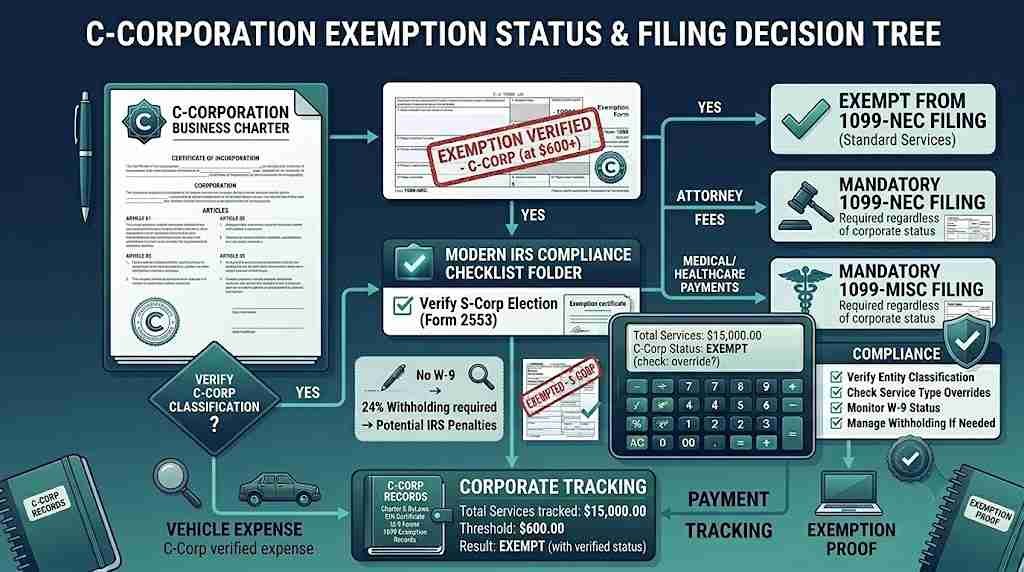
Does a C Corp get a 1099? — Generally, no. The IRS exempts C-Corporations from standard 1099-NEC reporting under IRS Publication 1281, meaning businesses paying a C-Corp $600 or more for routine services are typically not required to issue a 1099. However, three critical statutory exceptions permanently override this exemption — attorney and legal fee payments, medical and healthcare payments, and fishing boat proceeds — all requiring mandatory 1099 issuance regardless of C-Corp status under IRC § 6045(f) and § 6041(a) throughout the 2026 tax filing year.
Understanding Does a C Corp Get a 1099 Under 2026 IRS Rules
Does a C Corp get a 1099 is a deceptively simple question that carries significant financial consequences when answered incorrectly by business accountants and accounts payable departments.
The general exemption is clear — C-Corporations occupy a privileged reporting position in the IRS information return system that most other business entity types do not enjoy.
But the exceptions to this exemption are equally clear — and missing them creates direct IRS penalty exposure starting at $60 per form and escalating to $330 per form for non-filing in the 2026 compliance year.
Statutory Compliance Requirements for Businesses
The core statutory authority establishing the C-Corp 1099 exemption is IRS Publication 1281 combined with the information return regulations under IRC § 6041. These provisions instruct all business payers to exempt C-Corporations from standard 1099-NEC and 1099-MISC reporting for routine service payments — a policy rooted in the fact that C-Corps file their own Form 1120 corporate tax return providing an independent income verification trail.
Unlike partnerships and sole proprietorships that rely heavily on 1099 cross-referencing for IRS income matching, C-Corporations operate under a comprehensive corporate return filing regime that makes redundant information return reporting unnecessary for standard payment categories.
The single non-negotiable compliance step before any payment is collecting a properly completed Form W-9 from every C-Corp vendor. Box 3 must explicitly show “C Corporation” — and that documentation is your only legally defensible basis for withholding a 1099 filing for that payee in any subsequent IRS examination.
For the complete official IRS guidance on C-Corp exemptions and mandatory exception categories, refer to the IRS Instructions for Forms 1099-MISC and 1099-NEC.
Understanding whether does a C Corp get a 1099 exemption applies identically across all corporate variants is critical for multi-entity businesses. Reviewing whether S-Corps get 1099 forms under parallel IRS exemption rules confirms that both major corporation types share the same foundational exemption framework — while also sharing the same three mandatory exception categories that override corporate status entirely.
It is equally important for C-Corp business owners to understand whether incorporated companies get 1099 forms across all incorporation variants, since the exemption architecture applies consistently across the full spectrum of formally incorporated business entities operating under state and federal law.
Quick Reference Compliance Matrix
| Payment Scenario | Does C Corp Get 1099 | Applicable Form | IRS Authority |
|---|---|---|---|
| Standard Service Payments $600+ | Exempt — no 1099 required | N/A | IRS Pub. 1281 |
| Attorney / Legal Fee Payments $600+ | Required — no exemption | 1099-NEC | IRC § 6045(f) |
| Medical / Healthcare Payments $600+ | Required — no exemption | 1099-MISC | IRC § 6041(a) |
| Fishing Boat Proceeds | Required — no exemption | 1099-MISC Box 5 | IRC § 6041 |
| Rent Payments $600+ | Exempt for C-Corp landlords | N/A | IRS Pub. 1281 |
| Gross Proceeds to Attorneys | Required regardless of corp status | 1099-NEC | IRC § 6045(f) |
| Substitute Dividend Payments | Required in specific cases | 1099-MISC Box 8 | IRC § 6042 |
| C-Corp refusing to provide W-9 | Backup Withhold 24% | Form 945 | IRC § 3406 |
| LLC elected C-Corp status | Exempt — same as C-Corp | N/A | IRS Pub. 1281 |
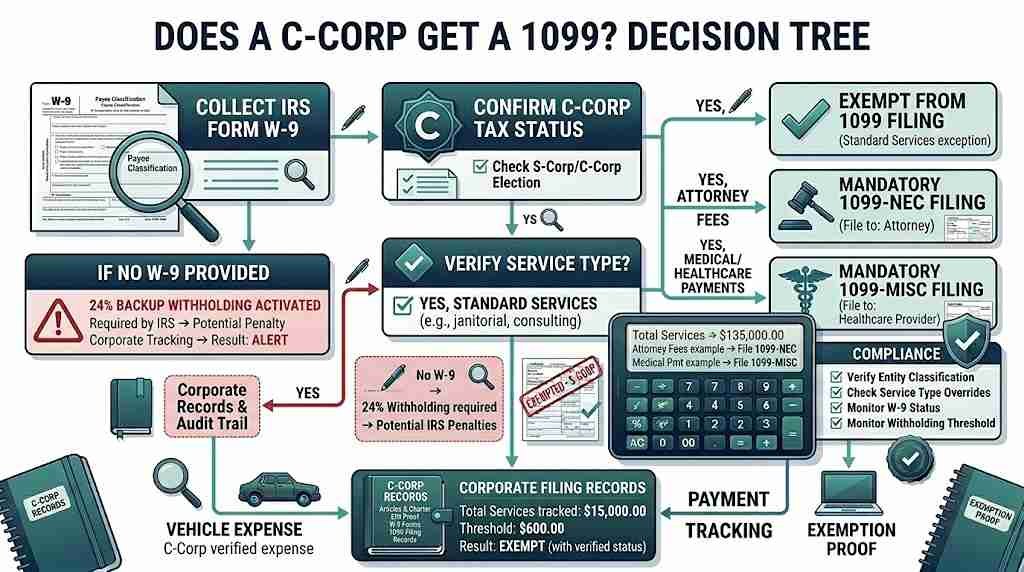
Does a C Corp Get a 1099 Compliance Workflow Matrix
The Three Statutory Exceptions That Override the C-Corp 1099 Exemption
The general answer to does a C Corp get a 1099 for routine service payments is no — but three ironclad statutory exceptions permanently override this exemption and demand precise compliance execution.
Exception 1 — Attorney and Legal Fee Payments: Under IRC § 6045(f), any payment of $600 or more made to a C-Corp law firm or attorney for legal services requires a mandatory 1099-NEC. Congress enacted this exception specifically to ensure attorney compensation is independently tracked at the payment source level — bypassing corporate exemption status entirely for all legal service payment categories without exception.
Exception 2 — Medical and Healthcare Payments: Under IRC § 6041(a), payments of $600 or more made to C-Corp medical practices, hospital systems, physician groups, or healthcare providers in the course of a trade or business require a mandatory 1099-MISC. This exception applies unconditionally — even when the healthcare provider operates as a fully incorporated C-Corporation with a comprehensive Form 1120 filing history on record with the IRS.
Exception 3 — Fishing Boat Proceeds: Under IRC § 6041, payments representing a proportional share of fishing boat proceeds paid to a C-Corp operator require mandatory 1099-MISC Box 5 reporting. While this exception targets a narrow and highly specific industry segment, it represents a complete and permanent override of the standard C-Corp exemption for every affected business transaction.
How the C-Corp Exemption Differs From the S-Corp Exemption in Practice
Both C-Corps and S-Corps share the same foundational 1099 exemption under IRS Publication 1281 — but their underlying tax structures create important practical differences that business payers must understand.
A C-Corporation pays federal income tax at the entity level on its own Form 1120 return at the flat 21% corporate tax rate established by the Tax Cuts and Jobs Act. Income is taxed twice — once at the corporate level and again when distributed to shareholders as dividends — making the corporate return filing regime particularly comprehensive and independently verifiable by the IRS.
An S-Corporation pays no entity-level federal income tax — income passes through directly to shareholders via Schedule K-1 and is reported on individual Form 1040 returns. Despite this structural difference, both entity types receive identical 1099 exemption treatment for standard service payments under current IRS rules.
The practical implication is that does a C Corp get a 1099 and does an S-Corp get a 1099 produce the same general answer — exempt for standard services, mandatory for legal, medical, and fishing boat payment categories.
Does a C Corp Get a 1099 When Structured as an LLC
The LLC-C-Corp hybrid creates one of the most frequently misclassified vendor scenarios in the entire 1099 compliance ecosystem — and the resolution depends entirely on proper W-9 documentation.
An LLC that has filed Form 8832 to elect C-Corporation tax treatment is taxed identically to a standalone C-Corporation for all federal income tax purposes. This means the standard C-Corp 1099 exemption applies in full to the LLC — the underlying LLC organizational structure does not reduce or eliminate the corporate exemption once the C-Corp election is properly confirmed on the vendor’s W-9.
The critical documentation requirement is that the LLC must check “C Corporation” explicitly in Box 3 of the W-9 — not merely write “LLC” with a C designation in the adjacent classification field. Ambiguous or incomplete W-9 documentation for LLC-C-Corps is one of the most consistent triggers for unnecessary 1099 issuance, TIN-matching complications, and unnecessary IRS correspondence for both the payer and the vendor entity.
Does a C Corp Need to Issue 1099 Forms to Its Own Vendors
This is the most overlooked compliance dimension of the entire does a C Corp get a 1099 question — and it catches many C-Corp finance teams completely unprepared during tax season.
A C-Corporation’s own exemption from receiving 1099 forms has absolutely zero bearing on its independent obligation to issue 1099 forms to its own vendors and service providers. These are two entirely separate compliance obligations operating on parallel tracks within the IRS information return system.
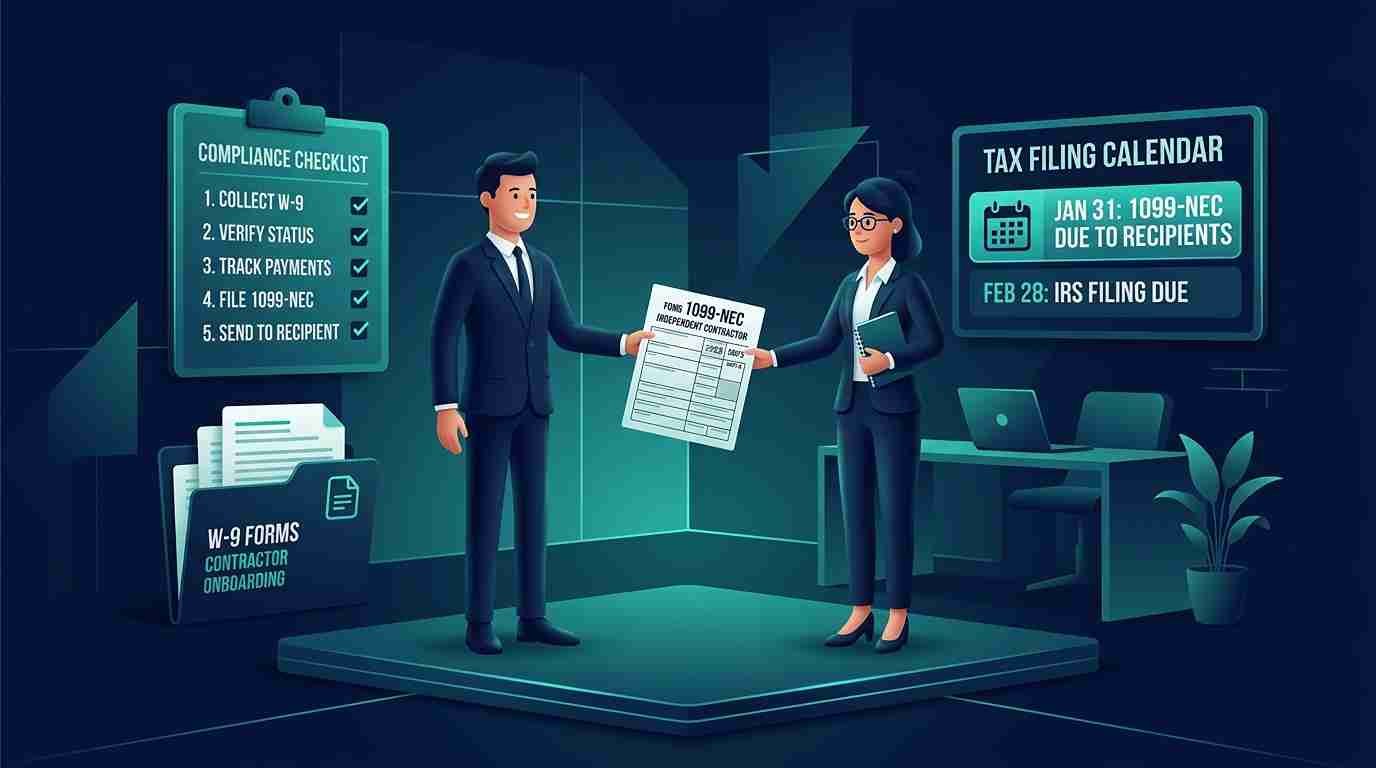
Any C-Corp that pays an unincorporated vendor, independent contractor, sole proprietor, or partnership $600 or more for services during the tax year must issue a 1099-NEC by January 31 of the following year — regardless of the C-Corp’s own exempt status as a payee in other business relationships.
C-Corp finance teams should establish a year-round W-9 collection protocol for all new vendors at onboarding — not as a year-end scramble — to ensure complete 1099 issuance compliance before the January 31 deadline arrives.
The January 31, 2026 Deadline and Mandatory Electronic Filing Rules
The 1099-NEC recipient copy deadline remains January 31, 2026 — the hard date by which any partnership, sole proprietor, or other non-exempt vendor must receive their copy of the form from your C-Corp accounting department.
The IRS paper filing deadline for 1099 forms is February 28, 2026. For electronic submissions, the deadline extends to March 31, 2026. Critically, businesses filing 10 or more information returns of any combined type are now mandatorily required to file electronically under IRS regulations that took effect from the 2024 tax year onward — with no grandfather exceptions available for existing paper filers.
Most enterprise accounting platforms including QuickBooks, NetSuite, Sage, and ADP now handle direct electronic 1099 submission through the IRS FIRE system — eliminating manual paper processing for virtually all mid-size and large C-Corporation finance operations.
Frequently Asked Questions
Does a C Corp get a 1099 for payments received through PayPal or business credit cards?
No — with a critical qualification every C-Corp finance team must understand. Payments received by a C-Corp through third-party settlement networks such as PayPal Business, Venmo for Business, Square, or via business credit card transactions are reported by the payment processor through a 1099-K issued directly to the C-Corp. In these specific payment scenarios, the paying business has no direct 1099-NEC filing obligation for those transactions. However, the attorney fee and medical payment exceptions remain fully active regardless of payment method — meaning even processor-routed payments for legal or medical services may trigger independent 1099 reporting obligations depending on the specific transaction structure involved.
Does a C Corp get a 1099 if it has multiple EINs across different business divisions?
No — each legally distinct C-Corporation entity is treated as a separate taxpayer by the IRS regardless of common ownership or operational integration. Each entity’s 1099 exemption status is evaluated independently based on its own Form W-9 documentation and its own Form 1120 filing history. Payments made to one C-Corp division cannot be aggregated with payments made to a separately incorporated division for 1099 threshold purposes — each EIN represents a distinct legal payee that must be evaluated and documented independently under current IRS information return matching protocols.
What penalty does a business face for incorrectly issuing a 1099 to an exempt C-Corp with wrong information?
Issuing an unnecessary 1099 to an exempt C-Corp is not itself a penalty event for the issuing business. However, filing a 1099 with incorrect information — including a mismatched legal name, wrong EIN, or inaccurate payment amount — triggers IRS CP2100 and CP2100A notices demanding backup withholding activation and potential penalty assessment. The IRS penalty for filing an incorrect information return starts at $60 per form for corrections made within 30 days and escalates to $330 per form for corrections made after August 1 or not made at all — making accurate W-9 verification before any 1099 submission a non-negotiable operational standard for every C-Corp accounts payable department.