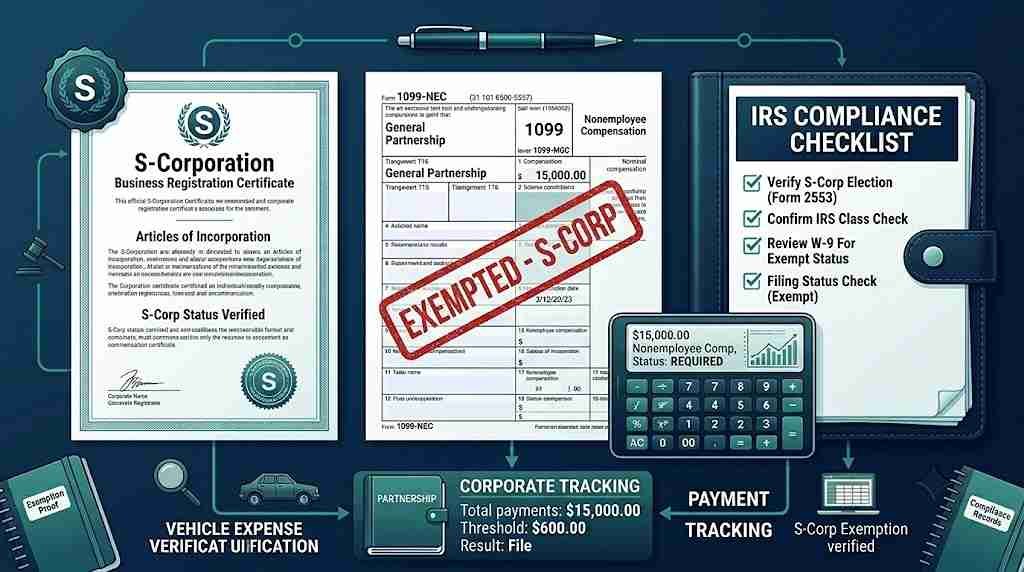
Do S-Corps Get 1099: The Definitive 2026 Tax Compliance Guide Every Business Payer Must Know
Do S-Corps get 1099 forms? — Generally, no. The IRS exempts S-Corporations from standard 1099-NEC reporting under IRS Publication 1281, meaning businesses paying an S-Corp $600 or more for services are typically not required to issue a 1099. However, three critical exceptions override this exemption entirely — attorney fees, medical and healthcare payments, and fishing boat proceeds — all of which require mandatory 1099 issuance regardless of S-Corp status under IRC § 6045(f) and § 6041(a) in the 2026 tax filing year.
Understanding Do S-Corps Get 1099 Forms Under 2026 IRS Rules
Do S-Corps get 1099 is one of the most frequently misapplied compliance questions in business accounting — and the errors flow in both directions.
Some businesses incorrectly issue 1099s to S-Corps for standard service payments, creating unnecessary paperwork and potential TIN-matching complications. Others incorrectly skip 1099 filings for S-Corps that fall squarely within mandatory exception categories — creating direct IRS penalty exposure.
Mastering the exact answer to whether do S-Corps get 1099 forms applies to your specific payment scenario is a non-negotiable financial compliance skill for every business operating in the 2026 tax environment.
Statutory Compliance Requirements for Businesses
The foundational statutory authority establishing the S-Corp 1099 exemption is IRS Publication 1281 combined with the backup withholding regulations under IRC § 3406. These provisions collectively instruct payers to exempt corporations — including S-Corporations — from standard information return reporting for most categories of business service payments.
The S-Corp exemption applies specifically because S-Corporations file their own Form 1120-S annual return with the IRS, providing an independent and verifiable income reporting trail that makes redundant 1099 cross-referencing unnecessary for routine service payments.
However, the exemption is not absolute. Three statutory exceptions carved directly into the IRC override the general S-Corp exemption and mandate 1099 reporting regardless of corporate election status.
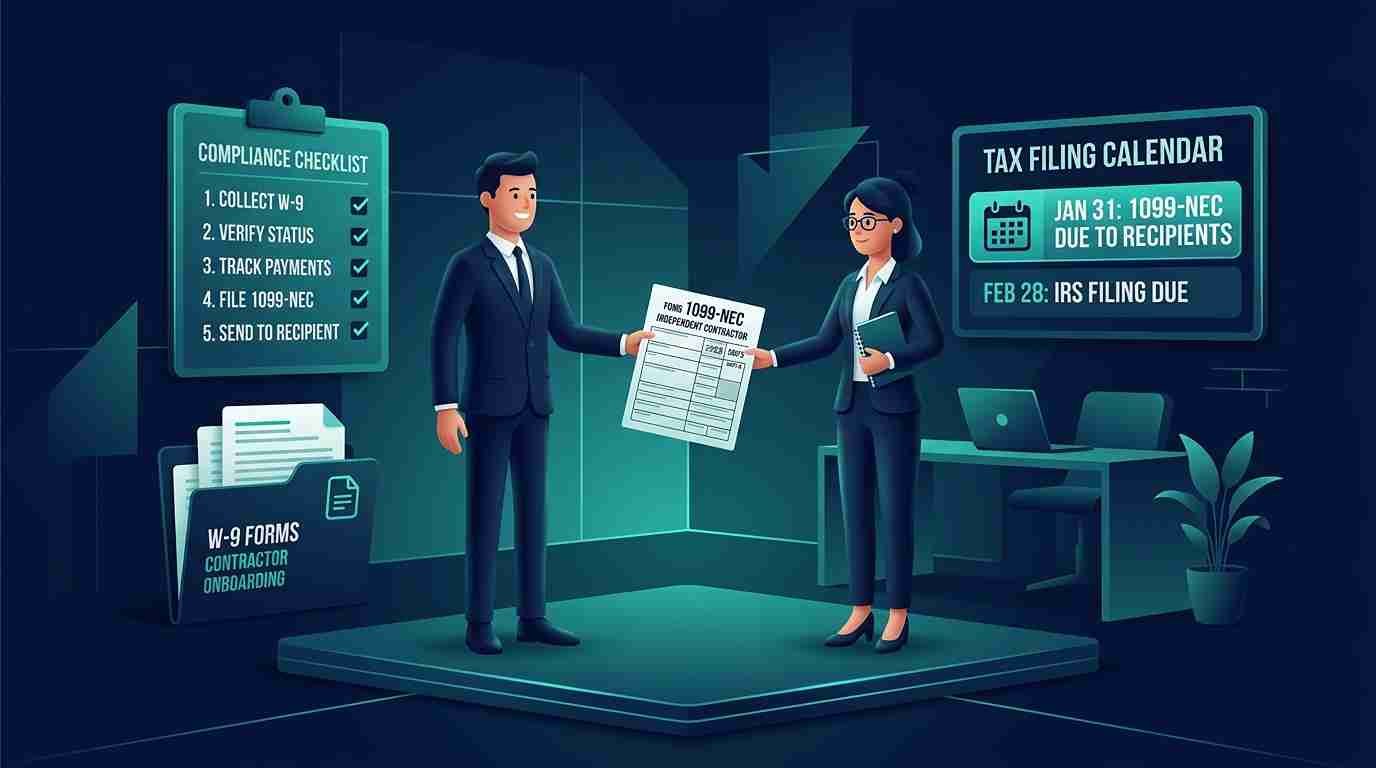
The essential compliance tool before any payment is a properly completed Form W-9 from the S-Corp vendor. Box 3 must show “S Corporation” — and that single checkbox is the only documentation that legally supports your decision to withhold a 1099 filing for that payee.
For the complete official IRS authority on S-Corp exemptions and mandatory exception categories, refer to the IRS Instructions for Forms 1099-MISC and 1099-NEC.
Understanding whether do S-Corps get 1099 treatment differs from how other corporate entities are handled is critical for multi-entity businesses. Reviewing whether C-Corps get 1099 forms under parallel IRS exemption rules clarifies exactly how the corporate exemption operates across both major corporation types simultaneously.
It is equally important to understand whether an S-Corp LLC gets 1099 treatment when the entity combines LLC organizational structure with S-Corp tax election — since this hybrid arrangement carries specific W-9 documentation requirements that differ from a standard standalone S-Corporation.
Quick Reference Compliance Matrix
| Payment Scenario | Do S-Corps Get 1099 | Applicable Form | IRS Authority |
|---|---|---|---|
| Standard Service Payments $600+ | Exempt — no 1099 required | N/A | IRS Pub. 1281 |
| Attorney / Legal Fee Payments $600+ | Required — no exemption | 1099-NEC | IRC § 6045(f) |
| Medical / Healthcare Payments $600+ | Required — no exemption | 1099-MISC | IRC § 6041(a) |
| Fishing Boat Proceeds | Required — no exemption | 1099-MISC Box 5 | IRC § 6041 |
| Rent Payments $600+ | Exempt for S-Corp landlords | N/A | IRS Pub. 1281 |
| Substitute Payments / Dividends | Required in specific cases | 1099-MISC Box 8 | IRC § 6042 |
| S-Corp refusing to provide W-9 | Backup Withhold 24% | Form 945 | IRC § 3406 |
| LLC elected S-Corp status | Exempt — same as S-Corp | N/A | IRS Pub. 1281 |
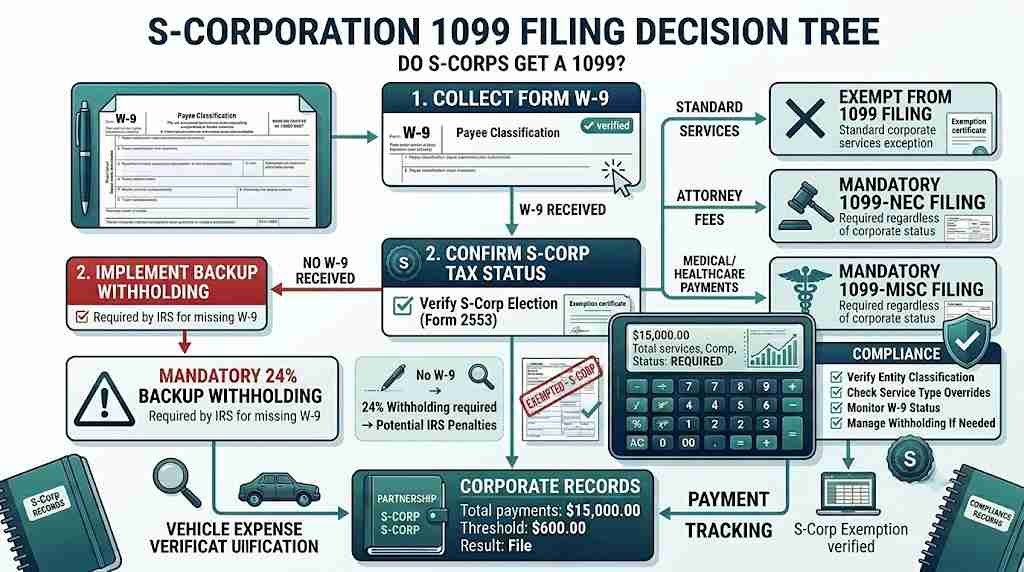
Do S-Corps Get 1099 Compliance Workflow Matrix
The Three Critical Exceptions That Override the S-Corp 1099 Exemption
The general rule is clear — do S-Corps get 1099 forms for standard service payments? No. But three statutory exceptions make this one of the most nuanced compliance areas in the entire 1099 reporting ecosystem.
Exception 1 — Attorney and Legal Fee Payments: Under IRC § 6045(f), any payment of $600 or more made to an S-Corp law firm or attorney for legal services requires a mandatory 1099-NEC. This exception was specifically enacted by Congress to ensure attorney compensation is independently tracked at the payment source level — regardless of the law firm’s corporate structure or tax election status.
Exception 2 — Medical and Healthcare Payments: Under IRC § 6041(a), payments of $600 or more made to S-Corp medical practices, physician groups, clinics, or healthcare providers in the course of a trade or business require a mandatory 1099-MISC. This exception applies even when the healthcare provider is a fully incorporated S-Corporation with its own Form 1120-S filing on record with the IRS.
Exception 3 — Fishing Boat Proceeds: Under IRC § 6041, payments representing a share of fishing boat proceeds paid to an S-Corp operator require mandatory 1099-MISC Box 5 reporting. While this exception applies to a narrow industry segment, it represents a complete and unconditional override of the standard S-Corp exemption for affected businesses.
How the W-9 Protects Your Business From S-Corp 1099 Errors
The Form W-9 is not administrative paperwork — it is your primary legal defense document in any IRS examination involving 1099 compliance decisions.
When an S-Corp vendor provides a properly completed W-9 showing S-Corporation status in Box 3, your decision to withhold a standard service payment 1099 is legally documented and defensible. Without a current W-9 on file, you have no documented basis for skipping the 1099 — and the IRS will treat the missing form as a compliance failure regardless of the vendor’s actual corporate status.
Collect and store W-9 forms for a minimum of four years from the payment date. Re-collect updated W-9 forms whenever a vendor reports a change in business name, EIN, address, or — critically — tax classification status.
Do S-Corps Get 1099 Treatment Differently When Structured as LLCs
The LLC-S-Corp hybrid is one of the most common business structures in the United States — and one of the most frequently misclassified for 1099 purposes.
An LLC that has filed Form 2553 to elect S-Corporation tax treatment is taxed identically to a standalone S-Corporation for all federal income tax purposes. This means the standard S-Corp 1099 exemption applies in full — the LLC organizational structure does not reduce or eliminate the corporate exemption once the S-Corp election is confirmed on the W-9.
However, the W-9 documentation requirement is even more critical for LLC-S-Corps than for standalone corporations. An LLC that has elected S-Corp status must specifically check “S Corporation” in Box 3 of the W-9 — not “LLC” with an S designation in the adjacent field. Ambiguous or incomplete W-9 completion for LLC-S-Corps is one of the most common triggers for unnecessary 1099 issuance and subsequent TIN-matching complications.
Does an S-Corp Need to Issue 1099 Forms to Its Own Vendors
This is a compliance obligation that many S-Corp owners completely overlook — and it operates entirely independently of whether the S-Corp itself receives 1099 forms.
An S-Corporation that pays its own vendors, independent contractors, or service providers $600 or more during the tax year carries the exact same 1099 filing obligations as any other business entity. The S-Corp’s own exemption from receiving 1099s has absolutely no bearing on its obligation to issue 1099s to its own payees.
S-Corp owners who are also the sole or primary shareholder-employees must also understand their reasonable compensation requirements — the IRS mandates that S-Corp owner-employees receive a market-rate W-2 salary before taking any remaining profit as pass-through distributions, making internal payroll compliance equally critical alongside vendor 1099 management.
Frequently Asked Questions
Do S-Corps get 1099 forms for rent payments made to them as landlords?
Generally no. When an S-Corporation acts as a landlord and receives rent payments of $600 or more from a business tenant, the standard S-Corp corporate exemption under IRS Publication 1281 applies — and the paying business is not required to issue a 1099-MISC for those rent payments. However, this exemption only applies when the S-Corp’s landlord status is properly confirmed via a completed Form W-9 showing S-Corporation tax classification. If the landlord entity is an LLC that has not confirmed its S-Corp election on the W-9, the standard rent reporting rules under IRC § 6041 activate and a 1099-MISC becomes mandatory at the $600 threshold.
What happens if a business incorrectly issues a 1099 to an S-Corp that did not need one?
Over-filing a 1099 to an exempt S-Corp is not a penalty event for the issuing business — it is simply redundant. The S-Corp will report its income independently through its Form 1120-S annual return regardless of whether a 1099 was issued. However, an incorrectly issued 1099 with a mismatched name, wrong EIN, or incorrect payment amount can trigger an IRS CP2100 notice and potential backup withholding demands against your business. Always verify the exact legal name and EIN from the S-Corp’s current W-9 before submitting any 1099 to the IRS — even when filing voluntarily beyond what is strictly required.
Do S-Corps get 1099 treatment differently in states with their own information return requirements?
Yes — and this is a compliance layer many multi-state businesses completely overlook. While the federal S-Corp 1099 exemption is consistent across all 50 states at the IRC level, several states impose independent state-level information return requirements that do not automatically mirror federal exemption rules. California, New Jersey, and Vermont are among the states that have enacted additional reporting obligations extending beyond standard IRS thresholds and exemptions. Businesses operating across multiple states must independently verify their state-specific 1099 filing obligations for S-Corp payees with each relevant state’s department of revenue before the applicable filing deadline.