Do partnerships get 1099 forms? — Yes, unambiguously. The IRS mandates 1099-NEC or 1099-MISC issuance to all general partnerships, limited partnerships, LLPs, and multi-member LLCs taxed as partnerships when payments reach $600 or more for services or qualifying income during the tax year. Partnerships are explicitly excluded from the corporate exemption under IRS Publication 1281 that protects S-Corps and C-Corps — making partnership 1099 reporting one of the most critical and non-negotiable compliance obligations in the 2026 filing season.
Understanding Do Partnerships Get 1099 Forms Under 2026 IRS Rules
Do partnerships get 1099 is a foundational compliance question that every accountant, business owner, and accounts payable professional must answer correctly before processing a single vendor payment.
The IRS answer is clear and unambiguous — partnerships are not corporations, and they do not receive the corporate 1099 exemption that eliminates reporting obligations for S-Corp and C-Corp payees.
Misunderstanding this distinction — or assuming partnership status carries some form of exemption — is one of the most expensive and frequently audited compliance errors businesses make heading into the 2026 tax filing season.
Statutory Compliance Requirements for Businesses
The core statutory authority governing whether do partnerships get 1099 obligations apply is IRC § 6041 and § 6041A. These provisions require any business engaged in a trade or business to file an information return for all payments of $600 or more made to partnerships for services, rents, prizes, and other qualifying income categories.
The $600 threshold is calculated on a per-payee, per-calendar-year basis. If your business makes multiple smaller payments to the same partnership that collectively exceed $600 during the year, the 1099 filing obligation is fully triggered — regardless of whether any individual payment crossed the threshold on its own.
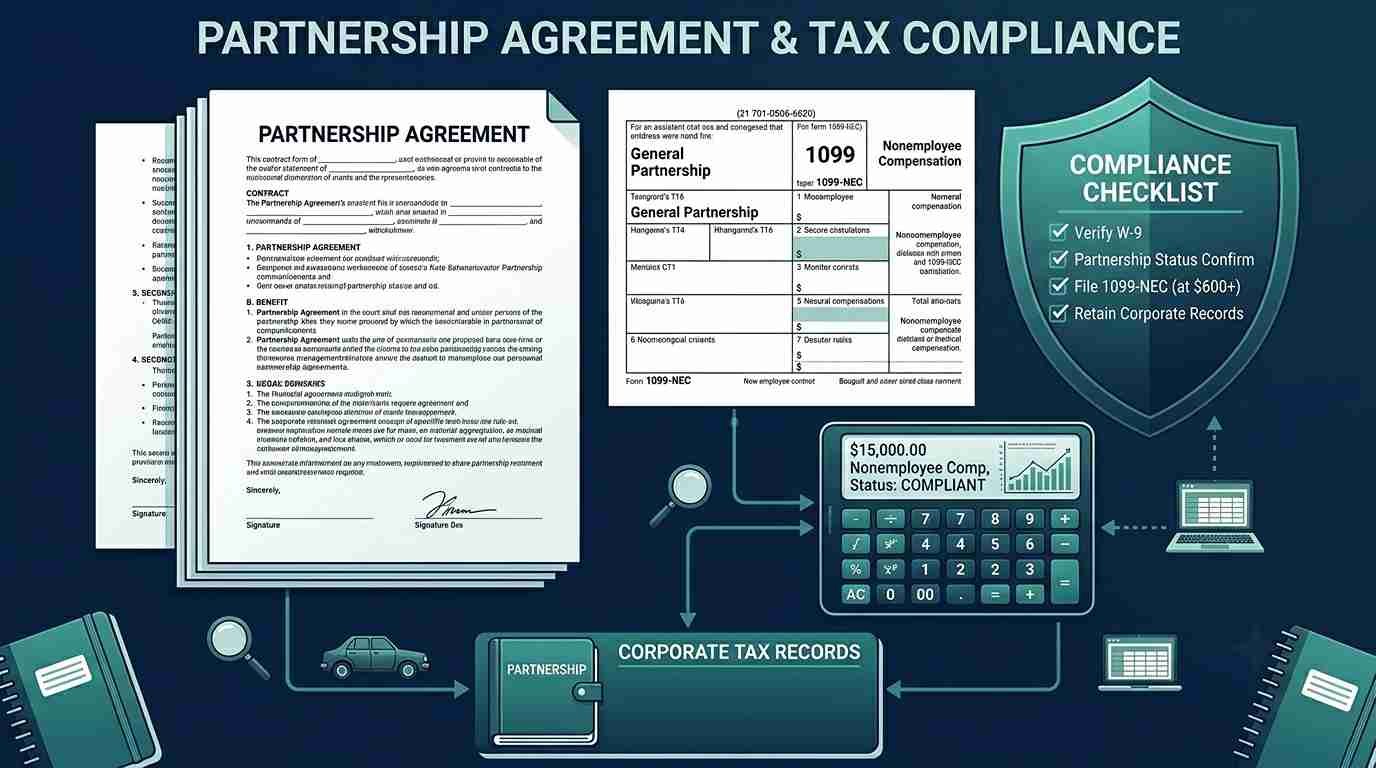
The single most important pre-payment compliance step is collecting a Form W-9 from every partnership vendor. Box 3 of the W-9 confirms the entity’s federal tax classification. If the partnership checks “Partnership” — your 1099 obligation activates immediately and unconditionally.
For the complete official IRS guidance on partnership information return requirements and filing protocols, refer to the IRS Instructions for Forms 1099-MISC and 1099-NEC.
When evaluating whether do partnerships get 1099 rules apply to LLC-structured entities, the classification question becomes especially important. A multi-member LLC taxed as a partnership receives identical 1099 treatment to a traditional general partnership — full reporting required at the standard $600 threshold without exception.
Understanding whether incorporated companies get 1099 forms under parallel IRS rules helps clarify exactly why partnerships occupy a fundamentally different — and more reporting-intensive — position than their corporate counterparts in the federal tax system.
Quick Reference Compliance Matrix
| Partnership Entity Variant | Do Partnerships Get 1099 | Applicable Form | IRS Authority |
|---|---|---|---|
| General Partnership | Yes — mandatory at $600+ | 1099-NEC | IRC § 6041 |
| Limited Partnership (LP) | Yes — mandatory at $600+ | 1099-NEC | IRC § 6041 |
| Limited Liability Partnership (LLP) | Yes — mandatory at $600+ | 1099-NEC | IRC § 6041 |
| Multi-Member LLC (Partnership Default) | Yes — mandatory at $600+ | 1099-NEC | IRC § 6041A |
| Partnership — Rent Payments $600+ | Yes — mandatory | 1099-MISC Box 1 | IRC § 6041 |
| Partnership — Legal Fee Payments | Yes — no corporate exemption | 1099-NEC | IRC § 6045(f) |
| Partnership — Medical Payments | Yes — no corporate exemption | 1099-MISC | IRC § 6041(a) |
| S-Corp or C-Corp (NOT a partnership) | Exempt — general rule | N/A | IRS Pub. 1281 |
| Partnership refusing W-9 | Backup Withhold 24% | Form 945 | IRC § 3406 |
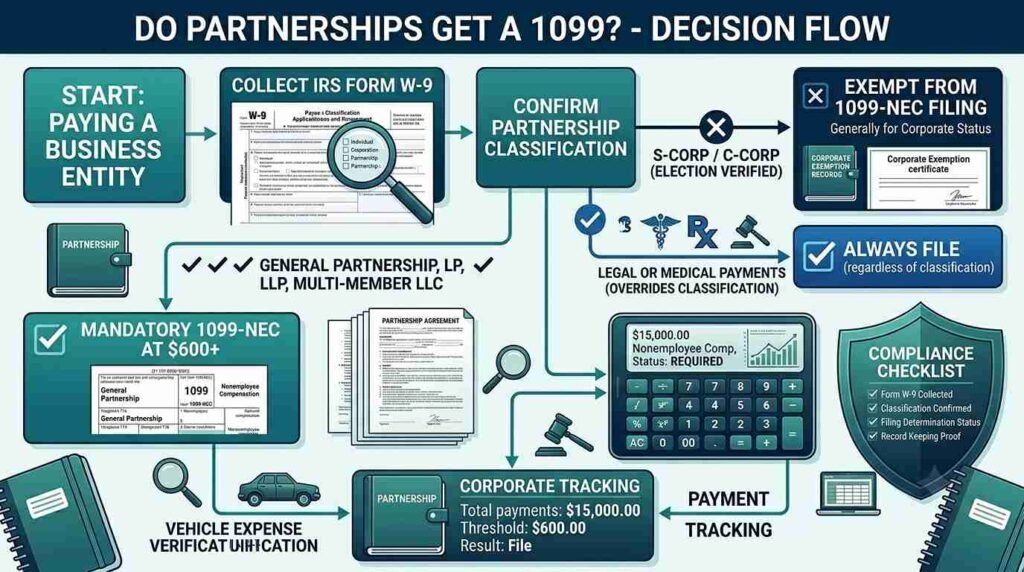
Do Partnerships Get 1099 Compliance Workflow Matrix
Do General Partnerships Get 1099 Forms Differently Than Other Entity Types
General partnerships represent the most straightforward answer to whether do partnerships get 1099 rules apply — there are zero exceptions, zero exemptions, and zero ambiguity under current IRS rules.
A general partnership has no separate corporate tax identity. It files a Form 1065 information return annually and passes all income, deductions, and credits through to individual partners via Schedule K-1. This pass-through structure is precisely why the IRS mandates 1099 reporting — the income must be tracked at the payment source level.
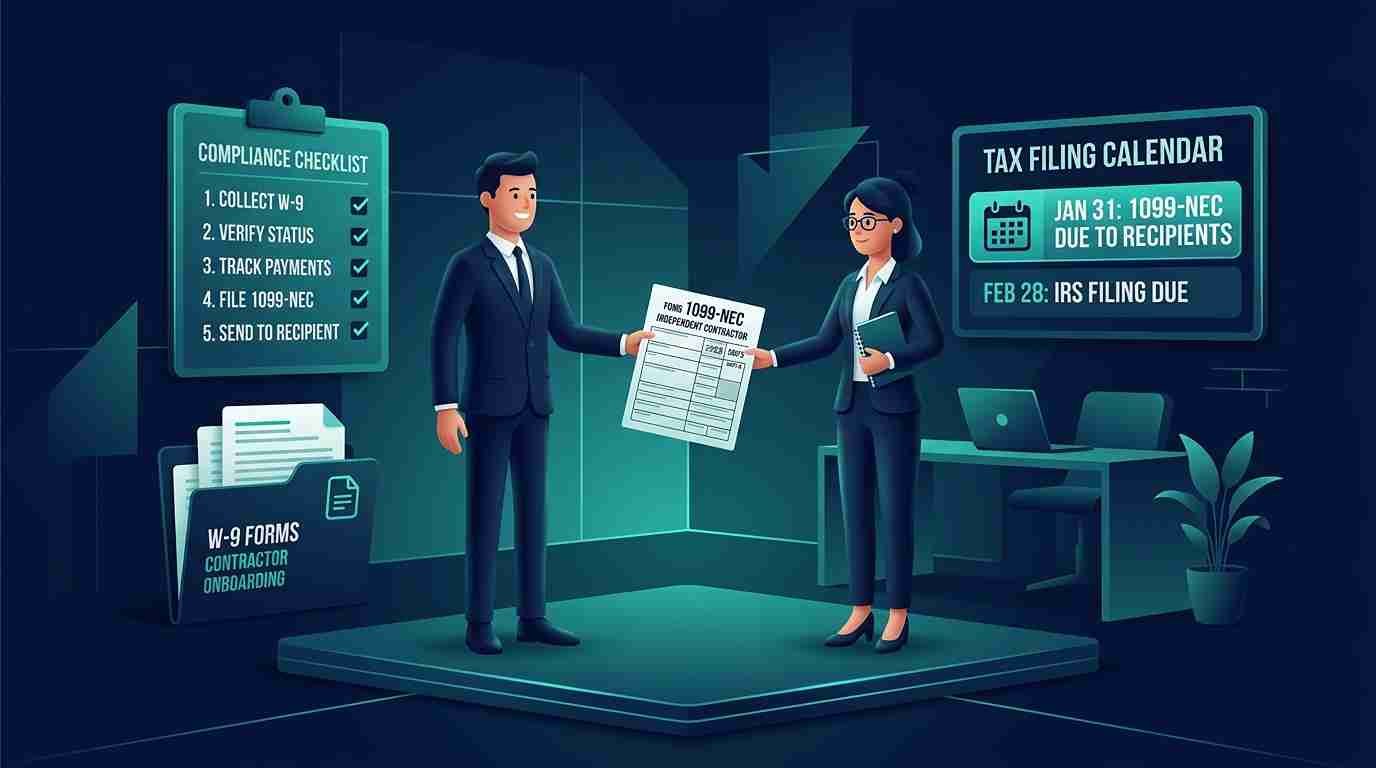
When your business pays a general partnership $600 or more for any qualifying service or income category, the 1099-NEC must reach the partnership by January 31, 2026 — no exceptions permitted under current compliance standards.
Do LLC Partnerships Get 1099 Forms Under the Same Rules
The LLC-partnership question is where most business payers introduce costly classification errors. The answer depends entirely on one document — the Form W-9.
A multi-member LLC that has not elected corporate tax treatment via Form 8832 is classified as a partnership by default under IRS Treasury Regulation § 301.7701-3. This default classification means the LLC receives identical 1099 treatment to any traditional partnership — full reporting required at the $600 threshold.
However, a multi-member LLC that has successfully elected S-Corp status via Form 2553 or C-Corp status via Form 8832 shifts into the corporate exemption category. In that scenario, standard service payment 1099 obligations are eliminated — though legal and medical payment exceptions still apply unconditionally.
Never determine LLC tax classification from the entity name, a verbal confirmation, or a prior year’s W-9. Always collect a current, signed W-9 before each new engagement begins.
Do Limited Liability Partnerships Get 1099 Forms in Professional Service Industries
Limited Liability Partnerships (LLPs) are the dominant entity structure across three major professional service industries — law, accounting, and medicine. Despite their professional stature and limited liability protections, LLPs are taxed as partnerships for all federal income tax purposes.
This means businesses paying LLPs must issue 1099-NEC forms at the standard $600 threshold — with an additional compliance layer that makes LLP payments among the most heavily reported in the entire 1099 ecosystem.
Since LLPs overwhelmingly provide legal and medical services, virtually every payment to an LLP simultaneously triggers either the attorney payment rule under IRC § 6045(f) or the medical payment rule under IRC § 6041(a). Both rules mandate 1099 reporting with no corporate exemption available — meaning even a hypothetically exempt LLP could not escape 1099 reporting on these payment categories.
The Critical Difference Between Partnerships and Corporations for 1099 Purposes
Understanding why do partnerships get 1099 treatment while corporations generally do not requires a clear grasp of the fundamental tax policy distinction between the two entity types.
Corporations file their own Form 1120 or 1120-S tax returns and pay taxes at the entity level or pass through via shareholder returns under strict IRS oversight. The IRS determined that corporate income is sufficiently tracked through corporate return filing — making additional 1099 cross-referencing largely redundant for standard service payments.
Partnerships file only an informational Form 1065 — they pay no entity-level federal income tax themselves. All income flows directly to individual partners whose personal reporting compliance is far harder for the IRS to verify without the 1099 paper trail. This structural difference is the precise policy rationale behind mandatory partnership 1099 reporting.
Frequently Asked Questions (Gutenberg Block Ready)
Do partnerships get 1099 forms if they are paid through Venmo, PayPal, or business credit cards?
No — with a critical qualification that every business payer must understand. Payments to partnerships processed through third-party settlement networks such as PayPal Business, Venmo for Business, Square, or via business credit card transactions are reported by the payment processor through a 1099-K issued directly to the partnership. In these specific payment scenarios, your direct 1099-NEC filing obligation is eliminated. However, all payments made via check, ACH transfer, wire, or cash remain your full and direct 1099 reporting responsibility — regardless of partnership entity type or payment amount allocation across the calendar year.
Do partnerships get 1099 forms even when the partnership has its own EIN on file?
Yes, unconditionally. Possessing an Employer Identification Number (EIN) provides no 1099 exemption whatsoever for partnership entities. The EIN is simply the partnership’s federal taxpayer identification number — it carries no classification implications and confers no corporate-equivalent exemption status. The 1099 is issued using the partnership’s EIN exactly as reported on their Form W-9, and the IRS cross-references this information against the partnership’s Form 1065 annual return and individual partner Schedule K-1 filings through its automated income matching system to verify complete and accurate income reporting across all partners.
What penalties apply if a business fails to issue a required 1099 to a partnership in 2026?
The IRS penalty structure for missing or late 1099 filings in 2026 scales directly with the severity and timing of the failure. Filing 1 to 30 days late triggers a penalty of $60 per form. Filing 31 days late through August 1 escalates the penalty to $130 per form. Filing after August 1 or not at all carries a $330 per form penalty. The most severe category — intentional disregard of the filing requirement — triggers a minimum penalty of $660 per form with absolutely no statutory maximum cap, making timely and accurate partnership 1099 compliance dramatically less expensive than any alternative course of action.