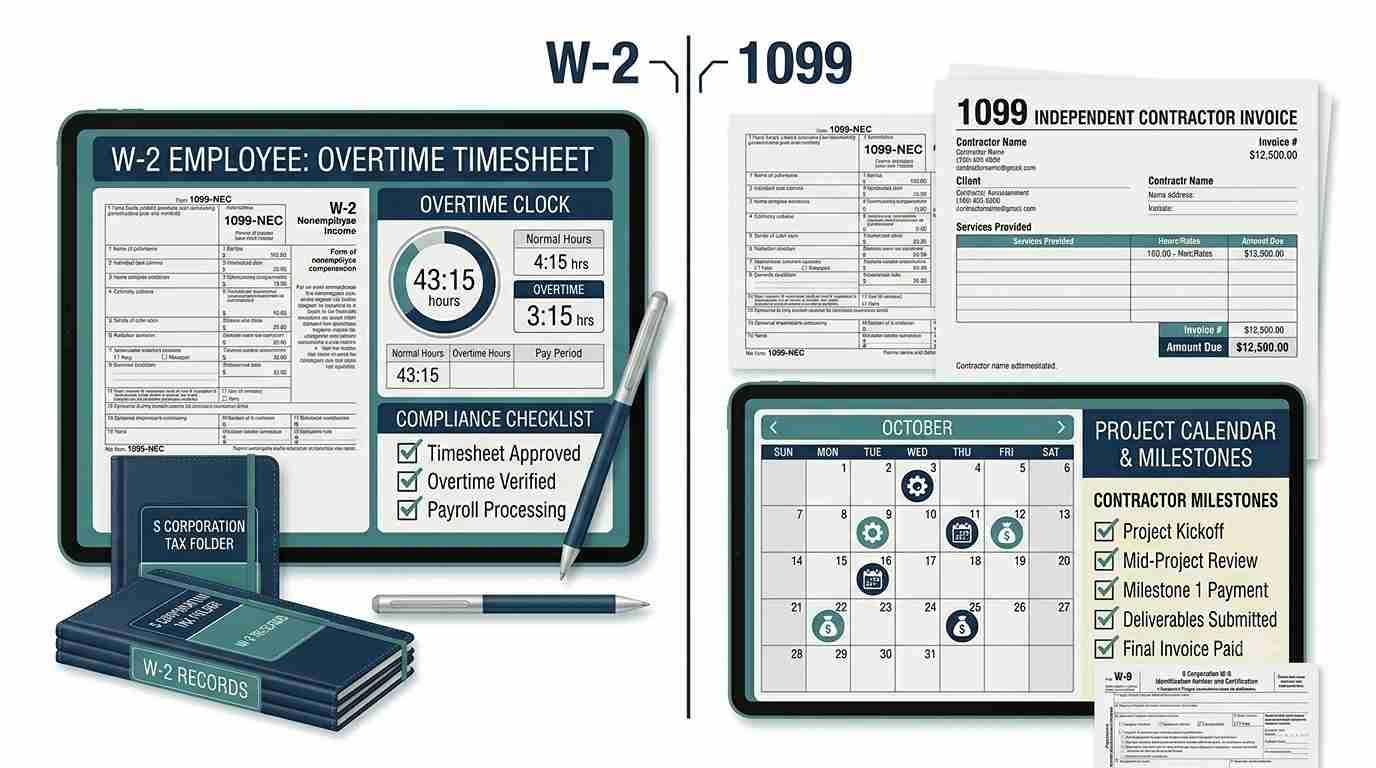
Do 1099 employees get overtime pay? — No. Under federal law, 1099 independent contractors are completely excluded from the overtime protections of the Fair Labor Standards Act (FLSA). The 1.5x time-and-a-half overtime rate applies exclusively to W-2 employees — not to self-employed contractors operating under 1099-NEC arrangements. However, when a business misclassifies a W-2 employee as a 1099 contractor, the IRS and Department of Labor can retroactively enforce full overtime back-pay liability plus substantial civil penalties under 2026 enforcement guidelines.
Understanding Do 1099 Employees Get Overtime Under 2026 Federal Law
Do 1099 employees get overtime is one of the most critical and most misunderstood workforce compliance questions facing American businesses and independent contractors in 2026.
The phrase “1099 employee” is itself a legal contradiction under US tax law. A worker is either a 1099 independent contractor or a W-2 employee — never both simultaneously under any legitimate classification framework.
This distinction carries enormous financial consequences. Getting the answer to whether do 1099 employees get overtime wrong — either through genuine misunderstanding or deliberate misclassification — exposes businesses to retroactive overtime liability, unpaid FICA taxes, and DOL civil penalties that can reach into six figures for multi-worker enforcement actions.
Statutory Compliance Requirements for Businesses
The Fair Labor Standards Act (FLSA) is the governing federal statute on overtime compensation in the United States. It mandates overtime pay at 1.5x the worker’s regular rate for all hours worked beyond 40 hours per week — but this protection applies exclusively to covered employees, never to independent contractors.
The FLSA definition of “employee” is deliberately broad — but independent contractors operating genuine businesses with multiple clients, their own tools, and autonomous work methods fall clearly outside its protective scope under established legal standards.
The critical compliance danger in 2026 is that the IRS and Department of Labor are running coordinated worker misclassification enforcement campaigns specifically targeting businesses that use 1099 classifications to avoid overtime obligations for workers who functionally operate as employees.
For the complete official federal guidance on FLSA overtime rules and worker classification standards, refer to the US Department of Labor Wage and Hour Division FLSA Overtime Rules.
Understanding whether do 1099 employees get overtime protections depends entirely on correct worker classification. Reviewing whether 1099 employees are considered self-employed under IRS definitions clarifies exactly which legal tests determine true contractor status — and where misclassification risk begins to accumulate in your workforce structure.
It is equally important to understand how many hours a 1099 employee can work under current IRS behavioral control standards — since hour management is the single most heavily weighted misclassification trigger in both IRS audits and DOL enforcement investigations in 2026.
Quick Reference Compliance Matrix
| Worker Classification Scenario | Do 1099 Employees Get Overtime | Governing Law | 2026 Enforcement Status |
|---|---|---|---|
| Legitimate 1099 Independent Contractor | No — FLSA does not apply | FLSA § 3(e) | Compliant |
| W-2 Employee — Over 40 Hours/Week | Yes — 1.5x mandatory | FLSA § 207 | Federally mandated |
| Misclassified Worker — 1099 Used for W-2 Role | Yes — retroactively owed | FLSA + IRC § 3509 | Active DOL enforcement target |
| California AB5 Reclassified Worker | Yes — state overtime applies | CA Labor Code § 510 | State enforcement active |
| Federal Contract Workers (SCA-Covered) | Yes — specific wage rates | Service Contract Act | Federal contractor mandate |
| Dual Classification Attempt | Invalid — legally impermissible | IRS Rev. Rul. 87-41 | Audit trigger |
| Freelancer — Multiple Clients | No — genuine contractor | FLSA § 3(e) | Compliant |
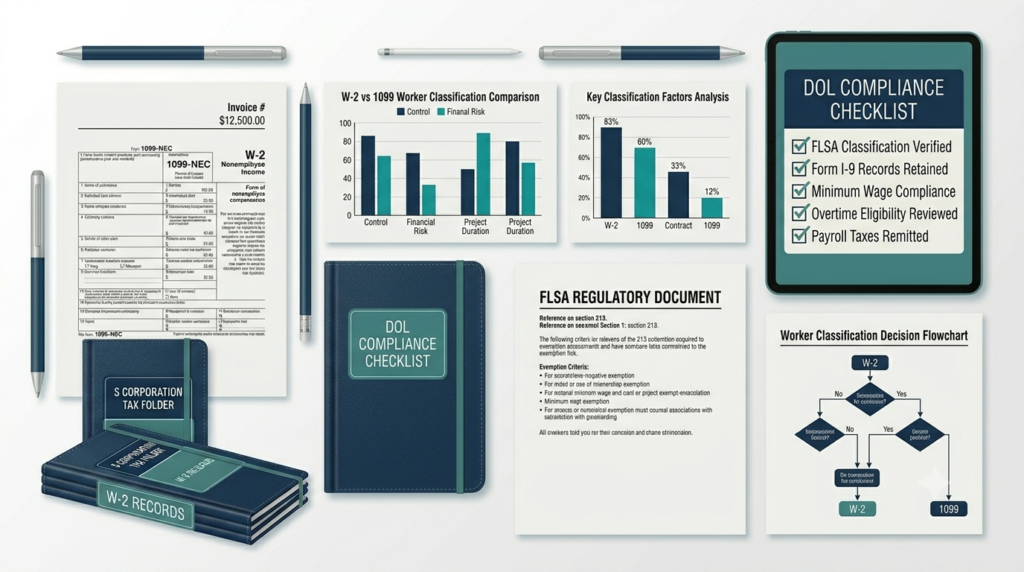
Do 1099 Employees Get Overtime Compliance Chart
The IRS 3-Category Control Test: The Real Classification Standard
The IRS determines worker status using a Behavioral, Financial, and Type-of-Relationship framework — commonly called the Common Law Control Test.
Behavioral Control asks: Does the company control how the worker performs their tasks? If yes, the worker leans toward employee status.
Financial Control asks: Does the worker invest in their own tools, set their own rates, and risk profit or loss? If yes, that supports contractor classification.
Type of Relationship asks: Is there a written contract? Are employee-type benefits (health insurance, pension) provided? Permanent or indefinite relationships favor employee classification.
If your working arrangement fails this test, the business may owe back overtime wages, unpaid FICA taxes, and civil penalties — regardless of what the contract says.
What Happens When a 1099 Worker Is Actually Misclassified?
Misclassification is not a paperwork technicality — it carries real financial consequences for both the business and the worker.
The Department of Labor Wage and Hour Division can order full back-payment of all overtime wages owed, going back two to three years.
The IRS can assess the employer’s share of FICA taxes, interest, and penalties on all misclassified compensation. Workers may also file a private lawsuit under the FLSA to recover unpaid wages plus attorney fees.
For authoritative guidance on worker classification rules, refer directly to the IRS Independent Contractor vs. Employee guidance.
Do Any States Give 1099 Workers Overtime Rights?
Federal law excludes contractors from overtime — but state law can go further.
California is the most aggressive state. Under AB5 and the ABC Test, many workers previously classified as 1099 contractors were reclassified as employees, instantly triggering state overtime protections under California Labor Code Section 510.
New York, New Jersey, and Washington also apply stricter classification tests than the federal standard. Always check your state labor board rules alongside federal FLSA guidelines.
7 Key Indicators That You May Be Misclassified as a 1099 Worker
Use this checklist to self-assess your classification risk:
- You work exclusively for one company with no other clients
- The company sets your daily schedule and work hours
- You use company-provided equipment and software
- You receive performance reviews just like staff employees
- Your contract is indefinite with no project end date
- The company controls your work methods and processes
- You are not free to subcontract your work to others
If three or more of these apply, your classification may not hold up under IRS or DOL scrutiny.
Frequently Asked Questions
FAQ 1: Do 1099 employees get overtime pay under federal law?
No. 1099 independent contractors do not receive overtime pay under the Fair Labor Standards Act (FLSA). The FLSA’s overtime protections apply only to W-2 employees. If you are legitimately self-employed or a freelancer, you negotiate your own rates — there is no federal mandate for time-and-a-half pay regardless of hours worked.
FAQ 2: Can a 1099 contractor sue for overtime if they were misclassified?
Yes. If a court or the Department of Labor determines you were misclassified as a 1099 contractor when you should have been a W-2 employee, you can recover back overtime wages for up to three years under the FLSA’s willful violation standard. Many workers have successfully won these claims even when they signed independent contractor agreements.
FAQ 3: Does California treat 1099 workers differently for overtime?
Yes, significantly. California’s ABC Test (established under AB5) presumes all workers are employees unless the hiring business can prove otherwise across three strict criteria. Workers reclassified as employees in California gain access to state overtime rules, which mandate 1.5x pay after 8 hours in a single day — stricter than the federal 40-hour weekly threshold.