Can I background check a 1099 contractor? — Yes, absolutely. Businesses have the full legal right to run background checks on 1099 independent contractors before or during engagement. However, the process is governed by the Fair Credit Reporting Act (FCRA), which mandates written disclosure and consent before any consumer report is pulled. Violating FCRA protocols when screening contractors exposes your business to civil liability up to $1,000 per violation plus potential class action exposure.
Understanding Can I Background Check a 1099 Contractor in 2026
Can I background check a 1099 worker is a question that sits at the intersection of hiring law, contractor rights, and business risk management — and the answer is more nuanced than most business owners realize.
Unlike W-2 employees, 1099 independent contractors occupy a unique legal gray zone. You are not their employer in the traditional sense, yet they often access your facilities, client data, and sensitive business systems.
That operational reality makes background screening not just legally permissible in 2026 — for many industries it is an absolute business necessity.
Statutory Compliance Requirements for Businesses
The primary federal statute governing contractor background checks is the Fair Credit Reporting Act (FCRA), enforced by the Federal Trade Commission (FTC). Any background check conducted through a Consumer Reporting Agency (CRA) — such as Checkr, Sterling, or HireRight — triggers full FCRA compliance obligations regardless of whether the worker is a W-2 employee or a 1099 independent contractor.
The FCRA makes no distinction between employees and contractors when it comes to consumer report protections. The moment you use a third-party screening agency, the full compliance framework activates.
For the complete official FCRA guidance applicable to contractor screening, refer to the FTC’s Business Guidance on the Fair Credit Reporting Act.
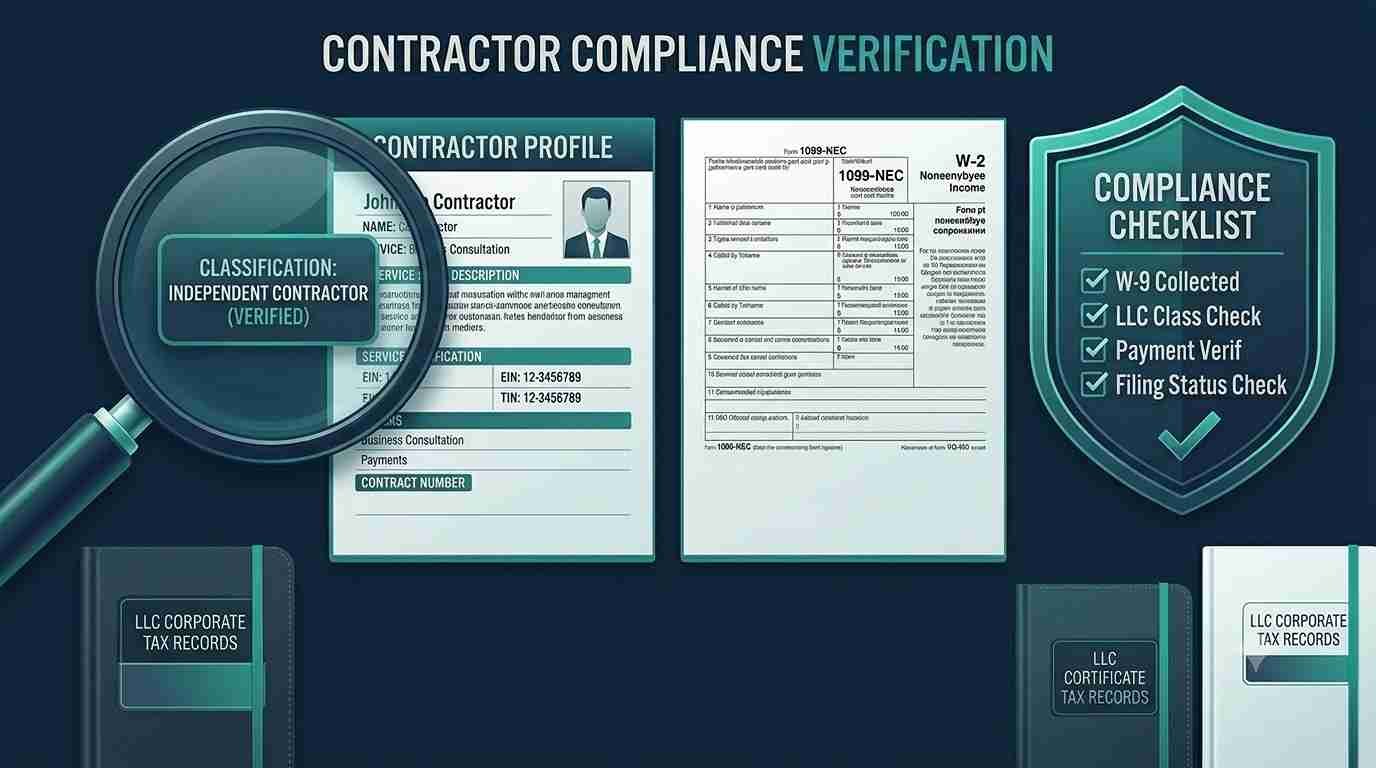
Before initiating any background check, you must provide the contractor with a clear and conspicuous written disclosure — in a standalone document, not buried inside a contract — stating that a consumer report may be obtained. You must then receive explicit written authorization from the contractor before pulling any report.
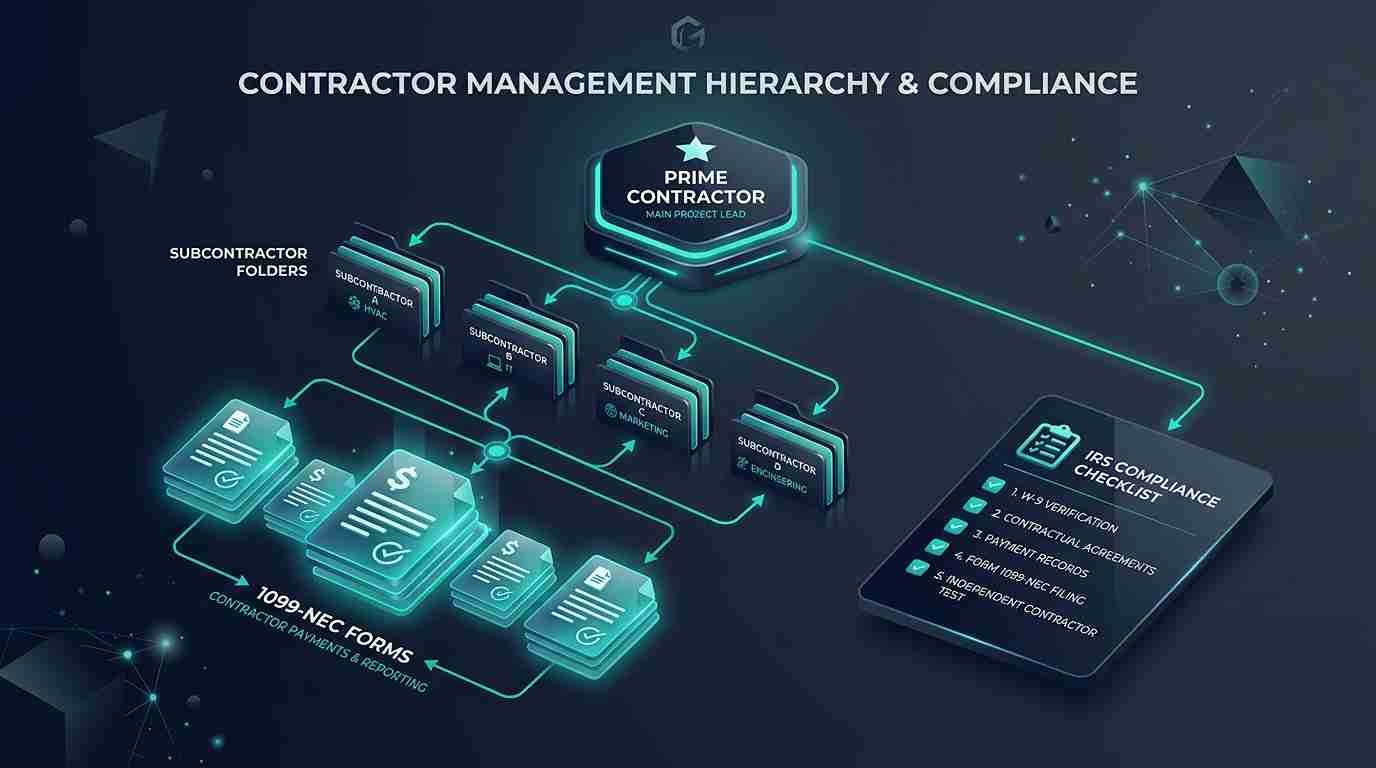
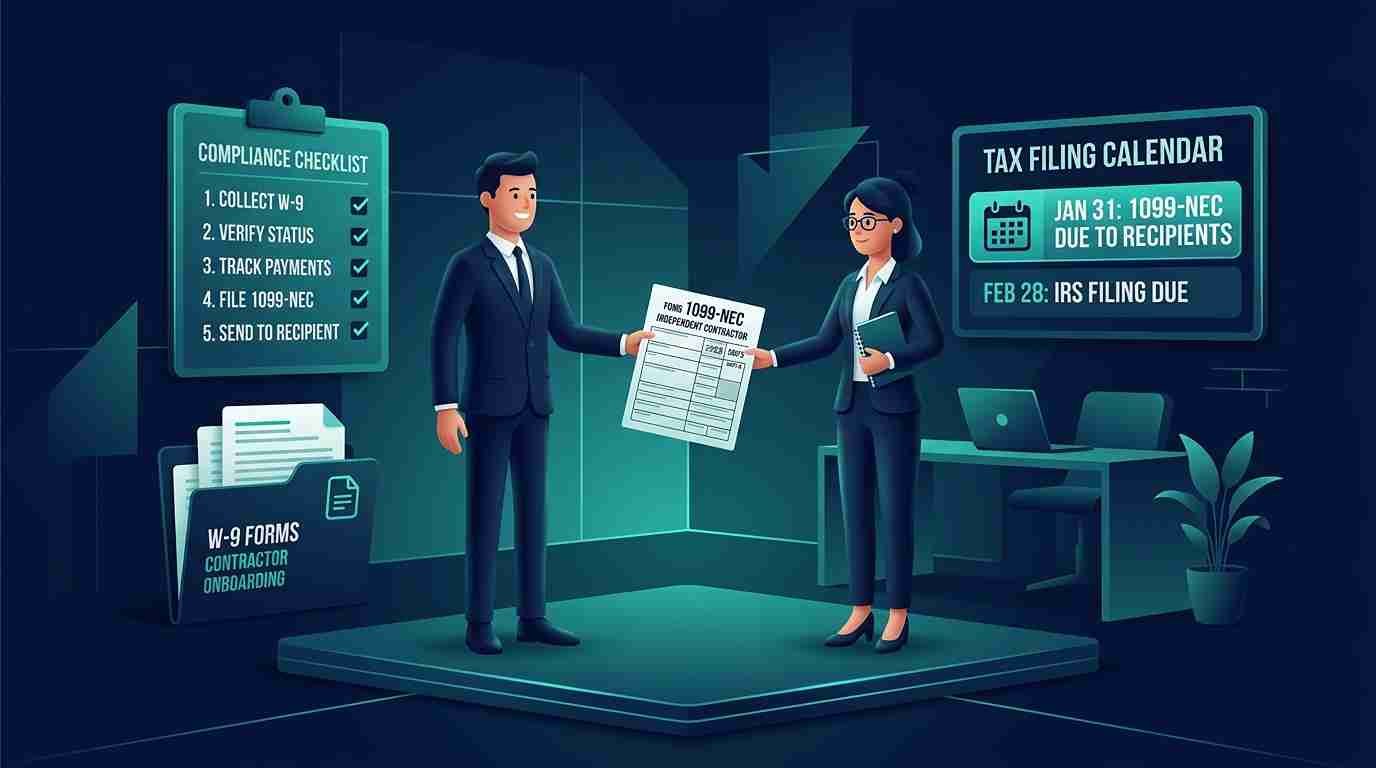
Understanding what paperwork you need for a 1099 employee is essential before initiating the screening process, since proper documentation must be collected and stored alongside your background check authorization records.
It is also worth understanding whether 1099 employees are considered subcontractors under your engagement structure, as this classification can affect which screening standards and industry-specific compliance rules apply to your situation.
Quick Reference Compliance Matrix
| Screening Scenario | Legally Permitted | FCRA Applies | Key Requirement |
|---|---|---|---|
| Background check via CRA (Checkr, Sterling) | Yes | Yes | Written disclosure + consent |
| Criminal history check | Yes | Yes | Adverse action process required |
| Credit history check | Yes | Yes | Written consent mandatory |
| Drug screening | Yes | No (direct test) | State law governs |
| Social media screening (manual) | Yes | No | Ban-the-box laws may apply |
| Driving record (MVR) check | Yes | Yes | Consent + permissible purpose |
| Sex offender registry check (public) | Yes | No | Publicly available data |
| Refusing background check | Contractor may decline engagement | N/A | Cannot legally compel consent |
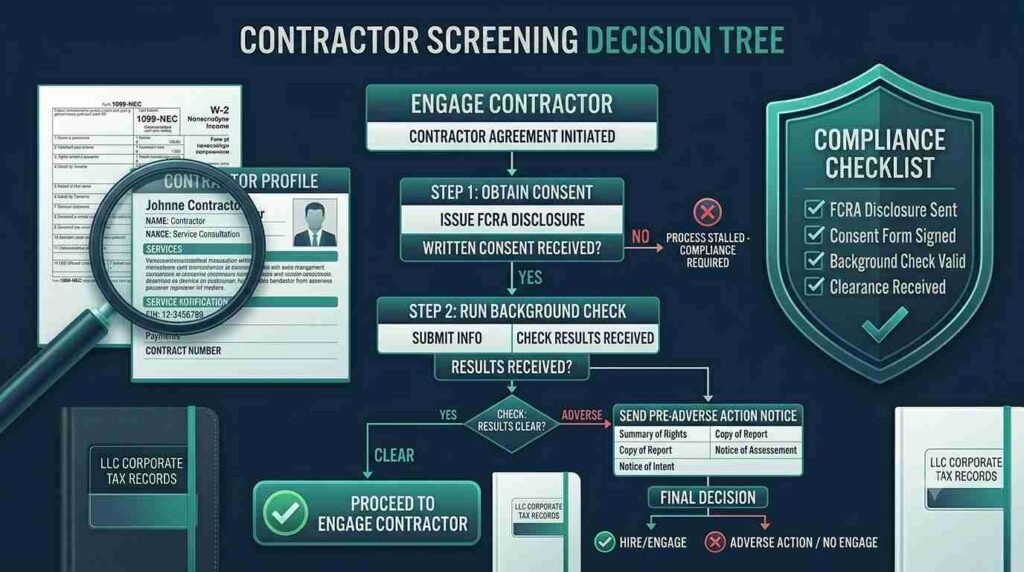
Can I Background Check a 1099 Compliance Workflow Matrix
The FCRA Adverse Action Process: What Happens If the Check Comes Back Negative
If a background check reveals information that causes you to decline or terminate a contractor engagement, FCRA’s adverse action protocol is mandatory — even for 1099 relationships.
Step 1 — Issue a Pre-Adverse Action Notice to the contractor along with a copy of the background report and the Summary of Rights Under the FCRA. This gives the contractor time to dispute inaccurate information.
Step 2 — Allow a reasonable waiting period (typically five business days minimum) before making your final decision. Courts have consistently upheld this window as a due process protection.
Step 3 — If you proceed with the adverse decision, issue a Final Adverse Action Notice stating the decision, the CRA’s contact information, and the contractor’s right to obtain a free copy of the report within 60 days.
Skipping any step in this process exposes your business to FCRA civil penalties and potential litigation from the contractor.
Industry-Specific Background Check Standards for 1099 Contractors
Certain industries face mandatory background screening requirements for all workers — including 1099 contractors — imposed by federal regulation or licensing boards.
Healthcare — The Office of Inspector General (OIG) exclusion database must be checked for any contractor accessing Medicare or Medicaid-related services. Engaging an excluded contractor triggers severe federal penalties.
Financial Services — FINRA-registered firms must conduct background checks on all associated persons, including contractors, under FINRA Rule 3110. This includes criminal history, regulatory actions, and financial disclosures.
Transportation — Contractors operating commercial vehicles must comply with DOT drug and alcohol testing regulations under 49 CFR Part 40, which applies regardless of W-2 or 1099 classification.
Childcare and Education — Federal and state laws mandate criminal background checks for any contractor with unsupervised access to minors, with zero exceptions for contractor classification status.
State-Level Ban-the-Box Laws That Affect 1099 Contractor Screening
Beyond federal FCRA rules, 37 states and over 150 cities have enacted Ban-the-Box legislation that restricts when and how criminal history can be considered in hiring and engagement decisions.
Several of these laws — including those in California, New York, New Jersey, and Illinois — explicitly extend Ban-the-Box protections to independent contractors, not just traditional employees.
In these jurisdictions, you cannot ask about criminal history on an initial application or during early screening stages. Criminal history inquiry is only permitted after a conditional offer of engagement has been extended.
Violating state Ban-the-Box laws carries separate civil penalties entirely independent of FCRA violations, making state-level compliance research non-negotiable before screening any contractor.
Frequently Asked Questions
Can I background check a 1099 contractor without their knowledge?
No. If you use a Consumer Reporting Agency (CRA) to conduct the background check — which covers the vast majority of formal screening services — the FCRA requires explicit written disclosure and consent before any report is pulled. Running a background check through a CRA without consent is a direct FCRA violation carrying civil liability of up to $1,000 per willful violation plus attorney fees. The only exception is publicly available data you research manually, such as court records or sex offender registries, which fall outside FCRA’s scope.
Can a 1099 contractor refuse a background check?
Yes. A 1099 independent contractor has the legal right to refuse consent to a background check. However, your business equally has the right to decline the engagement if the contractor will not authorize screening. Since independent contractors are not employees, standard employment discrimination protections have limited application in this context. The key is ensuring your background check policy is applied consistently across all contractors in similar roles to avoid disparate treatment claims under applicable civil rights statutes.
Does running a background check on a 1099 contractor risk reclassifying them as an employee?
This is a legitimate concern that many businesses overlook. Exercising extensive behavioral control over a 1099 contractor — including mandatory screening processes identical to employee onboarding — can be cited as one factor in an IRS or DOL misclassification audit. Background checks alone do not trigger reclassification, but they should be part of a clearly documented contractor onboarding policy that is distinct from your employee hiring process. Always ensure your contractor agreements reflect genuine independence to protect your classification position.