
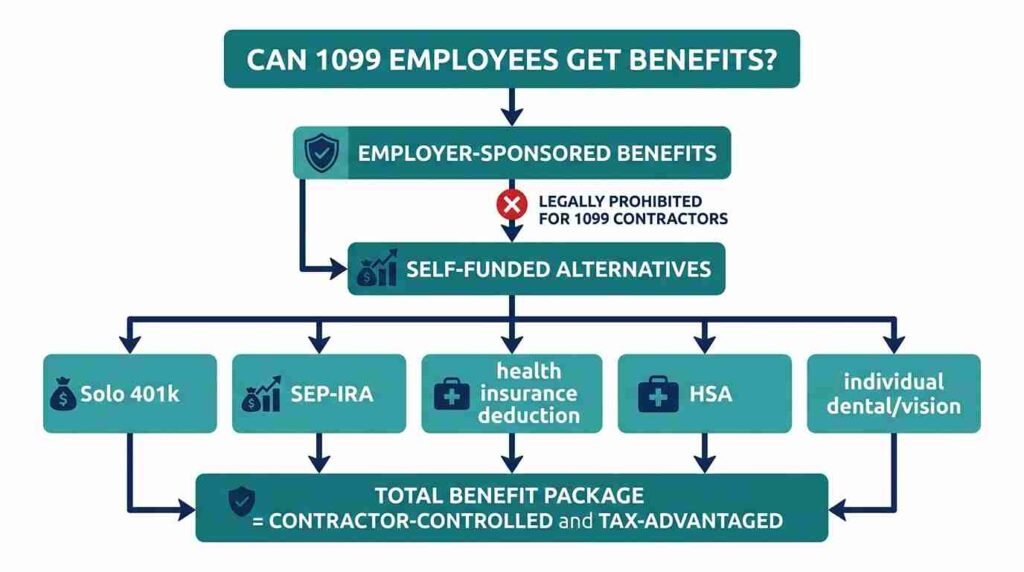
Can 1099 employees get benefits through their hiring clients? — Generally no. 1099 independent contractors are explicitly excluded from employer-sponsored benefit programs — including health insurance, 401(k) plans, paid time off, and workers compensation coverage — under current IRS and Department of Labor regulations. However, 1099 contractors can absolutely access powerful self-funded benefit alternatives — including Solo 401(k) plans, SEP-IRA retirement accounts, self-employed health insurance deductions under IRC § 162(l), and Health Savings Accounts (HSAs) — that in many cases deliver superior financial outcomes compared to standard employer benefit packages in 2026.
Understanding Can 1099 Employees Get Benefits Under 2026 IRS Rules
Can 1099 employees get benefits from their hiring clients is one of the most financially consequential questions facing independent contractors, freelancers, and gig economy workers across the United States in 2026.
The answer to whether can 1099 employees get benefits through a hiring business is an unambiguous no under current federal law — and providing standard employee benefits to 1099 contractors creates serious IRS misclassification risk for the hiring business simultaneously.
However, the complete financial picture of whether can 1099 employees get benefits through self-funded alternatives tells a dramatically different story — one that frequently favors contractor status over traditional employment when the full benefit strategy is properly executed.
Statutory Compliance Requirements for Businesses
The governing statutory framework establishing why can 1099 employees get benefits through hiring clients is legally prohibited spans multiple federal statutes simultaneously. ERISA — the Employee Retirement Income Security Act — governs employer-sponsored retirement and benefit plan eligibility exclusively for classified employees. IRC § 105 and § 106 govern employer-sponsored health insurance exclusions that apply only to W-2 employees. IRC § 3121 governs FICA tax obligations that fund Social Security and Medicare benefits — obligations that hiring businesses carry only for W-2 employees, never for 1099 contractors.
Each of these statutory frameworks collectively creates a legally enforced benefit separation between W-2 employees and 1099 independent contractors — making employer-provided benefits for contractors not just uncommon but legally inadvisable without triggering misclassification scrutiny.
The critical business compliance risk emerges when hiring companies provide employee-type benefits to 1099 contractors — including health insurance subsidies, retirement plan participation, or paid leave. These provisions are among the most heavily weighted indicators of employment relationship in both IRS Common Law Control Test examinations and DOL Economic Realities Test investigations.
For the complete official IRS guidance on contractor benefit treatment and self-employed benefit deduction eligibility, refer to the IRS Self-Employed Individuals Tax Center.
Understanding whether can 1099 employees get benefits through self-funded strategies connects directly to your overall contractor tax planning. Knowing how much to set aside for taxes as a 1099 contractor ensures your self-funded benefit contribution strategy is coordinated with your quarterly estimated tax payment obligations for maximum cash flow efficiency throughout the 2026 tax year.
It is equally important to understand whether 1099 jobs are financially worth it after accounting for the full cost of self-funded benefits — since the true financial comparison between contractor and employee status only becomes accurate when benefit replacement costs are properly calculated against the contractor’s gross 1099 income and available tax deductions.
Quick Reference Compliance Matrix
| Benefit Category | Can 1099 Employees Get Benefits From Client | Self-Funded Alternative | IRS Authority |
|---|---|---|---|
| Health Insurance — Employer Sponsored | No — misclassification risk | Self-employed premium deduction 100% | IRC § 162(l) |
| 401(k) — Employer Plan Participation | No — ERISA employee-only | Solo 401(k) up to $69,000 in 2026 | IRC § 401(a) |
| SEP-IRA Contributions | No — employer plan excluded | SEP-IRA up to 25% of net earnings | IRC § 408(k) |
| Paid Time Off / Vacation | No — employee benefit only | Self-funded through rate premium | N/A |
| Workers Compensation Coverage | No — employee coverage only | Independent contractor insurance | State law varies |
| Unemployment Insurance | No — UI taxes not paid | Emergency fund self-insurance | MESA / FLSA |
| Social Security / Medicare | No — employer FICA not paid | Self-employment tax — Schedule SE | IRC § 1401 |
| Health Savings Account (HSA) | Yes — self-funded independently | HSA contribution up to $4,300 single | IRC § 223 |
| Dental and Vision Insurance | Yes — purchased independently | Individual market plans available | IRC § 162(l) |
| Life Insurance | Yes — purchased independently | Individual term or whole life policy | IRC § 264 |
Health Insurance: The Most Critical Benefit 1099 Contractors Must Self-Fund
When contractors ask can 1099 employees get benefits covering health insurance through their hiring clients, the answer is a firm legal no — but the self-funded alternative carries a tax advantage that W-2 employees fundamentally cannot access.
IRC § 162(l) allows 1099 independent contractors to deduct 100% of health insurance premiums paid for themselves, their spouse, and their dependents as an above-the-line deduction directly on Form 1040 Schedule 1. This deduction reduces Adjusted Gross Income even without itemizing — a benefit completely unavailable to W-2 employees receiving employer-sponsored coverage.
The ACA Health Insurance Marketplace at healthcare.gov provides individual and family health insurance plans specifically designed for self-employed contractors. Premium tax credits under IRC § 36B are available to contractors whose household income falls between 100% and 400% of the federal poverty level — making marketplace coverage genuinely affordable for lower and mid-income contractors in 2026.
Health Savings Accounts (HSAs) paired with High-Deductible Health Plans (HDHPs) represent an additional tax-advantaged layer available exclusively to self-funded health insurance holders. In 2026, HSA contribution limits are $4,300 for individual coverage and $8,550 for family coverage — both fully deductible and triple-tax-advantaged through tax-free contributions, tax-free growth, and tax-free qualified medical expense withdrawals.
Retirement Benefits: How 1099 Contractors Build Superior Retirement Accounts
Can 1099 employees get benefits through retirement plans? — Not through employer-sponsored plans. But the self-funded retirement options available to 1099 independent contractors frequently exceed what standard W-2 employees can access through employer plans.
A Solo 401(k) — also called an Individual 401(k) or Self-Employed 401(k) — allows 1099 contractors to make both employee and employer contributions simultaneously. In 2026, the combined contribution limit reaches $69,000 — or $76,500 for contractors age 50 or older through the catch-up contribution provision. This is the single highest retirement contribution limit available to any individual taxpayer under current IRC rules.
A SEP-IRA allows contributions of up to 25% of net self-employment income or $69,000 in 2026, whichever is lower. Setup requires no annual filing with the IRS and contributions can be made up until the tax filing deadline including extensions — making it the most administratively straightforward retirement option for contractors who need flexibility in their contribution timing.
A SIMPLE IRA is available to contractors operating as business entities with consistent self-employment income. The 2026 SIMPLE IRA contribution limit is $16,500 — or $20,000 for contractors age 50 or older — with a lower administrative complexity than the Solo 401(k) structure.
Social Security and Medicare: The True Cost of the Benefits Gap
The most frequently overlooked dimension of whether can 1099 employees get benefits involves Social Security and Medicare — two foundational benefit programs that W-2 employees receive employer contribution matching for automatically.
W-2 employees pay 6.2% Social Security tax and 1.45% Medicare tax — with their employer matching these contributions dollar-for-dollar at the same rates. The combined employer-employee FICA contribution is 15.3% of covered wages — but employees only see the 7.65% employee share deducted from their paycheck.
1099 independent contractors pay the full 15.3% self-employment tax on 92.35% of net self-employment income under IRC § 1401 — covering both the employee and employer share simultaneously. For a contractor earning $100,000 net, this represents approximately $14,130 in annual self-employment tax with no employer contribution offset.
The partial mitigation is the above-the-line deduction for 50% of self-employment tax under IRC § 164(f) — reducing the effective net cost of the self-employment tax burden while preserving full Social Security benefit credit for future retirement income calculations.
Disability and Life Insurance: Self-Funded Protection Strategies
Can 1099 employees get benefits covering disability and life insurance through hiring clients? — No. But self-funded disability and life insurance represents one of the most financially critical benefit replacement investments any contractor can make.
Short-term and long-term disability insurance purchased independently by a 1099 contractor protects against income loss during illness or injury — a risk that W-2 employees partially cover through employer-sponsored group disability plans and state-funded disability programs in qualifying states.
The monthly premium cost for individual disability insurance typically ranges from 1% to 3% of monthly income — with benefit payments covering 60% to 70% of pre-disability income for qualifying disability events. Because 1099 contractors pay premiums with after-tax dollars, disability benefit payments received during a claim period are generally received tax-free — a tax treatment advantage over employer-sponsored plans where premiums are paid pre-tax.
Term life insurance purchased independently provides beneficiary protection at substantially lower cost than employer group life insurance in most cases — particularly for healthy contractors in their 30s and 40s who qualify for preferred underwriting rates on individual policies.
Paid Time Off: The Contractor’s True Financial Challenge
The most straightforward answer to can 1099 employees get benefits covering paid time off is a flat no — and this represents the genuine financial challenge at the heart of the contractor benefit equation.
1099 independent contractors receive no employer-funded paid vacation, sick leave, or holiday pay. Every non-working day represents direct income foregone — making the true hourly rate comparison between contractor and employee status more complex than gross income figures suggest.
The standard financial compensation strategy is the contractor rate premium — building the cost of unpaid time off directly into the hourly or project rate charged to clients. A contractor targeting the equivalent of two weeks annual vacation and ten federal holidays needs to incorporate approximately 5.8% of their target annual income into their base billing rate simply to break even with a salaried employee receiving identical paid leave benefits.
Frequently Asked Questions
Can 1099 employees get benefits from a hiring company without triggering misclassification risk?
Receiving standard employee benefits from a hiring company is one of the most dangerous misclassification indicators a 1099 contractor relationship can exhibit. The IRS Common Law Control Test specifically examines whether the hiring entity provides employee-type benefits — including health insurance, retirement plan participation, paid leave, or expense reimbursements — as a primary factor weighing toward employment classification. If a hiring company provides these benefits to a 1099-classified worker, both the company and the worker face potential IRS reclassification scrutiny, retroactive FICA tax assessments, and DOL back-wage liability. The only safe benefit a hiring company can provide to a legitimate 1099 contractor without misclassification risk is direct compensation at a rate sufficient for the contractor to self-fund their own benefit package independently.
Can 1099 employees get benefits through a professional employer organization or staffing platform in 2026?
Yes — and this represents one of the most rapidly growing benefit access strategies in the 2026 contractor economy. Several Professional Employer Organizations (PEOs) and contractor benefit platforms — including Stride Health, Catch Benefits, and Freelancers Union — now offer group-rate health insurance, dental, vision, disability, and retirement plan access to independent contractors on an individually purchased basis. These platforms pool contractors across thousands of members to access group purchasing power that dramatically reduces individual market premium costs. Participation in these platforms does not create any employer-employee relationship — contractors purchase coverage independently as individuals, maintaining their full 1099 classification status while accessing benefit quality previously available only through large employer group plans.
Can 1099 employees get benefits that qualify for the same tax deductions as employer-sponsored plans?
Yes — and in several critical categories, the self-employed tax treatment is actually superior to employer-sponsored benefit tax treatment. The 100% health insurance premium deduction under IRC § 162(l) reduces Adjusted Gross Income for 1099 contractors — whereas W-2 employees receiving employer-sponsored health insurance simply exclude the employer contribution from income without gaining the same above-the-line AGI reduction benefit. Solo 401(k) contributions allow 1099 contractors to shelter up to $69,000 annually from federal income tax — compared to the $23,500 employee-only 401(k) deferral limit that most W-2 employees are restricted to through standard employer plans. When the full suite of available self-employed benefit deductions is properly maximized, the effective after-tax cost of contractor self-funded benefits is substantially lower than the gross premium and contribution figures suggest.