Can 1099 employees get unemployment in Michigan under standard rules? — Generally no. Michigan Unemployment Insurance Agency (UIA) benefits under Michigan Employment Security Act (MESA) are designed exclusively for W-2 employees whose employers pay Michigan state unemployment taxes on their wages. However, misclassified 1099 workers who were genuinely performing employee-level work can successfully claim Michigan unemployment benefits after a formal reclassification determination by the Michigan UIA — making accurate worker classification one of the most financially critical compliance decisions for every Michigan business operating in 2026.
Understanding Can 1099 Employees Get Unemployment in Michigan in 2026
Can 1099 employees get unemployment in Michigan is one of the most urgent and frequently misunderstood financial questions facing independent contractors, gig workers, and freelancers operating across Michigan heading into 2026.
Michigan operates one of the most actively enforced worker misclassification programs in the Midwest — with the Michigan UIA running coordinated audit campaigns specifically targeting businesses that use 1099 classifications to avoid unemployment insurance tax obligations.
Understanding exactly whether can 1099 employees get unemployment in Michigan applies to your specific working situation requires a precise analysis of how Michigan defines employment under MESA — a definition that is broader than many contractors realize and has reclassified thousands of previously 1099-classified Michigan workers as covered employees in recent UIA enforcement cycles.
Statutory Compliance Requirements for Businesses
The governing statutory authority for can 1099 employees get unemployment in Michigan determinations is the Michigan Employment Security Act (MESA) — MCL § 421.1 et seq. — the foundational legislation establishing the Michigan Unemployment Insurance program and defining which workers qualify as covered employees entitled to benefits.
Michigan applies a multi-factor economic realities test for unemployment insurance classification — evaluating the totality of the working relationship rather than applying a single determinative standard. This framework gives Michigan UIA examiners substantial discretion to look beyond written contractor agreements and evaluate the actual economic substance of the worker-business relationship.
The Michigan UIA examines twenty distinct factors when determining whether can 1099 employees get unemployment in Michigan applies to a disputed worker relationship — covering behavioral control, financial control, relationship type, exclusivity, tool ownership, profit and loss exposure, and the permanency of the working arrangement across all periods under examination.
For the complete official Michigan guidance on unemployment insurance eligibility and worker classification standards, refer to the Michigan Unemployment Insurance Agency Official Portal.
Understanding whether can 1099 employees get unemployment in Michigan also depends on broader contractor classification principles. Reviewing whether 1099 employees are eligible for unemployment under general federal and state frameworks provides essential baseline context before analyzing Michigan’s specific multi-factor classification standards and their practical application in UIA examination proceedings.
It is equally important to understand whether 1099 employees can file for unemployment under the procedural filing rules that govern initial claims — since Michigan’s application process for misclassified workers involves specific documentation requirements and employer notification protocols that differ substantially from standard W-2 employee unemployment claims in the state.
Quick Reference Compliance Matrix
| Worker Scenario | Can 1099 Employees Get Unemployment in Michigan | Michigan Legal Standard | 2026 Enforcement Status |
|---|---|---|---|
| Legitimate Independent Contractor | No — UI taxes not paid | MESA MCL § 421.42 | Standard denial |
| Misclassified 1099 Worker | Yes — after UIA reclassification | Michigan 20-Factor Test | Active enforcement |
| Pandemic PUA Recipient (2020-2021) | Expired — program ended | CARES Act § 2102 | No longer available |
| Gig Economy Worker (Uber/Lyft) | Contested — active litigation | MESA MCL § 421.42 | Pending court rulings |
| LLC Owner — Single Member | No — self-employed exclusion | MESA MCL § 421.43 | Standard denial |
| Corporate Officer — 1099 Paid | No — officer exclusion applies | MESA MCL § 421.43 | Standard denial |
| Construction Worker — Misclassified | Yes — high UIA priority sector | MESA MCL § 421.42 | Active audit target |
| Day Laborer — Misclassified | Yes — strong reclassification case | Michigan 20-Factor Test | High UIA priority |
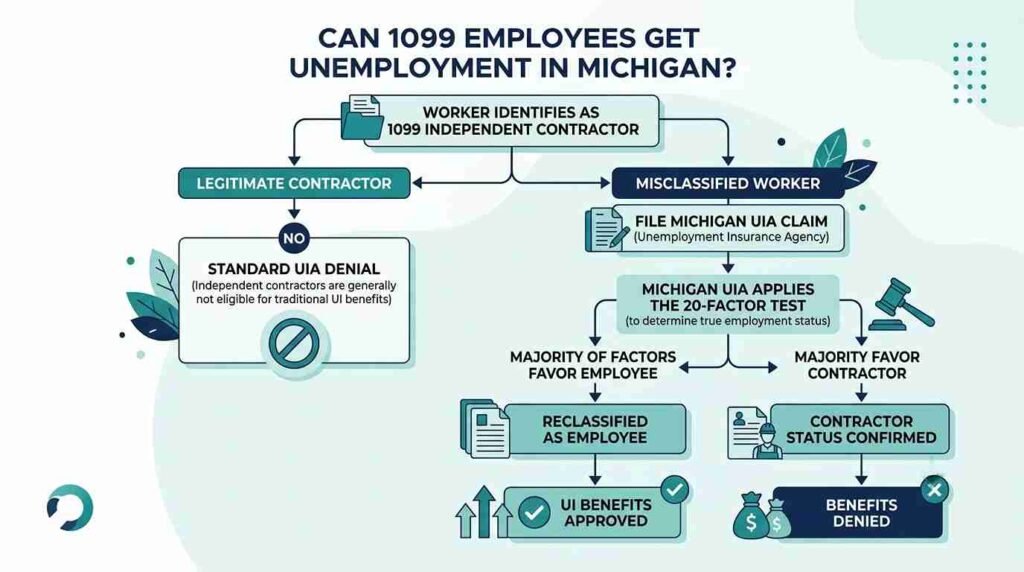
Michigan’s 20-Factor Test: The Critical Standard for Whether Can 1099 Employees Get Unemployment in Michigan
The Michigan UIA 20-Factor Test is the single most important legal framework for answering whether can 1099 employees get unemployment in Michigan applies to any specific worker situation — and it operates very differently from both the federal IRS Control Test and New York’s ABC Test.
Unlike New York’s ABC Test which presumes employee status from the outset, Michigan’s 20-Factor Test evaluates all factors collectively without a presumption in either direction — giving UIA examiners substantial flexibility to weigh the totality of evidence presented by both the worker and the hiring business.
The twenty evaluation factors cover the full spectrum of the working relationship — from whether the business provides training and sets work hours, to whether the worker maintains their own business location, advertises their services independently, and serves multiple clients simultaneously across the examination period.
No single factor is determinative under Michigan’s framework. A hiring business that scores favorably on fifteen factors but demonstrates strong behavioral control through scheduling, supervision, and method dictation on the remaining five can still face a misclassification determination — depending on how UIA examiners weight the specific combination of factors present in the examined relationship.
The Michigan UIA Misclassification Claim Process Step by Step
When a misclassified 1099 worker in Michigan believes they qualify for unemployment benefits, the claim process follows a specific procedural pathway through the Michigan Unemployment Insurance Agency.
Step 1 — File Initial Unemployment Claim: The worker files an initial UI claim through the Michigan Web Account Manager (MiWAM) portal at michigan.gov/uia or by calling the UIA Customer Service hotline. The claim identifies the hiring business as the base period employer regardless of the 1099 classification.
Step 2 — Employer Notification and Response: The Michigan UIA notifies the hiring business of the filed claim within ten business days. The business must respond within the specified deadline — asserting independent contractor status and providing supporting documentation — or risk a default determination in the worker’s favor.
Step 3 — 20-Factor Investigation: A Michigan UIA examiner conducts a formal investigation applying all twenty classification factors to the actual working relationship. Evidence reviewed includes the written contractor agreement, payment records, work location data, supervision documentation, tool ownership records, and evidence of the worker’s independent business activities outside the examined relationship.
Step 4 — UIA Determination and Appeal Rights: The UIA issues a formal written determination within approximately four weeks of completing the investigation. Both the worker and the hiring business have the right to appeal unfavorable determinations through the Michigan UIA Administrative Appeals system — with further appeal rights to the Michigan Unemployment Insurance Appeals Commission and ultimately the Michigan Circuit Court system.
Michigan UIA Benefit Calculation for Successfully Reclassified 1099 Workers
When a misclassified 1099 worker successfully establishes unemployment eligibility in Michigan, the benefit calculation follows the standard Michigan UI formula — based on the worker’s base period earnings from the hiring business during the applicable examination period.
Michigan calculates weekly unemployment benefits at 4.1% of the claimant’s total base period wages — subject to the maximum weekly benefit rate of $362 in 2026. The standard maximum benefit duration is 20 weeks of regular state unemployment benefits — shorter than New York’s 26-week maximum but applying the same base period wage calculation methodology.
The base period for Michigan unemployment calculations covers the first four of the last five completed calendar quarters before the claim filing date — meaning misclassified workers whose 1099 income from the hiring business spanned multiple consecutive quarters may qualify for the maximum weekly benefit amount despite their prior contractor classification status.
Michigan’s Construction Industry: The Highest-Risk Sector for 1099 Misclassification
The Michigan construction industry represents the single highest-risk sector for can 1099 employees get unemployment in Michigan enforcement actions — with the Michigan UIA dedicating specific audit resources to construction sector worker classification compliance.
Michigan MCL § 421.42(5) establishes a specialized classification framework for construction industry workers that is even more stringent than the standard 20-Factor Test. Under this provision, construction workers are presumed to be covered employees unless the hiring business can demonstrate the worker operates a genuinely independent construction business with their own tools, licenses, insurance, and established client base beyond the single hiring relationship.
Construction businesses that staff projects using 1099-classified laborers, subcontractors, or trade workers without meeting this elevated independence standard face the highest probability of UIA reclassification — combined with retroactive UI tax assessments, civil penalties, and potential criminal referral under Michigan’s aggressive construction sector enforcement program.
Business Liability When Michigan UIA Determines Can 1099 Employees Get Unemployment in Michigan Applies
When the Michigan Unemployment Insurance Agency determines that a business misclassified workers who were entitled to answer yes to whether can 1099 employees get unemployment in Michigan, the financial consequences for the hiring business are severe and multi-layered.
The Michigan UIA can assess retroactive UI tax liability covering all base period wages paid to reclassified workers — including both the employer UI tax contributions that should have been remitted and interest at 1% per month on all unpaid amounts going back up to three years for standard violations and six years for willful misclassification findings.
Michigan imposes civil monetary penalties of up to $1,000 per misclassified worker per quarter under MESA MCL § 421.54 — with additional penalties for businesses that fail to cooperate with UIA investigation requests or that provide false information during the classification examination process.
The Michigan Attorney General’s Office maintains an active Worker Misclassification Task Force that coordinates criminal referrals for the most egregious and systematic misclassification schemes — with potential felony prosecution for business owners who deliberately and repeatedly misclassify workers to avoid UI tax obligations across multiple tax periods.
Frequently Asked Questions (Gutenberg Block Ready)
Can 1099 employees get unemployment in Michigan if they worked for multiple clients simultaneously during the claim period?
Working for multiple clients simultaneously is actually one of the strongest indicators of genuine independent contractor status under Michigan’s 20-Factor Test — and it significantly reduces the probability of a successful Michigan UIA reclassification determination. The UIA specifically examines whether the worker actively marketed their services to multiple businesses and derived income from genuinely independent client relationships during the examination period. However, working multiple 1099 contracts does not automatically disqualify a worker from Michigan unemployment eligibility if other factors in the working relationship — particularly behavioral control by the primary hiring business — still weigh heavily toward employee status. Each factor is evaluated on its individual merits within the comprehensive 20-factor framework applied by the Michigan UIA examiner handling the specific claim.
Can 1099 employees get unemployment in Michigan if their contractor agreement explicitly states they are not employees?
No — not based on the contract language alone. Michigan courts and the Michigan UIA have consistently held that contractual labels cannot override economic reality in worker classification determinations. A written agreement stating the worker is an independent contractor is considered one factor within the broader 20-Factor Test analysis — not a conclusive barrier to unemployment eligibility for workers whose actual day-to-day working conditions demonstrate genuine employee status.
The Michigan Supreme Court has affirmed this position in multiple decisions establishing that the substance of the working relationship — not the title assigned in a written agreement — controls the classification outcome under MESA MCL § 421.42. Workers whose contracts say “independent contractor” but whose work arrangements demonstrate employee-level control should file Michigan UIA claims and allow the formal investigation process to evaluate the full factual record.
Can 1099 employees get unemployment in Michigan while continuing to operate their own independent business during the benefit period?
Partially — and Michigan’s self-employment income reporting requirements are strictly enforced during active benefit periods. Michigan unemployment claimants — including reclassified 1099 workers receiving UIA benefits — must report all earnings from self-employment and independent contract work during each weekly certification period through the MiWAM online portal.
Self-employment earnings are subject to Michigan’s earnings disregard calculation — which allows claimants to earn up to one-third of their weekly benefit amount without reduction, with dollar-for-dollar benefit reduction applied to all earnings above that threshold. Failing to accurately report ongoing 1099 income during a Michigan UI claim period constitutes unemployment fraud under MESA MCL § 421.54 — carrying mandatory repayment of all fraudulently obtained benefits, permanent disqualification from future Michigan UI benefits, civil fines up to $25,000, and potential felony criminal prosecution for willful concealment of self-employment earnings.